
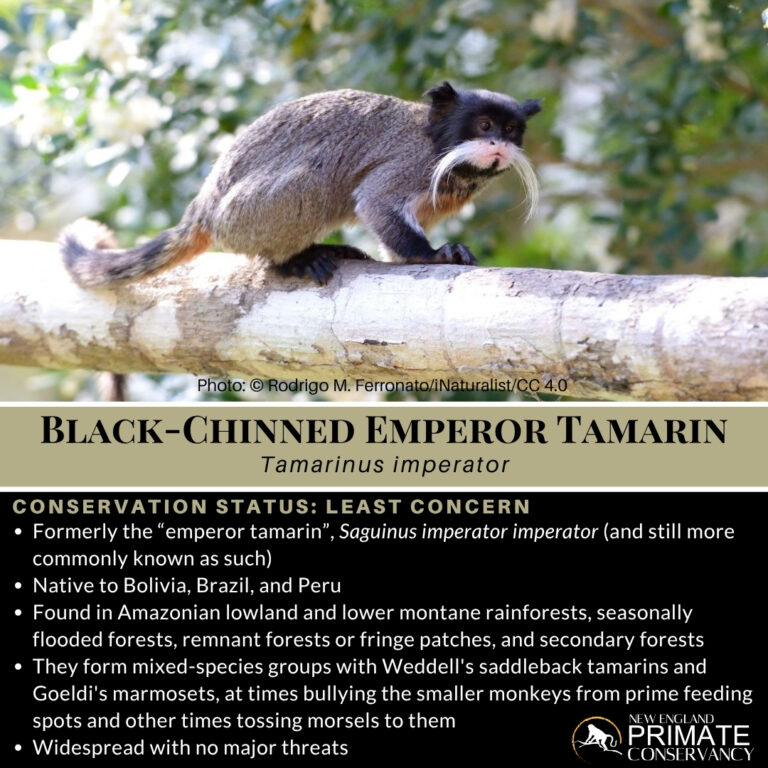
Black-Chinned Emperor Tamarin, Tamarinus imperator
BLACK-CHINNED EMPEROR TAMARIN
Tamarinus imperator
Geographic Distribution and Habitat
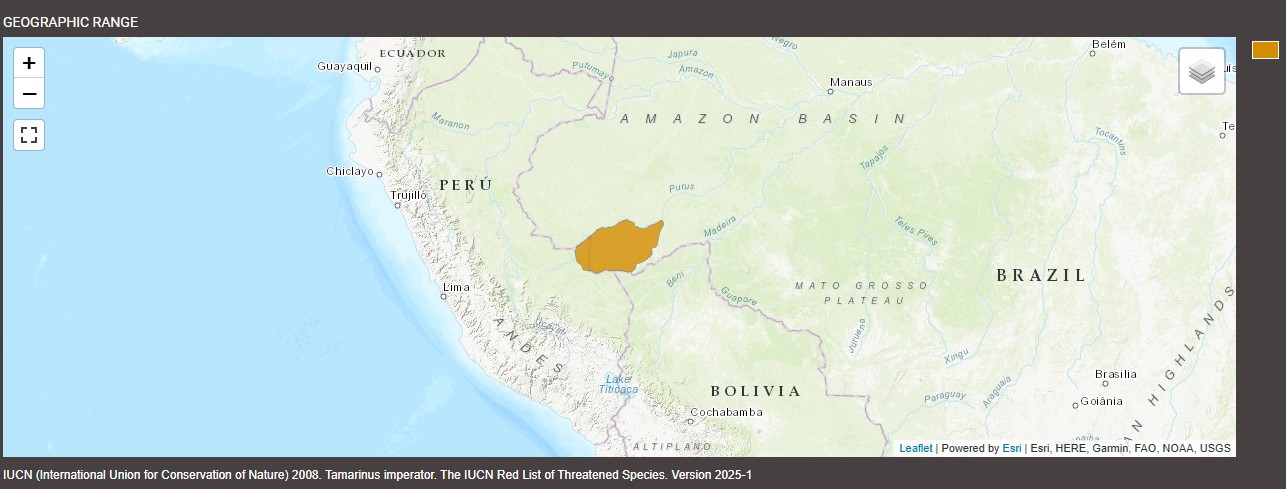
The black-chinned emperor tamarin—affectionately nicknamed the “mustache monkey”—is native to the South American countries of Brazil, Bolivia, and Peru, primarily where the three countries meet along the northwestern Brazilian state of Acre. Within this range, the black-chinned emperor tamarin occupies a variety of habitats, including Amazonian lowland and lower montane rainforests, seasonally flooded forests, remnant forest patches that remain after major land changes such as deforestation, and fringe areas where dense forest gradually transitions into more open habitat. They are also found, though less commonly, in secondary forests that have regrown following human disturbance.
The black-chinned emperor tamarin is one of two subspecies of “emperor tamarin” (formerly classified as Saguinus imperator), the other being the bearded emperor tamarin (Tamarinus subgrisescens, formerly known as S. i. subgrisescens). The main physical differences between these two mustachioed primates are the presence of a beard and their slight variations in coloration. As hinted by their names, the bearded emperor tamarin sports a mustache and beard, while the black-chinned emperor tamarin is beardless. In terms of color, the bearded emperor tamarin displays more variation across the chest, belly, and arms, whereas the black-chinned emperor tamarin tends to be more uniform in coloration.
Size, Weight, and Lifespan
The black-chinned emperor tamarin has a head-body length of 9.06-10.2 inches (23-26 cm), with a non-prehensile tail measuring 13.8-16.5 inches (35-42 cm). Weight ranges between 14.1-19.4 ounces (400-550 g). The average lifespan in the wild for emperor tamarins ranges between 10 and 20 years.
Appearance
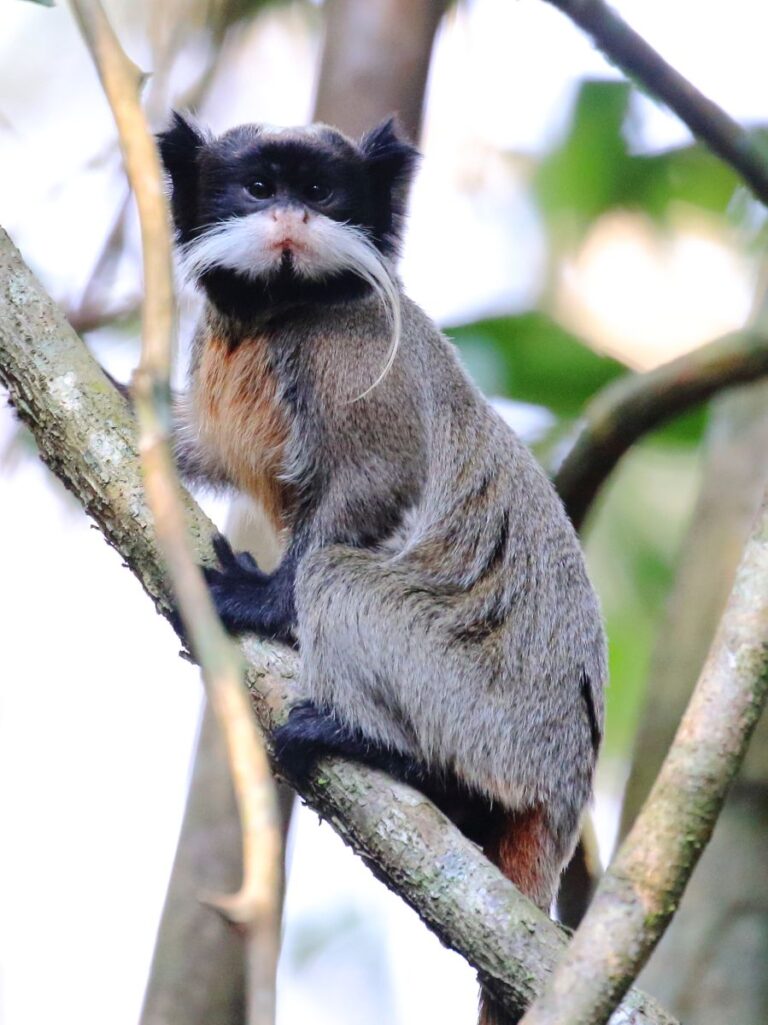
The coloration on the back side of the black-chinned emperor tamarin may be either a dark grayish agouti or a buff tone (light brownish-yellow), with a rusty red or orange underside and inner surface of the arms. The crown of the head is silvery-brown, with white chin hairs that fail to hide the distinctive black chin. Surrounding the light pink nose is the pièce de résistance: a long, white, furry, curved mustache. The hands and feet are black, and the non-prehensile tail, which is used for balancing among tree branches, and not for grabbing or grasping, is orangy-red and topped with a black tip.
Additional physical characteristics that further distinguish tamarins from other Latin American monkeys are far less obvious. Tamarins, like their smaller marmoset cousins, have modified claws instead of nails on each of their digits except for the big toe, which has a nail. These claws are believed to be an adaptation to allow for grasping while climbing up and down trees, while the nail is used for grooming.
Diet
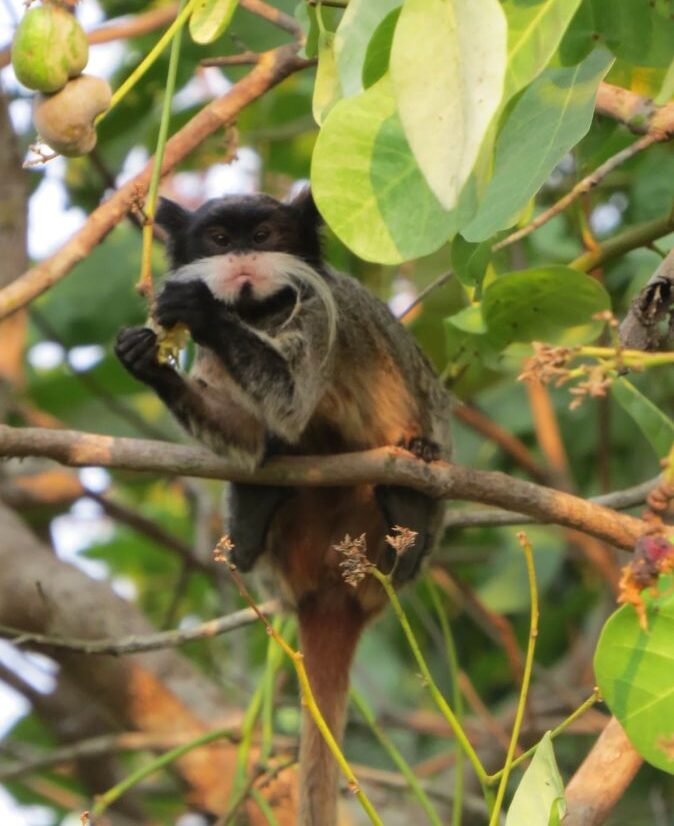
The black-chinned emperor tamarin is an omnivore, feeding on fruit, tree sap, flowers, insects, and spiders.
According to one resource that focused on emperor tamarins in Peru’s Manú National Park, fruit dominates the diet in the wet season, accounting for 97% of plant material consumed. This drops to around 41% in the dry season, with an increase in nectar consumption (52%). Tree gums previously gouged out by marmosets are eaten in small quantities (1-2%) in the wet and dry seasons, and small amounts of flowers and fungi are eaten in the wet season. For seasonal reference, Peru’s wet season lasts from November to April.
Ultimately, black-chinned emperor tamarins rely less on gums compared to their bearded cousins, as fruit availability is generally higher in their predominantly primary forest habitats.
Behavior and Lifestyle
The black-chinned emperor tamarin is diurnal, or active during daylight hours, and arboreal, preferring to spend those hours in the trees. Days are spent foraging in the trees, while nights are spent cuddling together and sleeping in the hollows of trees that stand from 85-90 feet (26-27.5 m) in height. According to one resource, yearly activity budgets of emperor tamarins involve around 34% of their time foraging for animal prey, 25% resting, 21% traveling, and 17% feeding on plant material; the remainder of their time is spent on social activities such as play and grooming. Early morning is marked by a peak of feeding on fruit (or nectar when fruits are lacking), and foraging for animal prey is almost constant throughout the day. Another peak of feeding on plant material occurs in late afternoon. They tend to rest more in the early afternoon, starting at around 2:00 PM (14:00).
Emperor tamarins as a whole are incredibly agile, hopping or running quadrupedally (on all four limbs) from branch to branch as they travel through the forest. Their ability to move quickly through their treed environment helps them evade predators such as wild cats, dogs, snakes, and birds of prey. Slender branches support their light body weight, allowing them to reach for food that is inaccessible to heavier animals. Clutching a branch with a clawed grip, they extend their free arm and retrieve a piece of fruit with the other hand.
She can see like you and me: About two-thirds of female emperor tamarins possess trichromatic vision, meaning they are able to recognize three distinct colors (green, blue, and red), just like humans. This selective adaptation assists them in finding ripe fruit, a dietary staple for the species. The males and remaining females possess dichromatic vision, meaning they can recognize two distinct colors (green and blue). Regardless of the color spectrum, all individuals are able to spot prey and detect camouflaged predators, thanks to their keen eyesight.
I “mustache” you a question: What’s in a name?: The late Swiss-Brazilian naturalist-zoologist Émil August Goeldi, who has several species—including Goeldi’s marmoset (Callimico goeldii)—named after him, is reported to have jokingly given the name “emperor” to this group of tamarins for their resemblance to Emperor Wilhelm II of Germany—thanks to that distinguished mustache. (Fun fact within a fun fact: Goeldi, himself, sported a similar mustache!)
Not just to taste food and blow raspberries: The emperor tamarin sports a relatively long tongue, which is used not just to lap up nectar and for grooming, but also to communicate with group members! Find out more in the Communication section!
Emperor tamarins are social and live in family groups of two to 20 individuals, with average group size closer to eight. Among black-chinned emperor tamarins, groups tend to be slightly larger than average, often numbering six to 10 individuals. This is likely tied to more continuous forest habitat. A troop comprises both males and females, typically with a predominantly male membership. But it’s the eldest female who acts as the group’s leader, reigning over the mature males. She’s also typically the only breeding female in the group. Upon reaching sexual maturity, members of both genders will leave their birth group to join other existing groups or start a new group with other recently “graduated” individuals.
Emperor tamarins in Manú National Park are observed to have group home ranges that are typically 74 acres (30 ha), with minimal overlap between those of rival groups. Despite this minimal overlap, emperor tamarins are territorial towards one another, and boundaries are marked using scent-based cues. Though they are intolerant of members of their species, emperor tamarins will politely share their range with the tiny Weddell’s saddleback tamarin (Leontocebus weddelli) and, tinier still, Goeldi’s marmosets. Emperor tamarins commonly form mixed-species groups with the saddleback tamarins, and to a lesser (known) degree, with Goeldi’s marmosets. These foraging associations benefit each species by offering greater safety in numbers against rainforest predators and by offering more opportunities for successful foraging expeditions. Both saddleback tamarins and Goeldi’s marmosets travel in the forest understory, about 33 feet (10 m) from the ground, while emperor tamarins spend more time in the lower or middle canopy, above 33 feet (10 m). Being more agile, the smaller-bodied monkeys typically arrive at food sources ahead of the emperor tamarins.
A word to the wise: these relationships are not exclusively beneficial. Emperor tamarins have been known to use their “might” to intimidate the smaller monkeys into giving up their premier position on a fruit tree. But emperors have also been known to share, dropping pieces of fruit to the lower levels of the forest canopy to their “downstairs” neighbors. Overnight, the three species separate and rejoin their respective troops. No inter-species sleeping involved!
Communication is important for tamarin groups, as it helps them stay together and work as a team. When leaving their sleeping spots in the morning, emperor tamarins use loud “long calls” that humans can hear from over 164 yards (150 m) away! These long, sustained contact calls help group members establish one another’s location when foraging, and allow neighboring tamarin groups to stay in touch and out of each other’s way if they happen to be of the same species. To warn intruders to keep away from their territory, they emit high-pitched, shrill calls. Chirps and hisses are included in their everyday dialogue. Emperor tamarins can even tell the gender of other tamarins just by their calls.
Tamarins distinguish the calls of fellow group members from those of other species. For example, compared to saddleback tamarin vocalizations, emperor tamarin calls are broader in frequency with shorter, rapidly emitted notes. Emperor tamarins are adept at discerning these different tamarin “dialects” and will respond to one another’s alarm calls.
As with all primates, body language conveys certain messages or gives clues to one’s mood. Emperor tamarins are known to rapidly flick their tongues when agitated or when submitting to another individual. Tongue-flicking often accompanies the intimidation calls they emit to warn off rivals or potential intruders. On the opposite end of the spectrum, a nursing mother may also extend and curl her tongue to solicit the help of a male helper. Emperors may also frown; however, their range of facial expressions is more limited when compared to other primates.
Scent glands are found on multiple parts of the emperor tamarin’s body, but those around the genitals and anus are the ones primarily used. They are mostly used to mark territorial boundaries between groups. The dominant female in bearded emperor tamarin groups releases pheromones, or chemical signals, to mark territorial boundaries. By doing so, she interferes with the reproductive ability of other females in the group, thereby ensuring that she is the only one that breeds. It’s reasonable to assume this technique also applies to the black-chinned emperor tamarin.
Finally, social grooming can strengthen bonds between individuals in a group.
Black-chinned emperor tamarins exhibit a polyandrous mating system, meaning one female (the dominant) mates with multiple males in the group, who then share parental care. After breeding anywhere from April to July, the gestation (pregnancy) period lasts from 140-145 days, after which the female gives birth to twins (and rarely, triplets). Births happen during the rainy season when food is most abundant. The time between births in the species is six months.
Since none of the males know who the father is, all of them pitch in to help in raising the offspring, carrying them on their backs and comforting them when they cry. They only return the babies to their mothers so she can nurse them. As the infants move on to the “toddler stage” and begin to explore their environment, they inadvertently put themselves at great risk of falling to their deaths. Mortality in the wild is reported at its highest between the first five and 15 weeks of life. To help ensure that the youngsters remain safe, a dominant female’s eldest daughters (at least those who have remained in the natal group) assist with child care.
At about three months of age, emperor tamarins are weaned from their mother’s milk and shift their diets to fruits and nectar. At two years of age, they are considered fully mature and will disperse to either join another group or form one of their own.
As insectivores, black-chinned emperor tamarins serve as pest controllers through their consumption of insects and larvae. As much of their diet also consists of fruit, they aid in the regeneration of their forest habitat by dispersing seeds through their feces during their daily travels. Finally, as a prey species, they also play a role in feeding local predators within their habitat.


The International Union for Conservation of Nature lists the black-chinned emperor tamarin as Least Concern (IUCN, 2020), appearing on the IUCN Red List of Threatened Species.
The preferred habitat of the black-chinned emperor tamarin has become increasingly subject to deforestation, largely as a result of human development and proximity to highways. Deforestation in this tamarin’s range has been especially associated with logging and cattle ranching. With deforestation comes the loss of trees that are critical food resources for the tamarins to eat, live in, and travel through. The black-chinned emperor tamarin is likely not hunted due to their small size, but they may be subject to trapping for the pet trade.
The black-chinned emperor tamarin is listed in Appendix II of the Convention on International Trade in Endangered Species (CITES), an international agreement between governments whose goal is to ensure that international trade in specimens of wild animals and plants does not threaten their survival.
The black-chinned emperor tamarin is included on the national official lists of threatened species of both Brazil and Peru.
Although no conservation programs exist with specifically the emperor tamarin in mind, those individuals who live in protected areas enjoy a measure of safety. These areas include southeastern Peru’s Manú National Park and Bolivia’s Manuripi-Heath Amazonian Wildlife National Reserve. Both subspecies of emperor tamarin, the black-chinned emperor tamarin and bearded emperor tamarin, also reside in these protected areas. While several conservation areas are found in Brazil, none are specifically dedicated to wildlife protection. Despite this, wildlife biologists believe it is likely that emperor tamarins reside within the following areas in Brazil: Acre River Ecological Station, Chico Mendes Extractive Reserve, Macauá National Forest, and Macauá and Antimari State Forests. Further research is needed to confirm this.
One way to help bring awareness to the species and help with their conservation may be through ecotourism. Manú National Park hosts programs and tours that give the public opportunities to see emperor tamarins, along with other species, in the monkeys’ native habitat. But ecotourism must be tempered with maintaining a pristine natural environment. Infrastructure built to allow access to the park, along with the loads of visitors, could have an adverse effect on the emperor tamarin population.
Conservationists advocate for educational programs geared toward local peoples that help establish an affinity between human and non-human primates. By directly involving locals in helping with emperor tamarin preservation, the locals learn to understand and appreciate the monkeys as fellow rainforest citizens. Ideally, this instills in the local human populace a sense of national pride for this non-human primate who shares their world. As a result, locals hopefully become committed to protecting the species.
Of course, captive emperor tamarins are found in zoos around the world. Apenheul in the Netherlands, describes itself as a “green zoo.” Here, emperor tamarins are one of 35 species of primates—and over 300 primates overall—who freely roam the park. Apenheul (the name is taken from the word “apen,” meaning “apes” or “monkeys” and from the archaic Dutch word “heul,” meaning “refuge” or “safe place”) participates in a European breeding program for emperor tamarins. The Apenheul Primate Conservation Trust (APCT), created in 1994, supports conservation projects for the protection of wild primates and their habitats.
Overall, the regulation of human activities such as deforestation, combined with public education regarding both species of emperor tamarin are key in ensuring that the black-chinned emperor tamarin doesn’t slide further down the path towards endangerment and extinction.
- https://www.apenheul.com/primates-abc/emperor-tamarin
- https://www.aucklandzoo.co.nz/animals/emperor-tamarin
- https://blairdrummond.com/animals/our-animals/emperor-tamarin/
- https://en.wikipedia.org/wiki/Bearded_emperor_tamarin
- https://en.wikipedia.org/wiki/Black-chinned_emperor_tamarin
- https://en.wikipedia.org/wiki/Emperor_tamarin
- https://www.facebook.com/leslie.rayburn/posts/nature-is-so-interestinghe-wears-a-mustache-fit-for-royalty-and-a-tongue-that-do/24349054141357525/
- https://www.gbif.org/species/2436471
- https://greatbigstory.com/the-mustached-monkey-named-after-a-former-german-emperor/
- https://www.iucnredlist.org/species/19827/192551358
- https://kids.kiddle.co/Emperor_tamarin
- https://openscholarship.wustl.edu/cgi/viewcontent.cgi?article=2046&&context=etd
- https://racinezoo.org/sites/default/files/Emperor%20Tamarin%20fact%20sheet.pdf
- https://www.sciencedirect.com/science/article/abs/pii/S037811270100490X
- https://treatment.plazi.org/id/DF668780FFCBFFDAFFDEF3636A1CE28C/8
- https://true-wildlife.blogspot.com/2011/02/emperor-tamarin.html
- https://www.voyagers.travel.peru/peru/peru-climate
- https://www.youtube.com/watch?v=Qr4y4AJL_Kk
- https://www.youtube.com/watch?v=UkwnQQTU-jk
Written by Sienna Weinstein, Nov 2025