
Moor Macaque, Macaca maura
MOOR MACAQUE
Macaca maura
Geographic Distribution and Habitat
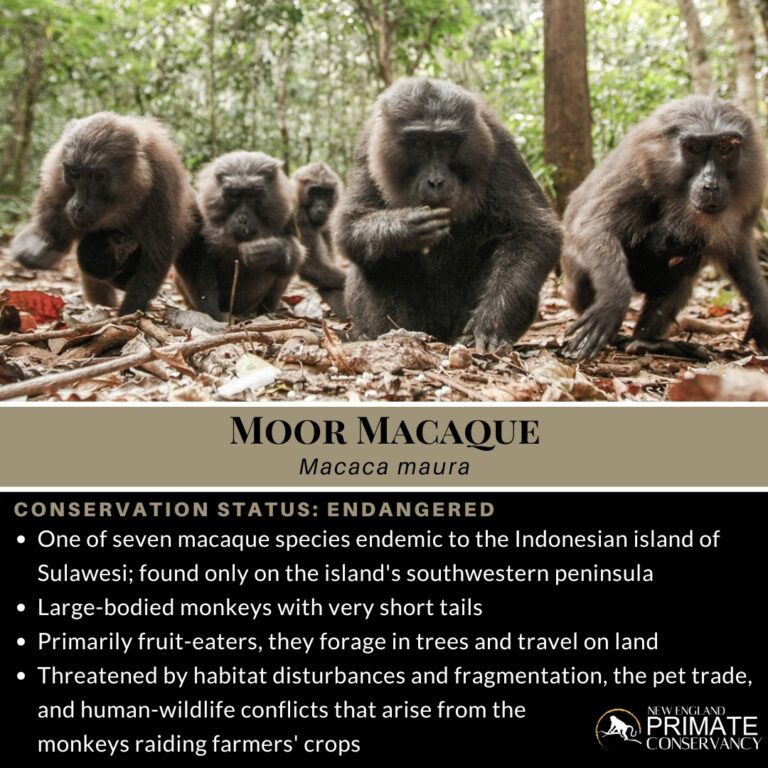
The Moor macaque is endemic to the southwestern peninsula (Selatan) of Sulawesi, Indonesia, meaning it occurs naturally in this region and nowhere else. Its known range extends from Bontobahari at the southern tip of the peninsula northward to the Tempe Depression. Within this area, the species now persists mainly in inland highlands and karst forest systems, although small groups continue to be reported from scattered lowland forest remnants.
Historically, Moor macaques ranged up to approximately 6,560 feet (2,000 m) on the slopes of Mount Latimojong, a mountain that rises more than 9,840 feet (3,000 m). Much of this high-elevation habitat has since been deforested, making it unlikely that macaques still occupy these upper zones except in small, isolated refuges.
Habitat-wise, the species is flexible. It occupies moist deciduous and moist lowland forests, and, where available, uses moist montane forest as well. The species shows notable tolerance for secondary habitats and mosaics of forest and grassland created by habitat conversion; it can even be found near human settlements in places. Moor macaques are especially associated with karst landscapes: the karst plain forests and tower karsts of South Sulawesi provide both food resources and refuges from human disturbance. Tower karsts, limestone pinnacles that can rise about 500-1,000 feet (150-300 m), often support many of the trees the macaques favor, including numerous fig species.
Karst plain forests appear particularly important for feeding, as surveys have recorded over 100 tree species in macaque-use areas, with roughly three-quarters of those identified as key food species. In contrast, the taller tower karst formations are less productive for foraging but valuable as sanctuaries where macaques can avoid hunters and farmers. Important local strongholds include secondary lowland areas, such as the Tabo-tabo forest in Pangkep, where fertile soils and high plant diversity create an abundance of food and shelter.
The Moor macaque is a monotypic species, meaning it has no recognized subspecies across its range. Within the macaque lineage, it is classified in the silenus species group, a cluster of closely related Sulawesi macaques grouped together for their shared evolutionary history and similar ecological traits
The species was historically referred to as Macaca maurus, a name still encountered in older literature.
At the northern boundary of its range, around the Tempe Depression near the base of the Toraja Highlands, the Moor macaque’s distribution overlaps with that of the Tonkean macaque (M. tonkeana). In this contact zone, the two species are known to hybridize. These hybrid populations offer valuable insights into how Sulawesi’s macaque species diverged and how they maintain distinct identities despite areas of overlap.
Size, Weight, and Lifespan
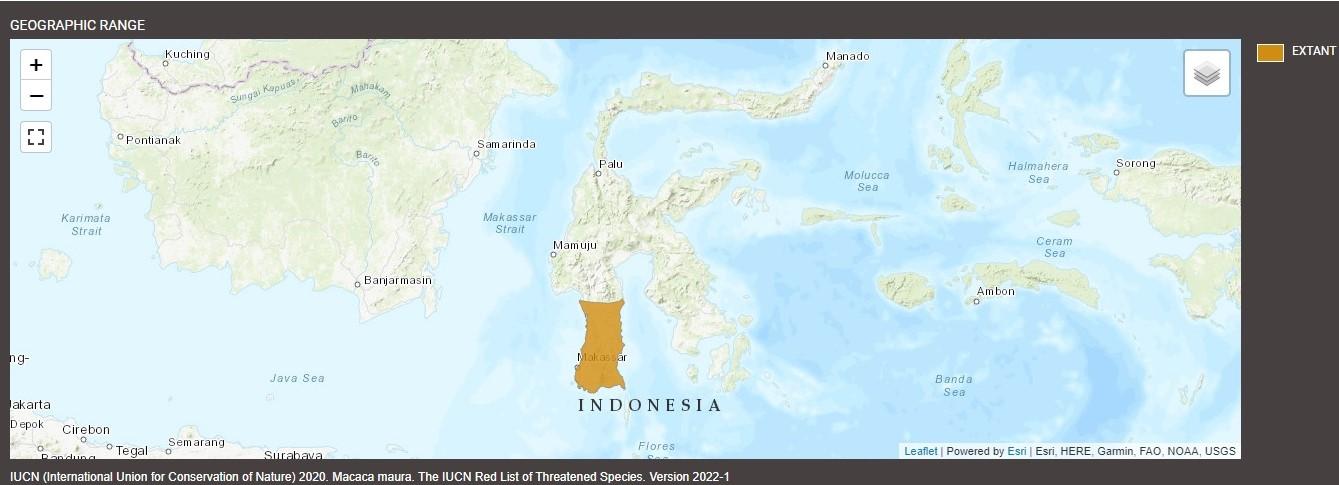
Moor macaques are medium-sized Afro-Eurasian monkeys with clear differences between males and females, a phenomenon referred to as sexual dimorphism. Male head-body length typically ranges from 22-27 inches (55-69 cm), while females measure about 18-23 inches (46-59 cm). The tail is very short, measuring only 2-3 inches (5-7 cm) in males and 1-2 inches (2-4 cm) in females, giving the species a compact, sturdy appearance.
Adult males generally weigh 18-22 pounds (8.2-10 kg), whereas females range from 8-17 pounds (3.8-7.6 kg).
As they age, the monkeys show gradual greying of their fur, a trait shared by both sexes. The typical lifespan of a Moor macaque is around 28 years, making it one of the longer-lived macaque species when provided with stable conditions.
Appearance
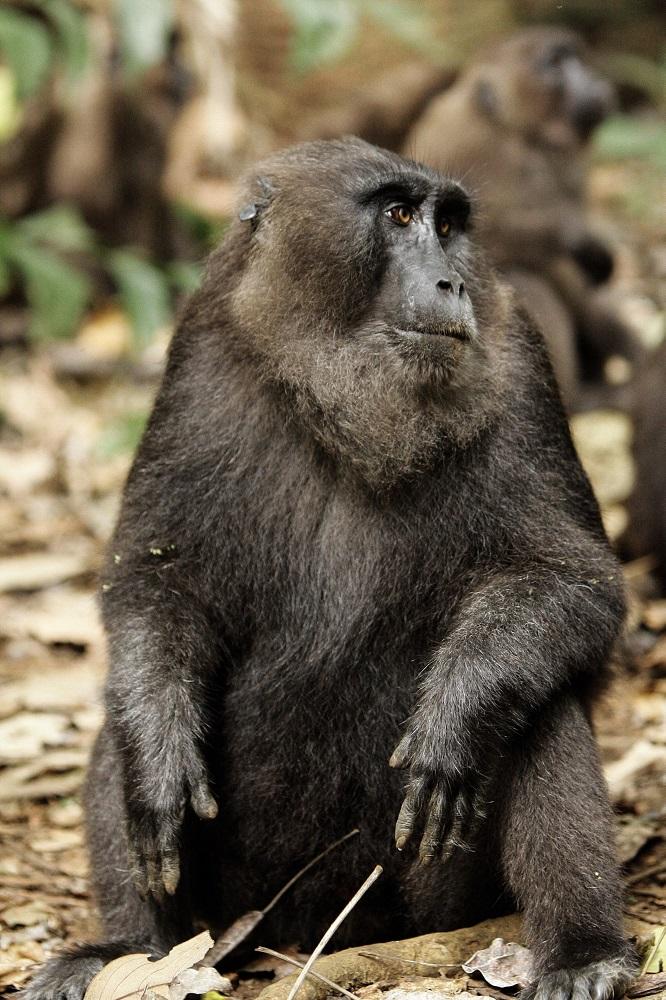
The Moor macaque is distinguished by its dark brown to brown-black coat, contrasted by a pale brownish-gray rump patch and pink, bare skin on the rump. Like many Afro-Eurasian monkeys, it has oval-shaped ischial callosities, the hairless sitting pads that help provide stability when resting on branches or rocky surfaces. These callosities are simple, smooth ovals, a typical shape for macaques.
The face is one of its most recognizable features: short, dark, and angular, with prominent brow ridges and a flat crown of hair. The shape of the muzzle is slightly elongated in a way that can resemble the profile of a dog’s snout, which is why the species is sometimes nicknamed the “dog-ape.” This nickname reflects appearance only; it does not indicate any closer relationship to apes than other Afro-Eurasian monkeys.
Some Moor macaques exhibit patches of whitening, especially around the eyes, on the head and back, or spread more extensively across the body. Both males and females may show this mottled or progressive whitening as they age. Combined with their compact build and short tails, these traits give the Moor macaque a distinctive, expressive appearance that sets it apart from other Sulawesi macaques.
Diet
Moor macaques are primarily frugivorous (fruit-eating), with figs forming a central component of their diet. Figs are especially abundant in Karaenta Nature Reserve, where densities reach approximately 9.44 fig trees per acre (23.3 trees per hectare), more than three times as many fig trees as in most Indonesian forests, for instance, 2.67 trees per acre (6.6 trees/ha) in East Kalimantan and 2.83–4.05 trees per acre (7–10 trees/ha) in North Sulawesi. This high availability contributes to the macaques’ heavy reliance on fig trees throughout the year. In addition to figs, moor macaques feed on a variety of other fruits, including those of rao (Dracontomelon mangiferum), pangi (Pangium edule), bakan (Litsea firma), and the Binkuru tree.
While fruit dominates the diet, the macaques also consume insects and leaves from herbaceous vegetation, particularly during the dry season when fruit availability declines.
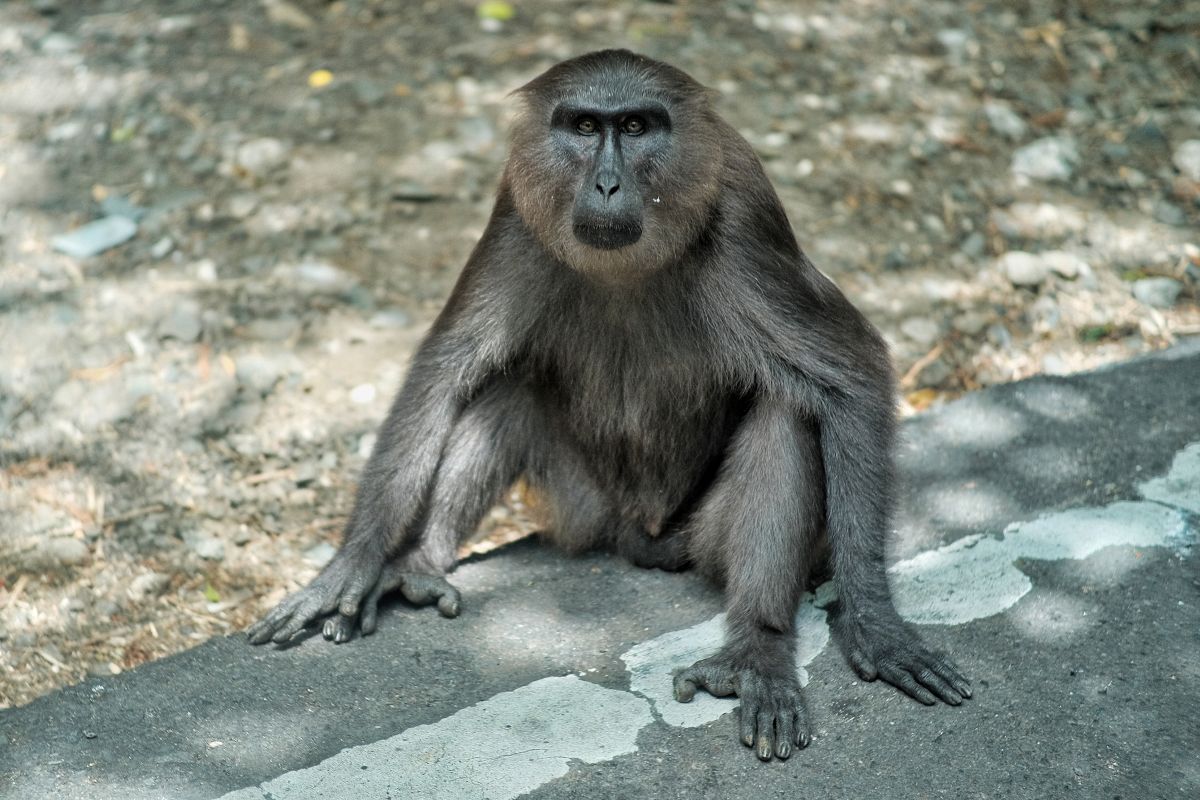
In areas bordering agricultural land, Moor macaques show considerable dietary flexibility, as they opportunistically exploit cultivated foods such as rice, cacao, maize, and a range of vegetable crops, which can bring them into conflict with farmers.
Recent observations highlight how anthropogenic food sources (originating from human activity) further influence their feeding ecology. At Bantimurung–Bulusaraung National Park, a major road bisects macaque habitat, and since 2015, Moor macaques have increasingly spent time along the road foraging in trash pits and waiting for provisioning from vehicles. Although this behavioral flexibility may help the macaques exploit new resources, it also exposes them to substantial risks, underscoring the need for effective management at human-macaque interfaces.
Behavior and Lifestyle
Moor macaques are diurnal monkeys, meaning they are active during the day and sleep at night. They divide their time between the forest floor and the canopy, and their daily activity budget is dominated by feeding, moving, resting, and social interaction. In Karaenta Nature Reserve, one study group spent roughly one-third of the day feeding and foraging, one-third moving, and the remainder split between resting and engaging in social behaviors. Similar studies report that feeding and movement consistently occupy the largest share of their day, patterns driven largely by food availability, how widely food is distributed across the landscape, and the seasonality of fruit production.
Their home ranges typically span 49–74 acres (20–30 hectares), with groups covering a total area of about 4.1 miles (6.6 km) over time and traveling 0.6–0.9 miles (0.9–1.5 km) per day. These movements are flexible and respond to ecological conditions, including the presence or absence of competitors. The species’ environment contains few major predators, which distinguishes their ecological context from that of many other primates, although predation pressure still plays a role in certain aspects of their behavior.
Sleeping provides one of the clearest examples of this. Over a recent 12-week study, a Moor macaque group used 19 sleeping trees across seven sites, showing a strong preference for large ficus trees located in central portions of their home range. These sleeping trees had significantly wider trunks and larger crowns than surrounding trees, features that may offer better protection from terrestrial predators such as snakes. The macaques frequently reused the same sleeping trees for consecutive nights, suggesting that familiarity and limited availability of suitable large fig trees influence their choices. They typically entered the sleeping trees soon after sunset and descended before sunrise. Notably, they vocalized on most evenings when settling in and on many mornings when departing, behavior that runs counter to expectations that primates remain silent to avoid detection.
However, human activity is increasingly altering the behavioral ecology of the species. At Bantimurung–Bulusaraung National Park, where a major road bisects macaque habitat, groups have shown significant changes in their ranging behavior. The monkeys have expanded their home ranges, increased their travel distances, and spent more time close to the road as they wait for food tossed from vehicles and forage in trash pits. These observations highlight the species’ behavioral flexibility, while also underscoring the risks posed by roads and human–primate interactions.
Did you know Moor macaques are picky about their sleep? They pick the biggest fig trees in the forest for a comfy night’s rest.
Their faces look like little dog muzzles, hence the nickname “dog-faced monkeys, ”but don’t worry, they don’t bark!
Figs are basically their fast food: in some forests, there are 9 fig trees per acre, more than three times as other parts of Indonesia.
Playtime matters: these macaques spend more hours wrestling, chasing, and goofing around than just grooming each other.
Males leave home at 7-9 years old to avoid awkward family dates. Females? They stay close to mom and sisters.
When they see snakes, they yell, but unlike some macaques, they skip the mobbing part. Safety first!
By spreading seeds everywhere they munch, these little monkeys are basically Sulawesi’s gardeners.
Moor macaques live in multimale–multifemale groups typically ranging from 15 to 40 individuals. These communities are shaped by a stable pattern seen across many macaque species: females remain in their natal groups throughout life, a phenomenon known as female philopatry, while males disperse at around 7–9 years of age. Male dispersal helps prevent inbreeding and maintains healthy genetic diversity within and between groups.
Within groups, females form linear dominance hierarchies, but their social relationships are notably relaxed. Aggression is uncommon and usually mild, and when conflicts do occur, they are often bidirectional; both individuals may assert themselves rather than one-sided domination. Just as importantly, Moor macaques show a strong tendency toward post-conflict reconciliation, frequently engaging in affiliative contact after disputes. Males, too, display a surprising level of social tolerance, contributing to an overall group atmosphere that is less tense than in many other macaque species.
Group cohesion remains tight, with individuals maintaining close distances during everyday activities. This tolerance extends even into tense contexts: during agonistic encounters, bouts of strong aggression are rare, and support from kin, common in many primates, plays a limited role. Groups may eventually split, a process known as fission, but the causes are complex. In Moor macaques, fission has been linked variously to ecological factors, overlapping home ranges, or shifts in male competition, rather than clear-cut competition among females for food.
Males take the lead in intergroup interactions. When neighboring groups meet, it is usually adult males who engage in displays, boundary defense, or confrontations. Females rarely participate, reinforcing the broader pattern of female investment in intra-group bonds and male investment in relationships between groups.
A typical group occupies a home range of about 49-74 acres (20-30 hectares), which often overlaps with those of other groups. Movement within these ranges reflects both ecological conditions and social dynamics; individuals of similar age, sex, or rank often stay close to one another as they travel, feed, and rest.
Play is an especially vibrant part of the Moor macaque society. These macaques are known for spending a greater proportion of time in both solitary and social play than in grooming, a contrast with many other primates. Play sessions often involve multiple individuals, a wide variety of playful behaviors, frequent “play faces,” extensive contact play, and long sequences of reciprocal play-biting. Notably, such sessions rarely escalate into real aggression, underscoring the species’ generally peaceful and tolerant social style.
Human presence introduces an additional layer of complexity to their social world. Along roads where macaques seek provisions or forage in refuse, individuals vary widely in how much time they spend near people. These differences influence the structure of the social network itself. When the group is near the road, their network becomes less cohesive, illustrating how human contact can subtly reshape relationships within the troop.
Taken together, the daily lives of Moor macaques reflect a combination of flexible social organization, gentle conflict management, rich play culture, and complex responses to ecological and human pressures.
Moor macaques communicate through a wide repertoire of vocalizations and facial signals, each serving specific social or ecological purposes. Their vocal system includes barks, grunts, coos, and screams, used across contexts such as group coordination, social negotiation, and responses to disturbances. As members of the Sulawesi macaque radiation, a term that refers to the evolutionary diversification of macaque species on Sulawesi, they share several communication traits that set them apart from other macaque species.
One distinctive feature is the quiet bared-teeth display, a facial expression that, in most macaques, signals submission. In Moor macaques, however, this expression is believed to convey peaceful intent, helping to maintain the species’ generally tolerant social atmosphere. Another hallmark of Sulawesi macaques is the loud call, a striking, bird-like vocalization produced especially by adult males. These calls function in long-distance communication, alerting the group to disturbances or signaling presence during intergroup contexts.
Communication also plays a role in their daily routines. When entering sleeping trees at sunset, Moor macaques frequently produce contact calls, loud calls, or even screams, with vocalizations occurring in 86% of observed evenings. They are less vocal when leaving the trees at dawn, though calls are still produced in nearly a third of mornings. This pattern contrasts with expectations that primates relying on predator avoidance should enter and exit sleeping sites silently, suggesting a complex balance between social coordination and risk management.
Vocalizations become especially important in encounters with predators. Like many primates, Moor macaques emit alarm calls when they detect snakes, alerting nearby individuals to danger. While crested black macaques are known to escalate these encounters by mobbing reticulated pythons, Moor macaques respond differently. They typically vocalize but do not engage in mobbing, although detailed data on their predator-prey interactions remain limited. These alarm responses highlight the importance of acoustic communication in coordinating group behavior during high-risk events.
Reproduction and family life in Moor macaques follow a predictable rhythm shaped by their biology and social structure. Females have reproductive cycles of about 36 days and exhibit large, pink sexual swellings of the perineum that last roughly twelve days per cycle. These swellings begin appearing when females are 4-6 years old, and most give birth for the first time between the ages of 6 and 7. Pregnancy lasts 174-196 days, and births are almost always single infants. The species shows moderate birth seasonality, with more than 30 percent of births clustered within a three-month window.
The timing between births and the pace of reproduction are relatively slow. Inter-birth intervals typically range from 1.5 to 2 years, reflecting the substantial maternal investment required to raise offspring. Moor macaques can live up to 28 years, meaning that a female may raise numerous young across her lifetime.
Family structure is shaped by a clear pattern of dispersal that helps maintain genetic diversity. Females remain in their natal groups for life, forming stable matrilines that anchor group cohesion. In contrast, males leave the groups into which they were born between ages 7 and 9. This male dispersal prevents inbreeding and broadens the genetic pool within and between groups, a crucial factor for the long-term health of the species.
Moor macaques play a vital ecological role as South Sulawesi’s only primarily frugivorous primate, making them a key agent in forest regeneration. Because they consume a wide variety of fruits, they disperse seeds across large areas as they travel, a process essential for maintaining plant diversity and supporting the natural recovery of forests.
Their feeding and movement patterns help sustain dense communities of seedlings and saplings. By transporting seeds far from parent trees and depositing them in nutrient-rich conditions, Moor macaques promote gene flow among plant populations and increase the chances that young plants will survive and establish. This makes them especially important in fragmented or degraded forests, where natural regeneration would otherwise be slow.
As an endemic species, their contributions cannot be replaced by any other primate in the region. Their role in seed dispersal directly supports the restoration of vegetation, enhances forest structure, and strengthens the overall health and resilience of South Sulawesi’s ecosystems.


Moor macaques are classified as Endangered by the International Union for Conservation of Nature (IUCN, 2015), appearing on the IUCN Red List of Threatened Species. Scientists have recorded a severe population decline of at least 50% over three generations (33 years: 1983–2016) and an ongoing decline projected to continue at a similar rate through 2040.
This downturn is driven primarily by a range of interrelated threats, most of which result from human activity within their forest habitats. Expanding settlements, agricultural development, and infrastructure projects have destroyed or degraded large portions of the species’ natural range. As a result, many populations are now confined to karst formations, marginal habitats that limit connectivity between groups, and these areas are increasingly threatened by cement mining.
Shrinking forests also bring macaques into closer contact with humans, particularly farmers. Crop-raiding is common, and in response, macaques are often poisoned or trapped, directly contributing to mortality. These conflicts also foster negative attitudes toward the species, further increasing the risks they face. In addition, Moor macaques are frequently captured for the pet trade, and intentional killing continues in areas where they are considered pests.
Infrastructure development, such as planned provincial roads and other land-clearing projects, threatens remaining habitat fragments, particularly within karst systems where the species is concentrated. Logging, often unregulated, adds another layer of habitat degradation and poses an additional potential threat to these already vulnerable populations.
Moor macaques are listed in Appendix II of the Convention on International Trade in Endangered Species (CITES), an international agreement between governments whose goal is to ensure that international trade in specimens of wild animals and plants does not threaten their survival.
Currently, conservation efforts for the Moor macaque are extremely limited. There is no species-specific action recovery plan, no systematic population monitoring, and no identified conservation sites or area-based management plans dedicated to the species. It is not formally managed through ex-situ programs, reintroduction efforts, or harvest management schemes, and education and awareness programs targeting the species are lacking.
Within the species’ primary protected area, it is believed to occur in only 21,500 acres (8,700 hectares) of the 107,500-acre (43,500-hectare) Bantimurung-Bulusaraung National Park. Other potential refuges, such as the Gunung Lompobatang forest, have been identified but remain unprotected, highlighting the urgent need for expanded conservation action. Priority measures include documenting remaining populations across the species’ historical range, particularly in unprotected areas, to determine habitat requirements, minimum area needs for viable populations, and conservation status. In addition, efforts to mitigate human-macaque conflict, including strategies to reduce crop-raiding and farmer retaliation, are essential for the long-term survival of the species.
- https://www.iucnredlist.org/ja/species/12553/197831931
- https://doi.org/10.1007/s10329-021-00899-6
- https://doi.org/10.1007/s10764-025-00510-5
- https://doi.org/10.1002/ajp.23727
- https://doi.org/10.1017/S003060532200151X
- https://doi.org/10.1007/s10329-020-00811-8
- https://doi.org/10.1038/s41598-019-56288-z
- https://animalia.bio/moor-macaque#google_vignette
- https://www.primatewatching.com/m-maura
- https://www.gbif.org/species/2436606
- https://doi.org/10.1007/s10764-023-00413-3
- https://ui.adsabs.harvard.edu/link_gateway/2021E&ES..886a2033M/doi:10.1088/1755-1315/886/1/012033
- https://doi.org/10.1002/1098-2345(200009)52:1%3C1::AID-AJP1%3E3.0.CO;2-F?urlappend=%3Futm_source%3Dresearchgate.net%26medium%3Darticle
Written by Brenda Awuor, Nov 2025