
Rio Cesar White-Fronted Capuchin, Cebus cesarae
RIO CESAR WHITE-FRONTED CAPUCHIN
Cebus cesarae
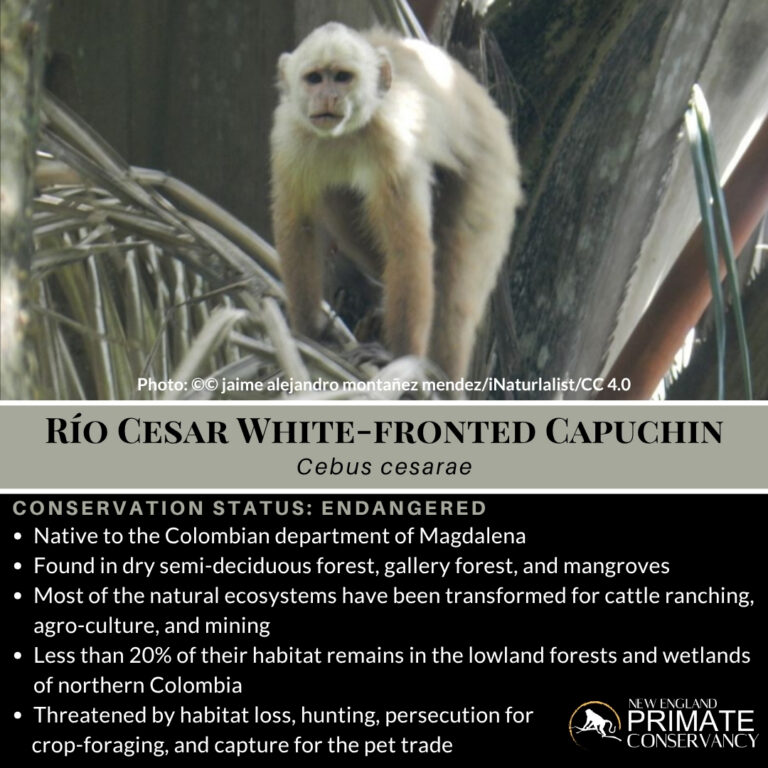
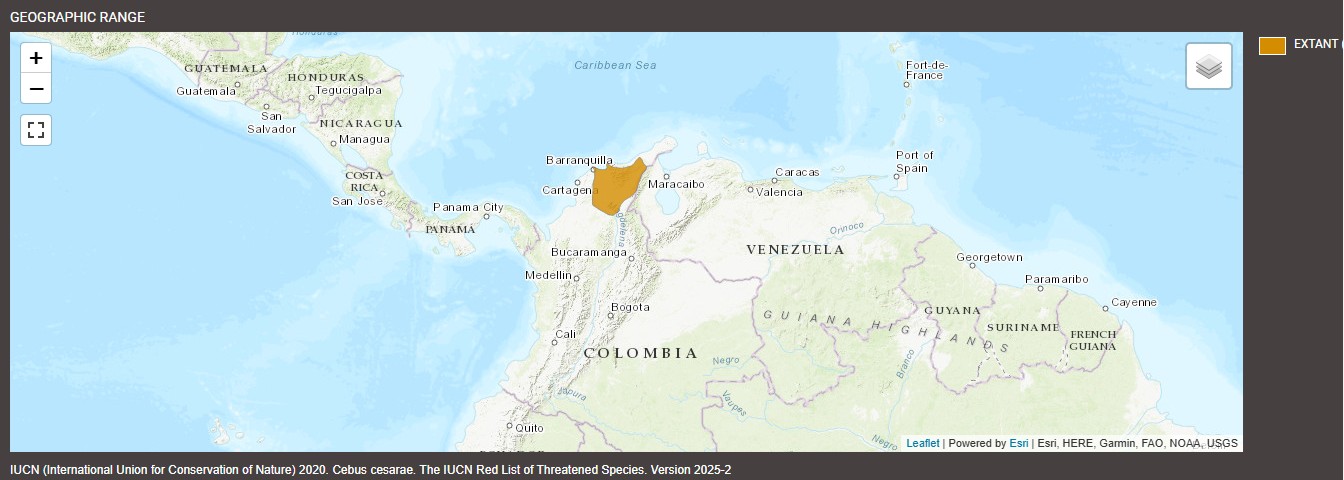
Geographic Distribution and Habitat
The Río Cesar white-fronted capuchin is native to northern Colombia, in the departments of Cesar, Magdalena, and La Guajira. Their distribution includes the upper limits of the Magdalena River Valley and lowland forests in the Cesar River Valley up to the eastern and southern slopes of the Sierra Nevada de Santa Marta. They reside in habitats up to 1,640 feet (500 m) above sea level. Within this range, they inhabit dry semi-deciduous forest, gallery forest, and mangroves. The region where the Río Cesar white-fronted capuchin lives experiences a warm tropical climate, with pronounced wet and dry seasons, and these seasonal fluctuations strongly influence the monkey’s ecology and behavior.
Temperatures remain warm throughout the year with relatively little seasonal variation. Average temperatures range from approximately 75–84°F (24–29°C) depending on elevation and locality, and daily highs commonly reach 88–95°F (31–35°C) during the hottest months. Nighttime temperatures generally remain between 68–75°F (20–24°C). Rainfall is highly seasonal, reflecting the tropical dry forest biome. Annual rainfall generally ranges between 31–71 inches (800–1,800 mm), although local amounts vary across the valley. The region typically experiences a major wet season from April to November, with rainfall peaking during May-June, and often again during September–October. A pronounced dry season occurs from December through March, when precipitation drops sharply, and many trees lose their leaves. Unlike tropical rainforests, where rainfall is distributed fairly evenly throughout the year, the Cesar River Valley’s climate produces several consecutive months with little rain, making water and food availability much more seasonal.
This strong seasonal climate shapes nearly every aspect of the Río Cesar white-fronted capuchin’s ecology. Food abundance changes dramatically between the wet and dry seasons. During the wet season, rainfall stimulates flowering and fruit production throughout the forest. Fruits become much more abundant, allowing capuchins to feed heavily on ripe fruit while also taking advantage of increased numbers of insects and other invertebrates that emerge under moist conditions. Food diversity is generally highest during this period. At the opposite end of the spectrum, during the dry season, many deciduous trees shed their leaves and produce fewer fruits. As fruit becomes scarcer, capuchins broaden their diet by increasing their use of fallback foods, including seeds, flowers, young leaves, bark-associated insects, spiders, and small vertebrates. Their flexible, omnivorous diet and skilled extractive foraging allow them to exploit concealed prey that remains available when fruit availability declines.
Resource distribution changes seasonally, influencing how the monkeys use their home range. When fruits are abundant during the wet season, feeding trees may be widespread, allowing groups to exploit productive patches. During the dry season, however, reliable food sources become concentrated in gallery forests, evergreen patches, and areas near permanent watercourses. Capuchin groups are therefore thought to spend proportionally more time in these habitats, where vegetation remains greener, and food resources persist longer than in surrounding deciduous forests.
High temperatures also affect daily activity. Capuchins are strictly diurnal, or most active during daylight hours. However, during the hottest parts of the day, they often reduce activity by resting in the shade of the forest canopy. Feeding and travel are concentrated during the cooler morning and late afternoon hours, while midday is frequently devoted to resting, grooming, and social interactions. This pattern helps reduce heat stress and water loss in the hot, seasonally dry environment.
One of the Río Cesar white-fronted capuchins’ greatest ecological strengths is their behavioral flexibility. Rather than relying on a single food type, they adjust their diet, foraging techniques, and habitat use in response to seasonal changes in rainfall and plant productivity. This adaptability allows them to survive in one of Colombia’s most seasonal forest ecosystems. Nevertheless, prolonged droughts and continued habitat fragmentation may reduce the availability of critical food resources and evergreen refuges for capuchins into the future.
The Río Cesar white-fronted capuchin was once considered a subspecies of Humboldt’s white-fronted capuchin (C. albifrons), until genetic analysis by Jean Boubli in 2012 revealed that it is actually more closely related to the Colombian white-throated capuchin (C. capucinus) than to the previously assigned species. Some researchers have also considered the Río Cesar white-fronted capuchin a subspecies of the varied white-fronted capuchin (C. versicolor).
All capuchin monkeys were once considered members of one genus (Cebus). However, in 2012, capuchins were subdivided into two genera: the robust or tufted capuchins (genus Sapajus) and the gracile capuchins (genus Cebus). The Río Cesar white-fronted capuchins are members of the gracile capuchin monkey group. Because of these taxonomic changes, much information can overlap and be hard to distinguish between these species, so beware!
Size, Weight, and Lifespan
The head-body length of the Río Cesar white-fronted capuchin has been recorded as ranging from 12.1 to 16.0 inches (30.8-40.7 cm) for males, with a tail length of between 16.5 and 19.5 inches (41.9 and 49.5 cm). Females have a head-body length ranging from 13.9 to 15.2 inches (35.3 to 38.5 cm), with tails measuring between 18.1 and 19.7 inches (46.1 and 50 cm). No records have been made regarding their weight. Like other capuchins, the Río Cesar white-fronted capuchin likely exhibits sexual dimorphism, or noticeable physical differences between genders. Adult males are likely larger and heavier than females, and develop larger canine teeth compared with those of females.
The lifespan of the Río Cesar white-fronted capuchin is unknown, but other capuchin species tend to live 15-25 years in the wild.
Appearance
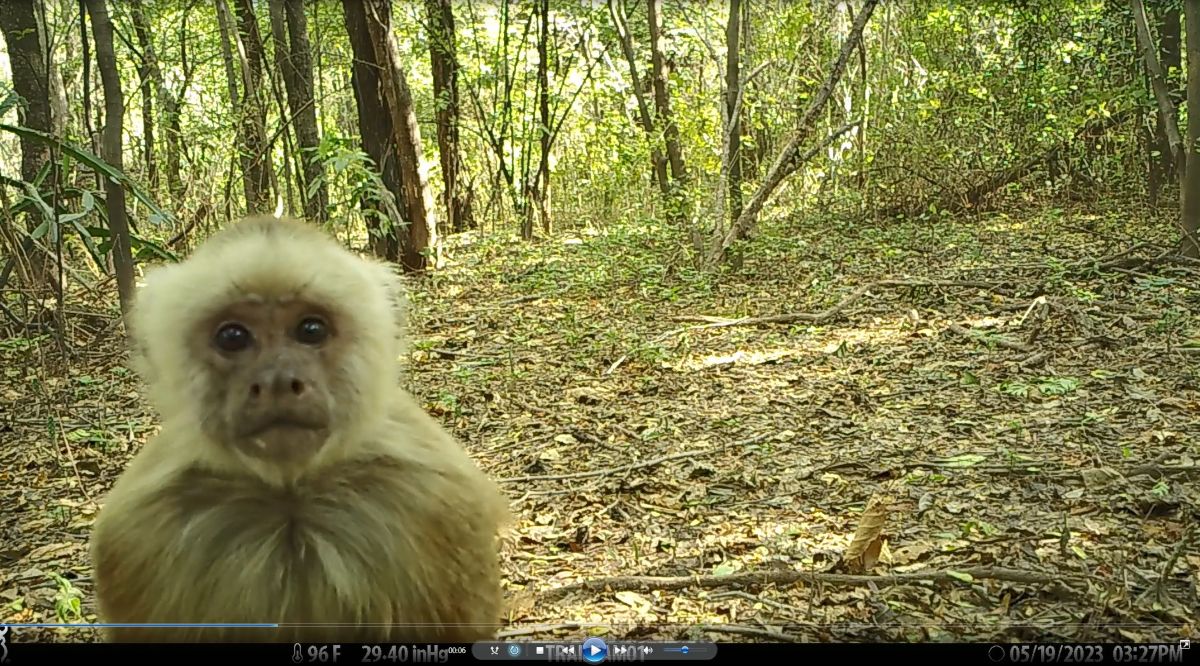
The Río Cesar white-fronted capuchin is one of the palest of the white-fronted capuchins native to northern Colombia and Venezuela. Their bodies have a cinnamon-brown or snuff-brown tone. Their arms, legs, and the center of the back feature a highly contrasting, vibrant orangey hue. The face is pale, fleshy-gray or light gray, with a white or light-colored forehead, and atop this adorable head is a cinnamon or snuff-brown cap. The hairs on the sides of the face are also lighter in appearance compared with much of the body. The upper surface of the tail is frosted cinnamon-brown. This varied combination of cinnamon-brown, orangey, and pale coloration may provide some degree of camouflage within the forest canopy. The warm brown and reddish tones can blend with branches, foliage, and dappled sunlight, while the lighter facial and body markings may break up the monkey’s outline. Although the camouflage value of their coloration has not been specifically studied, such patterns could make them less conspicuous to predators as they move and forage among the trees.
They are slender with long limbs that enable them to navigate their tree-dominated habitat with remarkable agility and grace. Their tails are semi-prehensile, allowing them to balance and grasp branches, but are not capable of supporting their full body weight.
Diet
The Río Cesar white-fronted capuchin has not been studied extensively, and as you’ll see in this profile, much of the information must be inferred from information known about other closely related capuchin species. This even includes information relating to their diet.
Like all capuchins, the Río Cesar white-fronted capuchin is likely an omnivore, eating both plant and animal material. Their diet likely includes ripe and unripe fruits, insects, spiders, and larvae, seeds and nuts, flowers, young leaves and shoots, and small vertebrates such as lizards and frogs. Despite the lack of information, fruit likely is their predominant food source for much of the year. Seeds and nuts are consumed particularly when fleshy fruits are scarce, and the capuchins’ strong jaws allow them to break relatively hard foods. Young leaves and shoots are likely a supplementary food, particularly during periods of reduced fruit availability. Insects and their larvae, as well as spiders and small vertebrates, are good sources of protein when encountered during foraging missions.
Behavior and Lifestyle
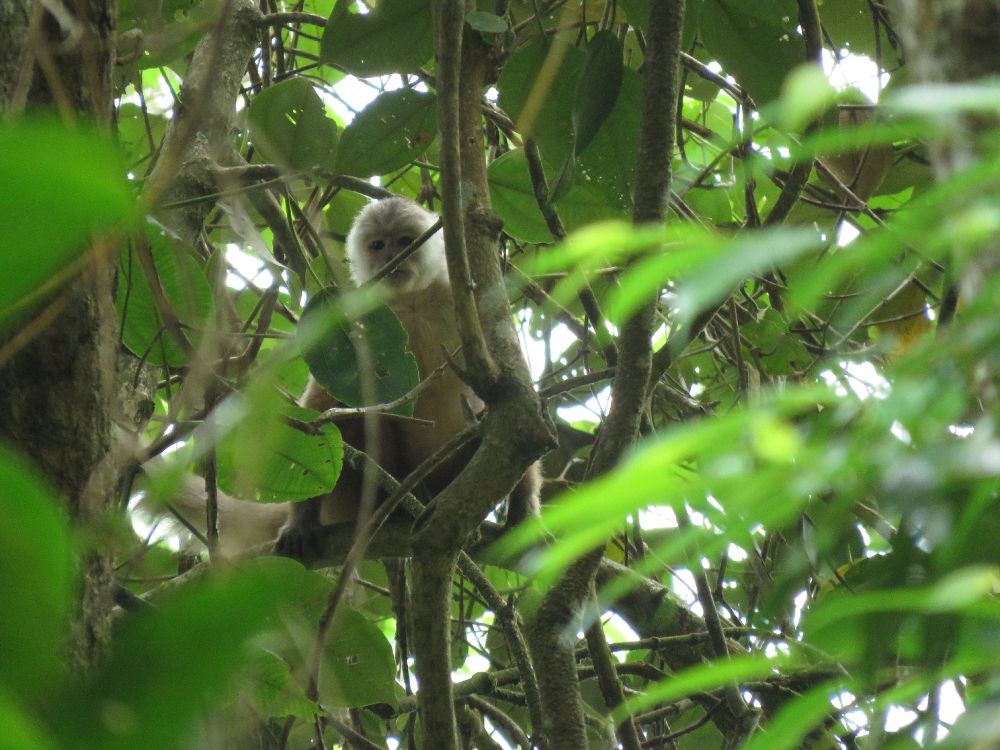
The Río Cesar white-fronted capuchin is generally diurnal and primarily arboreal, meaning active during the day and tree-dwelling. They are most commonly seen early in the morning, foraging in the forest’s middle canopy or on the forest floor.
Very few studies have been conducted specifically on the Río Cesar white-fronted capuchin. This includes specifics regarding their behavior and lifestyle. Using better-studied white-fronted capuchins as a comparison, much of their day is spent foraging in groups, while nights are spent sleeping on tree branches. Like other capuchins, the primary mode of locomotion is quadrupedalism, that is, moving on four limbs, though they may also be capable of standing and walking upright on two legs.
Besides humans, predators that target the Río Cesar white-fronted capuchin have not been documented. Other capuchins face threats from jaguars, cougars, coyotes, tayras, snakes, crocodiles, and birds of prey. While not directly observed, they likely use various defensive techniques to avoid predation. These may include emitting alarm calls which may vary depending upon the type of predator, remaining vigilant while foraging by staying close together in groups, spending most of their time in the trees to avoid ground-based predators, using their natural agility to beat a hasty retreat, using their natural coloration to act as camouflage which allows them to blend in with their tree-based habitat, and by selecting habitats that offer better protection from predators, such as dense forests, with plenty of cover and escape routes.
Capuchins sleep directly on the branches of tall trees with dense canopies, upper canopy branches often several meters above the ground, and trees with multiple interconnected branches that allow for rapid escape from potential threats if disturbed. In the Cesar River Valley, gallery forests along rivers and streams may provide especially favorable sleeping sites because they contain taller, evergreen trees than the surrounding tropical dry forest. Although this has not been studied specifically in Río Cesar white-fronted capuchins, other white-fronted capuchins and gracile capuchins typically reuse favored sleeping trees, particularly those that provide good visibility and multiple escape routes. Groups may alternate among several sleeping sites within their home range, rather than using the same tree every night. Sleeping high in the canopy provides several advantages: elevation reduces the risk from many ground-based predators, dense foliage helps conceal them from nocturnal predators, multiple branches and adjoining tree crowns allow rapid escape if a predator approaches, and groups often choose trees that provide good visibility of the surrounding forest, allowing for early detection of danger. The tropical climate of the Cesar River Valley generally eliminates the need for elaborate sleeping shelters. Sleeping within the canopy offers shade from lingering evening heat, reduces exposure to wind when compared with exposed branches, and offers protection from direct rainfall during the wet season. Finally, like other capuchins, Río Cesar white-fronted capuchins almost certainly sleep as a cohesive social group. This provides several benefits, namely: maintaining social bonds by remaining close together, reducing the chance that individuals become separated overnight, increasing vigilance, since many individuals can detect potential predators, and helping mothers keep dependent infants close and protected during the night. Infants typically sleep in close contact with their mothers, while juveniles remain near other members of the group.
A Crown Fit for a Cute King: Capuchins are named for their “caps” of hair, which resemble a capuche, the hood worn by a Capuchin friar, a type of Catholic monk.
Once again, as the Río Cesar white-fronted capuchin is one of the least-studied capuchins, much of the information regarding their daily lives and group dynamics must be inferred from other closely related capuchins.
They are believed to live in multi-male, multi-female social groups, the typical organization for gracile capuchins. Group sizes are unknown; however, related white-fronted capuchins generally live in groups of 8–20 individuals, with most containing 10–15 monkeys. Group size may vary depending on habitat quality and food availability. A typical group includes multiple ages and sexes: several adult males and females, subadult males and females, juveniles, and infants. Adult females usually maintain long-term social relationships with female relatives and their offspring, remaining in the group, while adult males may change groups over time.
Like nearly all gracile capuchins, female Río Cesar white-fronted capuchins are thought to remain in their natal, or birth, groups for life, while males typically leave their natal group upon reaching adolescence or early adulthood. By remaining in their birth group for life, females create and maintain stable associations consisting of mothers, daughters, sisters, and other female relatives. These long-term relationships promote social stability and cooperative behavior. When males leave, rather than establishing entirely new groups, they usually join existing neighboring groups, sometimes alone and sometimes with other dispersing males. Successful immigration introduces unrelated males into resident groups, increasing genetic diversity and reducing the likelihood that close relatives breed, supporting a healthy capuchin population.
Although all members of a group travel and forage together for much of the day, associations are not random. Adult females often spend more time near female relatives and their dependent offspring, mothers maintain close associations with infants during the first months of life, juveniles frequently associate with one another during play, and adult males generally participate in group defense, predator vigilance, and interactions with neighboring groups. Since group membership remains relatively stable despite male turnover, social cohesion is maintained across many years while still allowing proper genetic exchange through unrelated males immigrating into groups.
No estimates have been published specifically for the home ranges of Río Cesar white-fronted capuchins. Studies of closely related white-fronted capuchins report home ranges ranging from approximately 198 to over 741 acres (80-300+ ha), with considerable variation depending on forest productivity, habitat fragmentation, and group size. Home-range size reflects several ecological factors:
- Food availability: In productive, undisturbed forests, fruiting trees are often more densely grouped, allowing smaller ranges. In the seasonal tropical dry forests inhabited by Río Cesar white-fronted capuchins, food resources become patchier during the dry season, likely requiring wider travel.
- Group size: Larger groups consume resources more rapidly and therefore may require larger home ranges.
- Habitat fragmentation: Remaining forest patches in the Cesar River Valley may constrain movements and isolate neighboring groups.
Capuchins are not strictly territorial. Neighboring groups often have overlapping home ranges, although encounters may involve vocal displays, chasing, or aggressive interactions over valuable food resources.
The Río Cesar white-fronted capuchin shares their restricted range with relatively few other primates. Notably, the Colombian red howler (Alouatta seniculus) shares portions of their range, particularly in gallery forests and larger forest remnants. These species occupy different ecological niches. Whereas capuchins actively search for fruits, insects, and small vertebrates throughout multiple forest layers, red howlers rely much more heavily on leaves and mature fruits and travel less extensively. Since their diets differ substantially, direct feeding competition is thought to be limited. Mixed-species groups have not been documented for the Río Cesar white-fronted capuchin, although both species may feed in the same forest patches when fruit is abundant. Río Cesar white-fronted capuchins also share their habitat with numerous birds, squirrels, reptiles, and other mammals. Like other capuchins, they likely respond to alarm calls from birds or other mammals that detect predators, although this has not been specifically studied in this species.
Since the Río Cesar white-fronted capuchin has only recently been recognized as a distinct species and has received very little behavioral study, no published research has documented their communication system specifically. Consequently, there are no species-specific descriptions of their vocal repertoire, facial expressions, or scent-marking behaviors. Luckily, they belong to the gracile capuchin genus, whose communication has been studied extensively in closely related species, particularly the Panamanian white-throated capuchin (C. imitator), the Colombian white-throated capuchin, and Humboldt’s white-fronted capuchin. The following information distinguishes among behaviors well documented for these close relatives, while acknowledging what’s currently unknown about the Río Cesar white-fronted capuchin.
Like other capuchins, Río Cesar white-fronted capuchins almost certainly rely on a combination of vocal, visual, tactile, and chemical signals to coordinate group movements, maintain social relationships, detect predators, and reduce conflict. No single signal operates in isolation; instead, multiple channels are often combined depending upon the social or environmental context.
Starting with vocalizations, soft contact calls are among the most common vocalizations in capuchins. Group members exchange these calls while foraging or traveling through dense vegetation, allowing individuals to maintain awareness of one another even when visual contact is temporarily lost. These calls help maintain group cohesion, reduce the risk of individuals becoming separated, and coordinate movement through the forest. Capuchins produce loud alarm calls when predators are detected. Research on white-faced capuchins has shown that different predators can elicit distinct alarm calls, allowing nearby group members to respond appropriately. Alarm calls benefit both callers and listeners by rapidly alerting the group, promoting coordinated escape, increasing vigilance, and reducing the likelihood that a predator successfully surprises an individual. Although predator-specific alarm calls have not been studied in the Río Cesar white-fronted capuchin, there’s no evidence suggesting that they differ substantially from other gracile capuchins. Capuchins also use vocalizations during aggressive encounters, dominance interactions, reunions with group members, infant distress, and play. These calls communicate motivation and emotional state, often allowing conflicts to be resolved without physical fighting.
Moving to visual communication, capuchins possess highly expressive faces and use combinations of eye gaze, eyebrow position, mouth posture, and facial tension during social interactions. Observed facial expressions include signals associated with submission, mild threat, play, curiosity, and the maintenance of social and emotional bonds with others. Rather than provoking conflict, many facial signals appear to help individuals assess one another’s intentions before aggression escalates. Body orientation, approach behavior, and posture also communicate social intent. Examples observed in other capuchins include: approaching cautiously to avoid provoking aggression, adopting relaxed postures during affiliative encounters, and using conspicuous body movements during conflicts or predator encounters. Capuchins also employ numerous hand gestures while interacting socially, although many gestures are subtle and context-dependent.
Tactile communication is among the most critical forms of social interaction in capuchins. Social grooming is well-documented among gracile capuchins and serves several functions beyond hygiene. Grooming also strengthens long-term social bonds, reduces social tension, reinforces alliances, and maintains relationships among females and between mothers and offspring. Individuals often groom preferred social partners repeatedly over months or years. Infants remain in almost continuous physical contact with their mothers during early life. As they mature, tactile communication expands to include carrying, embracing, gentle touching, and play wrestling with juveniles and adults. These interactions facilitate both social development and learning.
Finally, chemical communication! Capuchins possess well-developed olfactory (scent-based) abilities despite relying heavily on vision. One of the best-known behaviors in gracile capuchins is… urine washing, in which individuals rub urine onto their hands and feet. Ew! The exact function remains debated, but proposed explanations include social signaling, enhancing scent cues, parasite deterrence, and even improving grip on branches. Evidence suggests the behavior may serve multiple functions depending on context, rather than a single purpose. Capuchins also investigate odors left by other individuals by sniffing and closely inspecting the scented area. Chemical cues likely provide information about identity, reproductive condition, recent presence, and social status.
Currently, no published studies have examined whether Río Cesar white-fronted capuchins specifically respond to alarm calls produced by other species. However, several other capuchins—including white-throated capuchins—have been observed reacting to alarm calls from birds and mammals that share the same habitat, thereby increasing vigilance or scanning for predators. Whether Río Cesar white-fronted capuchins do so remains unstudied. Hop on it, researchers!
Unlike many Amazonian monkeys, Río Cesar white-fronted capuchins have not been reported to participate in stable mixed-species groups that rely on coordinated communication. Even though they may occasionally forage near Colombian red howlers where their ranges overlap, there’s no evidence that the two species coordinate movements or exchange communication signals.
Once again, since the Río Cesar white-fronted capuchin has only recently been recognized as a distinct species and has received very little behavioral study, no published field studies have described their reproductive biology specifically. Consequently, nearly all of the information below comes from research on closely related gracile capuchins, namely our three “substitutes” from the previous section, the Panamanian white-throated capuchin, the Colombian white-throated capuchin, and Humboldt’s white-fronted capuchin.
In other gracile capuchin species, females typically reach sexual maturity at approximately 4–5 years of age, although first successful reproduction often occurs somewhat later, around 5–7 years, depending on social rank and environmental conditions. Males, meanwhile, generally become sexually mature at 6–8 years, but may not reproduce immediately since immigrant males often require time to establish themselves within a new group before gaining mating opportunities. This delayed reproduction reflects the capuchins’ slow life history, characteristic of many long-lived primates.
Like other gracile capuchins, the Río Cesar white-fronted capuchin is inferred to have a polygynandrous (multi-male, multi-female) mating system. Multiple adult males and females live together in the same social group, and both genders may mate with more than one partner during a breeding season. Although dominance relationships can influence mating success, no single male monopolizes reproduction in most groups. This system offers several evolutionary advantages, namely maintaining genetic diversity, reducing inbreeding through male dispersal, increasing reproductive opportunities for both sexes, and reducing the likelihood that one male can exclude all competitors.
No observations have been published specifically regarding the reproductive readiness of Rio Cesar white-fronted capuchin females. In closely related capuchins, females advertise their reproductive condition through a combination of behavioral and chemical cues, rather than dramatic physical changes. Observed signals include increased proximity to preferred males, frequent following or solicitation of males, specific facial expressions and body postures, increased social interactions, and olfactory cues that males investigate through sniffing. Gracile capuchins generally lack conspicuous sexual swellings, so reproductive status is communicated primarily through behavior and scent rather than obvious external anatomy. Males often respond by increasing grooming, following receptive females, and competing—usually through displays rather than direct fighting—for access to mating opportunities.
The gestation (pregnancy) period in gracile capuchins averages approximately 150–160 days, with the vast majority of births resulting in a single infant. Among gracile capuchins, birth seasonality varies geographically. Populations living in strongly seasonal forests often experience birth peaks that coincide with or occur shortly before periods of greatest food availability, allowing lactating females and growing infants access to abundant fruit and insects. In less seasonal forests, births may occur throughout the year with only weak seasonal peaks. Since the Cesar River Valley experiences pronounced wet and dry seasons, Río Cesar white-fronted capuchins may likewise exhibit seasonal birth peaks, but this has not been documented. Females generally produce one infant every two years. Intervals vary, however, depending on infant survival, maternal condition (in other words, mom’s health and child-rearing experience), and food availability. Typical birth intervals range from about 19 to 30 months, with shorter intervals occurring if an infant dies prematurely. This relatively slow reproductive rate means that population recovery following declines can be correspondingly slow.
The mother is the primary caregiver of the infant, providing nearly all direct parental investment. She’s responsible for carrying the infant, nursing, protection, thermoregulation, transporting the infant while traveling, and gradually introducing her baby to solid foods. Maternal investment is prolonged because capuchins develop slowly and require years to master complex foraging techniques. Direct paternal care has not been documented. Since paternity is uncertain within multi-male groups, adult males generally don’t provide parental care comparable to that seen in pair-bonded primates. Nevertheless, resident males often contribute indirectly by defending the group, participating in predator detection, and protecting all group members from outside threats. Alloparental care, or care given by those other than the biological parents, is well documented in capuchins. Infants are frequently handled, groomed, and briefly carried by older siblings, juvenile females, adult females, and even occasionally, adult males. These interactions are generally brief and occur only when the mother permits them. Alloparenting may strengthen social bonds, provide inexperienced juveniles with parenting experience, allow infants to become familiar with multiple group members, and occasionally give mothers brief opportunities to forage without carrying the infant continuously.
Infants nurse frequently during early life. Across gracile capuchin species, nursing typically continues for approximately 12–18 months, although solid foods are sampled within the first several months of life. Weaning is gradual rather than abrupt, with milk forming a decreasing proportion of the infant’s diet as independence increases.
Newborns cling tightly to their mother’s fur. During the earliest weeks, they are carried primarily on the mother’s underside, providing warmth, protection, and easy nursing access. As infants become stronger, they transition to riding on the mother’s back, where they remain while she travels and forages.
Unsurprisingly, young capuchins are highly social. Infants regularly interact with their mothers, juvenile play partners, adult females, and other tolerant group members. Play becomes increasingly important after the first few months of life and includes chasing, wrestling, climbing, and manipulating objects in their environment. These activities help develop the motor, cognitive, and social skills needed for adulthood.
As juveniles mature, they gradually spend more time moving independently, begin locating their own food, participate in group travel, and develop relationships beyond that with their mothers. Even after weaning, juveniles remain socially dependent upon the group for several years while learning complex foraging techniques and social rules. Although capable of independent feeding well before adulthood, they are not considered fully mature until reaching sexual maturity several years later. Once they reach that milestone, females remain within their natal group, while males leave to join a neighboring group.
While this information is predominantly inferred from other closely related species, the reproductive biology of the Río Cesar white-fronted capuchin reflects a classic slow life-history strategy. Producing a single infant after a relatively long gestation, followed by prolonged maternal care, extended juvenile development, and infrequent births, allows young capuchins the time needed to acquire the sophisticated foraging, social, and cognitive skills required to survive in a complex, seasonally variable forest. Stable social groups, female group stability, and occasional alloparental care further enhance offspring survival, while male dispersal maintains genetic diversity among populations
As fruit-eaters, Río Cesar white-fronted capuchins aid in the regeneration of their forest habitats by dispersing seeds through their feces as they move around the habitat. In addition, they may serve as pest controllers, since a portion of their diet consists of insects and their larvae. Finally, as a prey species, they also support local predator populations within their range.


The International Union for Conservation of Nature lists the Río Cesar white-fronted capuchin as Endangered (IUCN, 2020), appearing on the IUCN Red List of Threatened Species.
The predominant threat facing the Río Cesar white-fronted capuchin is habitat loss due to large-scale cattle ranching, oil palm agro-industries, and mining. Most of the natural ecosystems within their range have been transformed, and less than 20% of their habitat remains in the lowland forests and wetlands of northern Colombia. In addition, the pet trade, human-wildlife conflict due to crop foraging, and subsistence hunting also pose threats to many species of white-fronted capuchins.
The Río Cesar white-fronted capuchin is listed in Appendix II of the Convention on International Trade in Endangered Species (CITES), an international agreement between governments whose goal is to ensure that international trade in specimens of wild animals and plants does not threaten their survival.
Unfortunately, the Río Cesar white-fronted capuchin isn’t found in any national protected areas of Colombia.
The single most important conservation action is to prevent further destruction of the remaining tropical dry forest and gallery forest in the Cesar River Valley. Priority actions include expanding legal protections for existing forest remnants, preventing illegal clearing, and protecting gallery forests along rivers and streams.
Habitat restoration should focus on reforesting degraded land, restoring native dry forest vegetation, creating forested corridors between isolated patches, and reconnecting gallery forests that naturally serve as movement routes for the capuchin. Conservation planning should emphasize networks of protected forests, conservation easements on private lands, sustainable agricultural landscapes, and habitat connectivity across the entire Cesar River Valley.
Long-term conservation also depends heavily upon community participation. Successful programs may include incentives for conserving forest on private land, environmental education, ecotourism where appropriate, support for sustainable farming practices, and restoration projects involving local landowners. When communities benefit from conserving forests, habitat protection is generally more durable than enforcement alone. To combat the pet trade and killings from human-wildlife conflict, conservation efforts should strengthen wildlife law enforcement, monitoring of the (illegal) pet trade, public awareness campaigns discouraging primate ownership, and conflict-mitigation strategies where capuchins use agricultural areas.
Finally, as you’ve seen in this profile, field research and population monitoring of the Río Cesar white-fronted capuchin is necessary to ensure the survival of this adorable monkey of northern Colombia. We cannot save that which we do not know.
- https://academic.oup.com/jmammal/article-abstract/87/4/820/969084
- https://www.alltheworldsprimates.org/Members/Home/MasterPrimate.aspx?tid=1248
- https://animalia.bio/ro-cesar-white-fronted-capuchin
- https://www.bioexplorer.net/animals/mammals/monkeys/rio-cesar-white-fronted-capuchin/
- https://en.wikipedia.org/wiki/Cesar_River
- https://en.wikipedia.org/wiki/Magdalena_River
- https://en.wikipedia.org/wiki/Marmoset
- https://en.wikipedia.org/wiki/R%C3%ADo_Cesar_white-fronted_capuchin
- https://en.wikipedia.org/wiki/Sierra_Nevada_de_Santa_Marta
- https://en.wikipedia.org/wiki/White-fronted_capuchin
- https://en.climate-data.org/south-america/colombia/cesar-100/
- https://explorer.natureserve.org/Taxon/ELEMENT_GLOBAL.2.1298943/Tropical_Dry_Forest_Subbiome
- https://www.iucnredlist.org/species/4082/195995295
- https://www.researchgate.net/profile/James-Anderson-24/publication/248035385_Dorothy_M_Fragaszy_Elisabetta_Visalberghi_Linda_M_Fedigan_eds_The_complete_capuchin_the_biology_of_the_genus_Cebus_Cambridge_University_Press_Cambridge_2004_339_pp/links/681ff917bfbe974b23c7dc2d/Dorothy-M-Fragaszy-Elisabetta-Visalberghi-Linda-M-Fedigan-eds-The-complete-capuchin-the-biology-of-the-genus-Cebus-Cambridge-University-Press-Cambridge-2004-339-pp.pdf
- https://www.researchgate.net/publication/226279060_Tracking_Neotropical_Monkeys_in_Santa_Rosa_Lessons_from_a_Regenerating_Costa_Rican_Dry_Forest
- https://www.researchgate.net/profile/Shannon-Digweed/publication/233551625_Variable_specificity_in_the_anti-predator_vocalizations_and_behaviour_of_the_white-faced_capuchin_Cebus_capucinus/links/5bcf8414a6fdcc204a034e40/Variable-specificity-in-the-anti-predator-vocalizations-and-behaviour-of-the-white-faced-capuchin-Cebus-capucinus.pdf
- https://www.researchgate.net/publication/20765144_Vertebrate_Predation_in_Cebus_capucinus_Meat_Eating_in_a_Neotropical_Monkey
- https://ri.conicet.gov.ar/bitstream/handle/11336/45480/CONICET_Digital_Nro.bbbeb048-101c-4180-a3fa-739aeff87f07_A.pdf
- https://www.sciencedirect.com/science/chapter/bookseries/abs/pii/B9780123942883000046
- https://www.sciencedirect.com/topics/earth-and-planetary-sciences/dry-forest
- https://theses.hal.science/tel-05515490/file/153534_MORTESSAGNE_2025_archivage.pdf
- https://treatment.plazi.org/GgServer/xhtml/560F8786B7302842083AF3DB39F2F9C2
Written by Sienna Weinstein, August 2026