
Golden-Handed Tamarin, Saguinus midas
GOLDEN-HANDED TAMARIN
Saguinus midas
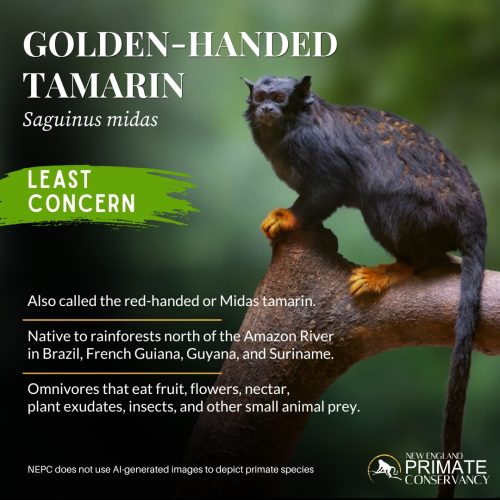
Geographic Distribution and Habitat
Golden-handed tamarins are found in northeastern South America, including Brazil, Guyana, Suriname, and French Guiana. In Brazil, their range is largely restricted to the region north of the Amazon River and extends into the Guiana Shield. Major rivers, including the Rio Negro and Rio Branco, help define their distribution boundaries.
Golden-handed tamarins are adaptable and inhabit a variety of environments, including hilly tropical rainforests, mixed forest-savanna habitats, coastal white-sand forests, and secondary forests near human settlements. They thrive in ecotones (transitional areas between two different habitats) and are considered a pioneer species, meaning they are among the first mammals to occupy recently disturbed habitats, such as forests regenerating after agricultural clearing or fires. They typically travel through the lower and middle levels of the forest canopy and are typically absent in forests that lack a well-developed understory.
Other names for the species include golden-handed tamarin, red-handed tamarin, and yellow-handed tamarin
The golden-handed tamarin has undergone fewer taxonomic changes than some other tamarin species. Historically, the midas group included two subspecies: the golden-handed tamarin (Saguinus midas midas) and the black-handed tamarin (Saguinus midas niger). Later taxonomic revisions recognized these as two distinct species, with the golden-handed tamarin retaining the scientific name Saguinus midas.
The species name “midas” refers to the Greek myth of King Midas, who could turn everything he touched into gold. This fits the tamarin’s distinctive golden-orange hands and feet. However, not all individuals have the same coloration. Some have redder hands, and researchers suggest these variations may represent distinct geographical forms within the same species or, potentially, separate species. Further research is needed to clarify these differences.

Size, Weight, and Lifespan
Adult male golden-handed tamarins weigh approximately 19.8–20.8 ounces (560–590 g), while females weigh 17.0–19.4 ounces (481–549 g). Their head-body length averages about 9.1 inches (23 cm), and their tail length averages 13.8 inches (35 cm). Golden-handed tamarins are among the larger species of tamarins.
Their lifespan in the wild is unknown, but captive individuals have been recorded living up to 21 years.
Appearance
Golden-handed tamarins are squirrel-sized monkeys with striking jet-black fur that contrasts with their bright orange-golden hands and feet. Their faces have black, mostly hairless skin, with protruding snouts and large eyes that often peer through dense foliage. A scattering of orange-gold fur runs down their backs, breaking up the otherwise dark appearance of their bodies. Their prominent, mostly hairless ears have notched or concave edges, giving these monkeys an almost gremlin-like appearance. Their small bodies are balanced by long tails, which are considerably longer than their bodies.
Young golden-handed tamarins have white or buff-colored patches on their foreheads and cheeks, and their ears are covered in fur.
Like other tamarins, golden-handed tamarins have pointed, claw-like nails called tegulae on all their fingers and toes except their big toes, which have the flat nails commonly seen in other primates. These specialized nails help them grip vertical surfaces, allowing them to cling to tree trunks and branches as they climb and leap through the forest.
On their lower jaws, golden-handed tamarins have canine teeth that are considerably longer than their incisors. This feature is so prominent that early researchers called members of the genus Saguinus “long-tusked tamarins”. They can use their sharp canines to deliver defensive bites when threatened.

Diet
Golden-handed tamarins are primarily frugivorous (fruit-eating) and insectivorous (insect-eating) primates. They supplement their diet with nectar from flowers and plant gums.
When eating fruit, they generally consume the fleshy portions and discard larger seeds. However, when the seeds are small enough, they may swallow them along with the fruit.
While many fruit-eating primates increase their fruit consumption during periods of greater fruit availability, golden-handed tamarins have been observed eating less fruit and more insects during these periods. In one study, insects and other invertebrates made up approximately 50% of their diet, while fruit accounted for 47%. Researchers suggest this unusual dietary shift may reflect the increased competition from other fruit-eating animals. Their ability to switch between food sources helps them adapt to changing environmental conditions and seasonal fluctuations in food availability.
Behavior and Lifestyle
Golden-handed tamarins are diurnal (active during the day) and arboreal (tree-dwelling) primates. They spend much of their time in the forest’s lower canopy and understory, usually around 33–66 feet (10–20 m) above the ground. However, they also venture into the upper canopy, particularly when searching for fruit. This allows them to use food resources at different heights in the forest.
They use thick vegetation and tangled vines for cover from predators as they move through the forest in search of food. They primarily move quadrupedally (on all fours), walking or running along branches, and also use vertical clinging and leaping to move between trees and supports. Their sharp, claw-like nails help them cling securely to trunks and other vertical surfaces and navigate branches and vines, including narrow supports.
Golden-handed tamarins occupy home ranges of approximately 84–96 acres (34–39 ha). Although neighboring groups’ home ranges may overlap, troops defend their core territories against intruders. Territorial behavior includes loud vocalizations and chasing away intruders. This helps them maintain access to important resources, including feeding areas and sleeping sites.
At night, golden-handed tamarins gather in dense vegetation that provides support and protection while they sleep. They huddle together to conserve body heat and reduce energy expenditure. Studies of captive tamarins have found that nighttime heart rates can decrease by 35–50 beats per minute and body temperatures by up to 7.2°F (4°C). These physiological changes help conserve energy at night but may also mean tamarins need time to warm up before becoming fully active in the morning. Choosing suitable sleeping sites is especially important because they protect tamarins when they are less alert and more vulnerable to predators.
Golden-handed tamarins spend considerable time inspecting and selecting sleeping sites. They may change sites daily, sometimes choosing one close to where they last fed. They have been observed inspecting potential sleeping sites several times, sometimes hours before settling in for the night, particularly when using an unfamiliar site. They also incorporate new sleeping sites into their range as older ones become unsuitable or other groups occupy them.
Researchers suggest that the irregular reuse of sleeping sites may help reduce predation risk. A predator that learns where tamarins sleep could potentially anticipate their movements and ambush them. Another possible explanation is that regularly changing sleeping sites reduces exposure to parasites that may accumulate in frequently used locations. These behaviors suggest that familiarity with their surroundings plays an important role in how golden-handed tamarins select sleeping sites.
As small, social primates, golden-handed tamarins are visible and vulnerable to predators such as snakes and birds of prey. They use alarm calls to warn group members of potential threats and may also mob them. Mobbing occurs when tamarins detect a predator and respond as a group by approaching it, making repeated alarm calls, and displaying threatening movements while maintaining a safe distance. This draws attention to the predator and may discourage an attack by removing the element of surprise. In one recorded encounter, a group of golden-handed tamarins mobbed a boa constrictor for 29 minutes. They stayed more than 33 feet (10 m) away, made repeated alarm calls, and made lurching movements toward the snake before eventually moving on.
Allogrooming, a behavior in which individuals groom one another to remove dirt, debris, and parasites from their fur, is common among tamarins. Because golden-handed tamarins often sleep together in close quarters, grooming may help reduce the spread of ectoparasites (external parasites such as fleas and ticks). Golden-handed tamarins live in cooperative social groups, where members share responsibilities such as caring for young. Social bonds are important for maintaining group cohesion, and allogrooming serves more than just a hygienic purpose. The physical contact and attention involved in grooming help maintain social closeness and strengthen bonds between individuals
Golden-handed tamarins can thrive along forest edges, making them more adaptable than many other forest primates.
They have claw-like nails on all their digits except for their big toe, helping them grip tree trunks and leap between branches
They are cooperative breeders. One dominant female gives birth to (usually) twins. Fathers and other group members help carry and care for infants.
Golden-handed tamarins can change their vocal calls in areas where they share habitat with pied tamarins, almost like adopting a different accent.
Golden-handed tamarins spend much of their day traveling through the forest, up to 1.2 miles (2 km) a day, searching for fruiting trees and foraging for insects or animal prey. They spend the remaining hours resting or sleeping together in dense vegetation that shelters and protects them.
As diurnal (active during the day) primates, golden-handed tamarins begin stirring around sunrise. Before leaving their sleeping sites, they spend some time grooming, interacting with other group members, and warming up. They tend to spend more time active at their sleeping sites in the morning than in the evening. Once they leave, they move quickly through the forest to search for food, often staying at fruiting trees for some time before moving on.
Around midday, they may pause foraging to rest, groom one another, or bask in the sun before resuming their activities. By late afternoon, usually between 4 and 5 p.m., golden-handed tamarins begin settling into their sleeping sites, often well before sunset. They move more quickly as they approach their sleeping sites, where they may groom and huddle before settling down for the night.
Golden-handed tamarins live in social groups that vary in size by location, with some groups containing 5–20 individuals. These groups typically include multiple adult males and females, along with young of different ages. Researchers have also reported smaller groups in Guyana, sometimes with just 2–5 individuals, including one or two adult females and more adult males.
Group composition can change over time. Larger groups may exhibit fission-fusion behavior, in which members temporarily split into smaller groups to forage before reuniting to rest or sleep. Living in larger groups can protect against predators, as more individuals can detect threats and alert others. However, larger groups face increased competition for food and may also be more conspicuous to predators, especially when traveling through the forest. These competing pressures can influence group size and social organization.
Within a group, adults cooperate to care for infants, and interactions among group members are generally peaceful. However, encounters between neighboring groups can become aggressive, particularly when territorial boundaries are challenged. These confrontations may involve loud vocalizations, threatening displays, and chasing away members of the opposing group.
Golden-handed tamarins share a small part of their geographical range with the closely related pied tamarin (Saguinus bicolor). The two species share similar diets and habitat requirements, which may lead to resource competition. Although researchers have rarely observed direct aggression between the species, golden-handed tamarins respond more strongly to pied tamarin calls in areas where their ranges overlap, suggesting territorial competition.
Pied tamarins have a much smaller geographical range than golden-handed tamarins. In recent decades, golden-handed tamarins have expanded into areas previously occupied by pied tamarins, whose range has been shrinking. Researchers suggest that the golden-handed tamarin’s ability to adapt to a wider range of habitats may give it a competitive advantage, potentially contributing to pied tamarins’ displacement. However, researchers are still investigating competition’s exact role in this range shift.
Vocal communication plays an important role in how golden-handed tamarins interact with group members, other tamarins, and their surroundings. Researchers suggest that tamarin calls can convey information beyond the caller’s species, including characteristics such as body size, sex, and health.
Golden-handed tamarins produce several types of vocalizations, including chirp-like alarm calls, aggressive trills during encounters with other tamarins, and characteristic long calls used in territorial communication.
Long calls are often given in the morning, when one or more group members sit on exposed branches and produce loud, high-pitched vocalizations. These calls help announce the group’s presence and may signal that an area is occupied. Neighboring groups often respond with their own long calls. Calling activity generally decreases as the day progresses, with relatively few long calls heard toward evening.
The golden-handed tamarin’s long calls are complex and variable. Interestingly, researchers have found that these calls can differ depending on where the tamarins live. In areas where golden-handed tamarins and pied tamarins (Saguinus bicolor) share the same habitat, golden-handed tamarins produce long calls that more closely resemble the whistle-like calls of pied tamarins. These differences include a narrower frequency range and changes in call amplitude.
Researchers compare this behavior to changing one’s accent to be better understood by others. By making their calls more similar to those of pied tamarins, golden-handed tamarins may communicate their presence and reduce territorial conflicts over shared resources. Interestingly, researchers have observed this similarity in primary forests, but not in secondary forests. Pied tamarins do not appear to make corresponding changes to their calls. Researchers suggest that both interspecies competition and differences in forest structure may influence these vocalizations. This flexibility in their vocal communication is a remarkable example of how golden-handed tamarins may adapt to their environment.
Chemical communication, through scent or olfactory signals, is another important part of tamarin social behavior. Tamarins have specialized scent glands near their reproductive organs and on their chest that produce secretions they can deposit on trees, branches, and vines as they move through the forest. They may also use urine and other bodily secretions to leave chemical signals in their environment.
These scent marks can contain information about an individual, including their identity, sex, and reproductive status. Olfactory signals are particularly useful for communicating a female’s reproductive condition, as scent changes may indicate when she is hormonally receptive and ready to mate. Although researchers have not extensively studied the specific functions of scent marking in golden-handed tamarins, they suggest that chemical signals may also help tamarins recognize familiar individuals and mark frequently used areas or territorial boundaries. Unlike vocal calls, scent marks can remain in the environment after an individual moves away, allowing tamarins to communicate without direct contact or being within hearing distance.
Golden-handed tamarins also use visual signals to communicate aggression or warn other individuals. These include arching their bodies, raising their fur, and opening their mouths. Such displays may signal a willingness to defend themselves and discourage further aggression without physical confrontation.
Tactile communication (communication through touch) also plays an important role in these social primates. Allogrooming, in which individuals groom one another, helps maintain hygiene while strengthening social bonds. The physical contact and attention involved in grooming help reinforce relationships and maintain group cohesion, much like hugging and other forms of physical affection in humans.
Golden-handed tamarins live in cooperative breeding groups that may contain multiple adult males and females, although typically only one female reproduces. Other group members help care for the young, particularly by carrying infants. The breeding female may mate with more than one male, a mating system known as polyandry. This uncertainty about paternity may encourage several males to help care for the infants.
Golden-handed tamarins reach sexual maturity at approximately 14–21 months of age. When a female is ready to mate, she enters estrus (the receptive phase of her reproductive cycle). She may communicate changes in her hormonal condition through scent signals, including cues in her urine, that help males recognize when she is receptive. Gestation (the period of pregnancy) lasts about four to five months, after which females typically give birth to twins. Births have been reported between October and December, during the early rainy season in parts of their range.
Newborn golden-handed tamarins weigh approximately 1.4 ounces (40 g) and look noticeably different from adults, with their furry ears and paler coloring. These differences may help adults recognize young infants and respond to their need for care, although researchers have not studied the role of these visual cues in this species. Infants are initially carried by their mothers, but within a few days, other group members begin helping carry and care for them. Adult males are particularly involved in infant care, which is important because young tamarins depend on being carried during their first weeks of life. Research on cooperatively breeding tamarins suggests that having more adult helpers can improve infant survival.
Over the next few months, young tamarins become increasingly independent as they start eating solid foods and spend less time being carried. By approximately five months of age, they can generally feed and travel independently. They enter the juvenile stage as they continue to develop, although studies vary on the exact age used to distinguish infants from juveniles.
Young golden-handed tamarins may remain with their natal groups after becoming independent, sometimes helping care for younger siblings. As a result, groups can include several generations living together and cooperating to raise the next generation.

Golden-handed tamarins occupy a wide range of habitats, including forest edges and human-altered areas. Their adaptability to different environments and ability to switch between food sources allow them to interact with a variety of plant and animal species, giving them several important ecological roles.
As fruit-eating primates, golden-handed tamarins help disperse seeds. They swallow small seeds along with fruit, which may later pass through their digestive systems and be deposited in their feces. They may also drop seeds while feeding on the fleshy portions of larger fruits. By moving seeds away from parent trees, they can help forest regeneration and maintain plant diversity. Their insect-rich diet may also help regulate populations of the insects and other invertebrates they consume.
Golden-handed tamarins also play an important role in the forest food web, serving as prey for predators such as birds of prey and snakes.
Their interactions with other primates may also influence species distribution within their habitats. Golden-handed tamarins share a small part of their range with the endangered pied tamarin (Saguinus bicolor), and the two species have similar ecological requirements. Researchers suggest that competition with the more adaptable golden-handed tamarin may contribute to the pied tamarin’s restricted distribution and displacement from areas where their ranges overlap. Although the extent of this competition remains uncertain, these interactions illustrate how golden-handed tamarins may influence the distribution and composition of other primate communities.


The International Union for Conservation of Nature lists the golden-handed tamarin as Least Concern (IUCN, 2015), appearing on the IUCN Red List of Threatened Species.
Golden-handed tamarins are among the most common primates in parts of their range, and their tendency to live along forest edges makes them relatively easy to observe. At the Nouragues Field Station in French Guiana, researchers recorded them as the most common primate, with a population density of 37.1 individuals per square kilometer (0.39 square miles). In the Brazilian Amazon, population densities ranged from 16.4 to 33.5 individuals per square kilometer in Amapá State, while densities north of Manaus were much lower, at 3.9 individuals per square kilometer.
Golden-handed tamarins are rarely hunted and are not a preferred food species, although local communities sometimes use their tails for ornamental purposes. In some areas, they are the only primate species remaining near villages where hunting has reduced other primate populations. This suggests that golden-handed tamarins tolerate certain human disturbances better than some other primate species.
The forests within the golden-handed tamarin’s range continue to face habitat loss and degradation. However, their ability to adapt to different habitats, including forest edges and areas altered by human activities, makes them more resilient to these changes. A well-developed understory and lower canopy appear to be important habitat features for these tamarins. Therefore, despite their relatively high population densities in some areas and their ability to survive in disturbed forests, future changes to forest structure could affect their populations.
The golden-handed tamarin is listed in Appendix II of the Convention on International Trade in Endangered Species (CITES), an international agreement between governments whose goal is to ensure that international trade in specimens of wild animals and plants does not threaten their survival.
Because golden-handed tamarins are relatively common and not currently considered endangered, few conservation programs focus specifically on their protection. Instead, they benefit from broader habitat conservation efforts and protected areas that also support other wildlife, including other primate species.
In Suriname, golden-handed tamarins occur in protected areas such as Brownsberg Nature Park and Raleighvallen-Voltzberg Nature Reserve. In Brazil, they occur in numerous protected areas across the states of Amapá, Pará, and Amazonas.
Although golden-handed tamarins are relatively adaptable and can survive in disturbed forests, these protected areas remain important for their long-term conservation. They help preserve suitable forest habitats and provide some protection against deforestation and other human activities that could affect their populations in the future.
Golden-handed tamarins are also kept and successfully bred in captivity. Some zoos use them as animal ambassadors to educate visitors about Neotropical primates and the importance of protecting their forest habitats.
- Brcko, I.C., Carneiro, J., Ruiz-García, M., Boubli, J.P., Silva-Júnior, J.D.S.E., Farias, I., Hrbek, T., Schneider, H. and Sampaio, I. (2022) ‘Phylogenetics and an updated taxonomic status of the tamarins (Callitrichinae, Cebidae)’, “Molecular Phylogenetics and Evolution”, 173, 107504. https://doi.org/10.1016/j.ympev.2022.107504.
- Cherundolo, G. (2018) “A survey of ranging patterns and micro-habitat preference of Saguinus midas in Berg en Dal, Suriname”. OhioLINK.
- Day, R.T. and Elwood, R.W. (1999) ‘Sleeping site selection by the golden-handed tamarin Saguinus midas midas: The role of predation risk, proximity to feeding sites, and territorial defence’, “Ethology”, 105(12), pp. 1035–1051.
- Fleagle, J.G. and Mittermeier, R.A. (1980) ‘Locomotor behavior, body size, and comparative ecology of seven Surinam monkeys’, “American Journal of Physical Anthropology”, 52(3), pp. 301–314.
- Ford, S.M., Porter, L.M. and Davis, L.C. (eds.) (2009) “The smallest anthropoids: The marmoset/callimico radiation”. New York: Springer. https://doi.org/10.1007/978-1-4419-0293-1.
- Genomics of Senescence (n.d.) “AnAge: Saguinus midas”. Available at: https://genomics.senescence.info/species/entry.php?species=Saguinus_midas.
- Kleiman, D.G. (ed.) (1977) “The biology and conservation of the Callitrichidae: A symposium held at the Conservation and Research Center, National Zoological Park, Smithsonian Institution, August 18–20, 1975”. Washington, DC: Smithsonian Institution Press.
- Maiolino, S.A., Kingston, A.K. and Lemelin, P. (2016) ‘Comparative and functional morphology of the primate hand integument’, in Kivell, T.L., Lemelin, P., Richmond, B.G. and Schmitt, D. (eds.) “The evolution of the primate hand: Anatomical, developmental, functional, and paleontological evidence”. New York: Springer, pp. 195–224.
- Masilkova, M., Weiss, A., Šlipogor, V. and Konečná, M. (2020) ‘Comparative assessment of behaviorally derived personality structures in golden-handed tamarins (Saguinus midas), cotton-top tamarins (Saguinus oedipus), and common marmosets (Callithrix jacchus)’, “Journal of Comparative Psychology”. https://doi.org/10.1037/com0000226.
- Mittermeier, R.A., Urbani, B., Rylands, A.B. and Régis, T. (2021) “Saguinus midas” (amended version of 2018 assessment). “The IUCN Red List of Threatened Species”, 2021, e.T41525A192552538. https://doi.org/10.2305/IUCN.UK.2021-1.RLTS.T41525A192552538.en.
- Oppenheimer, J.R. (1977) ‘Communication in New World monkeys’, in Sebeok, T.A. (ed.) “How animals communicate”. Bloomington: Indiana University Press, pp. 851–889.
- Pack, K.S., Henry, O. and Sabatier, D. (1999) ‘The insectivorous-frugivorous diet of the golden-handed tamarin (Saguinus midas midas) in French Guiana’, “Folia Primatologica”, 70(1), pp. 1–7. https://doi.org/10.1159/000021668.
- Planet Marmoset (n.d.) “Red-handed tamarin”. Available at: https://planetmarmoset.com/en/red-handed-tamarin/.
- Poirier, A.C., Waterhouse, J.S., Dunn, J.C. and Smith, A.C. (2021) ‘Scent marks signal species, sex, and reproductive status in tamarins (Saguinus spp., Neotropical primates)’, “Chemical Senses”, 46. https://doi.org/10.1093/chemse/bjab008.
- Rylands, A.B., Heymann, E.W., Lynch Alfaro, J., Buckner, J.C., Roos, C., Matauschek, C., Boubli, J.P., Sampaio, R. and Mittermeier, R.A. (2016) ‘Taxonomic review of the New World tamarins (Primates: Callitrichidae)’, “Zoological Journal of the Linnean Society”, 177(4), pp. 1003–1028.
- Rylands, A.B. and Mittermeier, R.A. (2013) ‘Family Callitrichidae (marmosets and tamarins)’, in Mittermeier, R.A., Rylands, A.B. and Wilson, D.E. (eds.) “Handbook of the mammals of the world. Volume 3: Primates”. Barcelona: Lynx Edicions. Available at: https://treatment.plazi.org/GgServer/xhtml/DF668780FFCAFFDAFF38FCCC687FE7EB.
- Smithsonian Magazine (2021) “Red-handed tamarins can mimic other species’ accents”. Available at: https://www.smithsonianmag.com/smart-news/red-handed-tamarins-can-mimic-other-species-accents-180977855/.
- Snowdon, C.T. and Ziegler, T.E. (2020) ‘Contextual complexity of chemical signals in callitrichids’, “American Journal of Primatology”.
- Sobroza, T.V., Gordo, M., Barnett, A.P., Boubli, J.P. and Spironello, W.R. (2021a) ‘Parapatric pied and red-handed tamarin responses to congeneric and conspecific calls’, “Acta Oecologica”, 110, 103688. https://doi.org/10.1016/j.actao.2020.103688.
- Sobroza, T.V., Gordo, M., Pequeno, P.A., Dunn, J.C., Spironello, W.R., Rabelo, R.M. and Barnett, A.P. (2021b) ‘Convergent character displacement in sympatric tamarin calls (Saguinus spp.)’, “Behavioral Ecology and Sociobiology”, 75, article 88. https://doi.org/10.1007/s00265-021-03028-x.
- Sussman, R.W. and Garber, P.A. (1987) ‘A new interpretation of the social organization and mating system of the Callitrichidae’, “International Journal of Primatology”, 8, pp. 73–92. https://doi.org/10.1007/BF02737114.
- Tokiwa, T., Ueda, K., Watanabe, N., Chou, S. and Ozaki, K. (2024) ‘A new species of Demodex (Acari: Demodecidae) from the skin of golden-handed tamarins, Saguinus midas (Primates: Cebidae)’, “International Journal for Parasitology: Parasites and Wildlife”, 23, 100920. https://doi.org/10.1016/j.ijppaw.2024.100920.
- Ziegler, T.E. (2012) ‘Social effects via olfactory sensory stimuli on reproductive function and dysfunction in cooperative breeding marmosets and tamarins’, “American Journal of Primatology”, 75(3), p. 202. https://doi.org/10.1002/ajp.22061.
Written by Acima Cherian, October 2026