
Moustached Guenon, Cercopithecus cephus
MOUSTACHED GUENON
Cercopithecus cephus
Geographic Distribution and Habitat
Moustached guenons, also known as moustached monkeys, are native to West Africa. They are present in southern Cameroon, southwestern Central African Republic, northwestern Angola, Equatorial Guinea, Gabon, eastern Democratic Republic of Congo (DRC), and the Congo. Their geographic distribution ranges from the Sanaga River in Cameroon, south and east of the Congo River, to the lower Congo River in the DRC.
For the most part, these monkeys favor primary lowland tropical rainforests, but they can also be found in secondary rainforests, gallery forests, flooded forests, and mangrove forests.
Scientists recognize the moustached guenon as the original (or parent) species, with three known subspecies. It is important to note that many references for this species use the word “monkey” instead of “guenon” and spell “moustached” as “mustached,” as seen below.
The red-tailed mustached monkeys (Cercopithecus cephus cephus) are 70 percent identical to the moustached guenon (i.e., the original species). These primates are found in Cameroon, Gabon, Equatorial Guinea, the Republic of Congo, and the Central African Republic. The forests they inhabit are nested between the Sanaga River in the north and the Ogooué River in the south. Please note that they should not be confused with red-tailed monkeys or Schmidt’s guenons (Cercopithecus ascanius), which are a separate species altogether.
The gray-tailed mustached monkeys (Cercopithecus cephus cephodes) live in the Angolan province and exclave of Cabinda, in the southern region of the Republic of Congo, south of the Ogooué River in Gabon, and in a small coastal area of the Democratic Republic of Congo, where the Congo River serves as the southern geographic boundary.
The white-nosed mustached monkeys (Cercopithecus cephus ngottoensis) reside in Mambéré-Kadéï within the Central African Republic (CAR), east of the Ubangui River, as far north as the capital city of Bangui and in the northern region of the Democratic Republic of Congo.

Size, Weight, and Lifespan
Males are slightly larger than females and weigh approximately 8.8 pounds (4 kg) versus 7.9 pounds (3.6 kg) for females. They are also taller, with a head-to-body length of 23 inches (58 cm) versus 9.3 inches (49 cm) for females. Their tail is about 31 inches (78 cm) long, and that of females is about 27.4 inches (69.5 cm).
Their longevity in the wild is unknown but can be estimated at 22 years, based on the average lifespan of other guenon species. Under rare, highly managed captive conditions (such as in well-resourced, professionally run institutions), some individuals may live over 35 years. This estimate is based on a female moustached guenon born in the wild and captured at a young age, who lived in such a facility for 31 years. She was about 36 years old at the time of her death.
Appearance
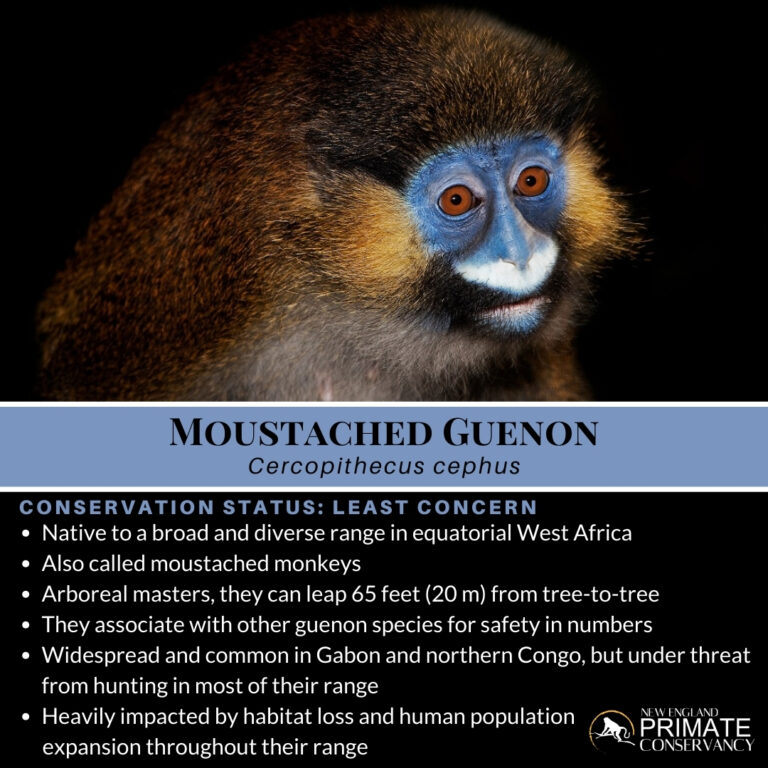
Moustached guenons are petite and slender. Their face is bare, with copper almond-shaped eyes, and the skin of their narrow muzzle, cheekbones, and the area surrounding their eyes is bluish-grey with violet undertones.
Light copper-brown hair forms a soft and subtle crown just above the marked ridge of their eyebrow line. Their head is covered in reddish-gold-speckled fur, and their dark ears point outward on each side.
A striking white strip of fur, resembling a mustache, lies under their nose and above their lips. Strands of golden fur on each side of their cheeks and the hair under their chin evoke the thick sideburns and beard of nineteenth-century gentlemen, giving these monkeys a very elegant look indeed.
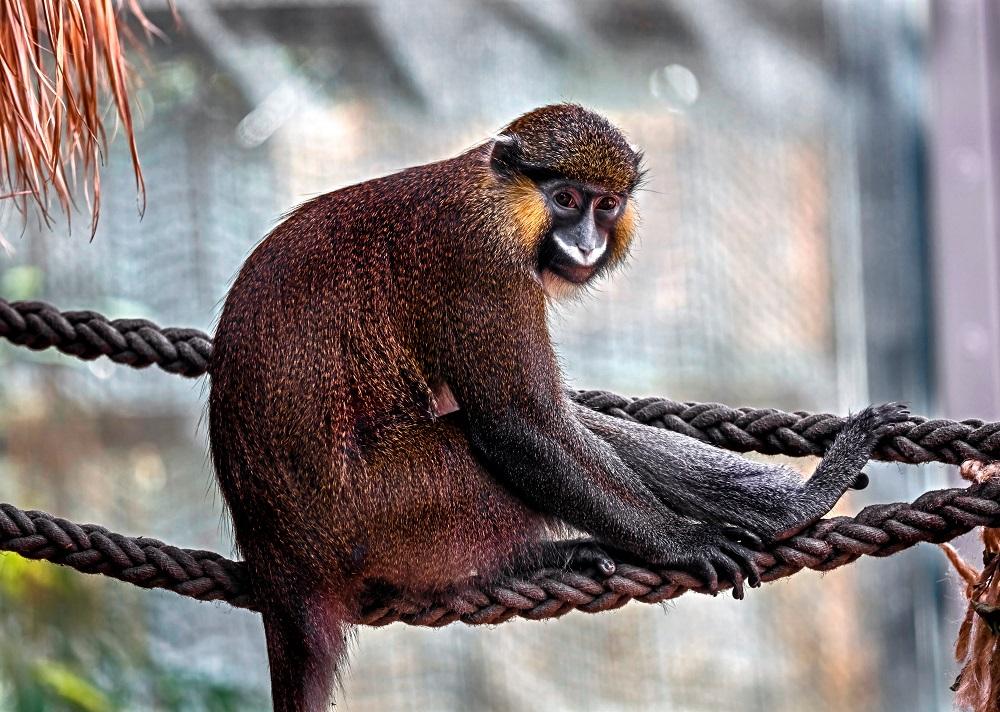
The black and reddish-gold fur covering their back, limbs, and tail matches the pattern of their fur cap. It blends in with the foliage, making these primates invisible to predators. The fur on their underside is ashen grey.
Except for a slight difference in weight and height, both males and females look alike, down to the characteristic mustache. So, rather than playing a role in gender identification, the facial markings of this species serve as visual communication and help individuals in a group stay connected.
As they walk quadrupedally or leap from branch to branch in the canopy, moustached guenons use their long tail for balance. They have hairless patches of thick skin on each side of their buttocks, called ischial callosities. Blood flow and nerves bypass this area of their rump, so these monkeys never get numb or sore and can sit still for long periods of time on the thinnest of branches while foraging.
Diet
Moustached guenons are frugivorous omnivores, which means they eat mostly fruit (83%) but also leaves, flowers, and seeds (6%), insects, nestlings, and bird eggs (13%).
They consume fruit, leaves, trees, or lianas. These guenons consistently feed on about 21 plant species belonging to the mulberry, fig, and nutmeg families, as well as flowering climbing plants.
During the dry season, they are often seen foraging in Otounga trees. These medium-sized trees produce a large number of fruit resembling black olives. They also consume the pulp of nuts from the African oil palm or the Bitter nut tree. The flesh of these nuts is rich in healthy fats that give the guenons energy.
During the rainy season, they feed on the same fruiting lianas that local people harvest for food, such as the climbing shrub or the elegant Salacia.
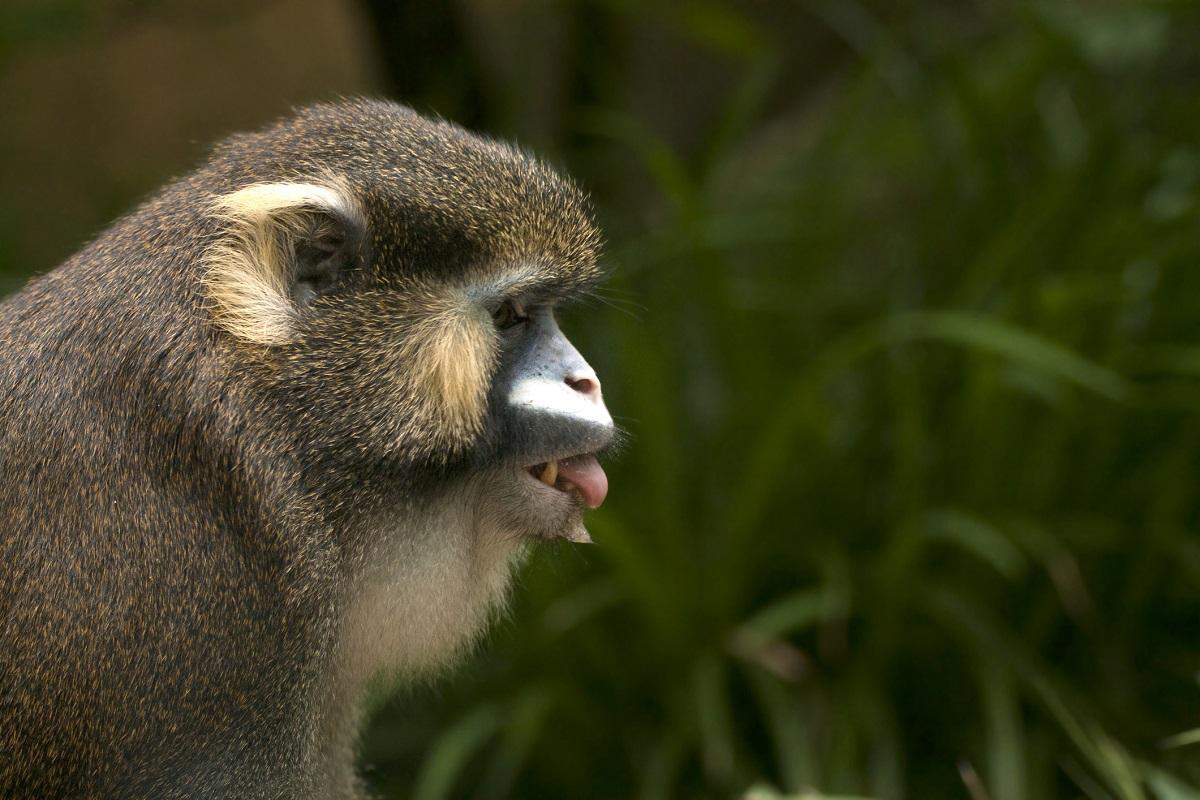
Like other guenons, moustached guenons have expandable cheek pouches located inside their mouths that extend down into the sides of their necks. These remarkable pouches can hold nearly as much food as the monkey’s stomach, allowing them to gather food quickly before retreating to a safer location to eat. This “eat and run” strategy reduces the time spent exposed to predators and competition at feeding sites. Once safely away, the guenon transfers the stored food back into its mouth to chew and swallow, maximizing feeding efficiency while minimizing risk.
Behavior and Lifestyle
Moustached guenons are arboreal. They spend most of their time in the lower canopy and dense thickets of vegetation. They travel from branch to branch by walking on their hands and feet, using their long non-prehensile tail for balance. They can also leap, jumping as far as 65 feet (20 m) between trees, which is a definite advantage when fleeing from predators.
They are diurnal and travel to foraging sites in the early hours of the day. They feed for a couple of hours, rest from noon to 2 PM, then resume their activities until about 6 PM.
Because of their smaller size, these guenons are particularly vulnerable to birds of prey. So, to hide from predators, they travel to areas of the forest with dense tree coverage. When foraging, individuals may choose to store food they cannot readily eat in their cheek pouches. These pouches are like pockets located between each jaw and cheek. These can hold almost as much food as the stomach, which is useful when there is a lot of competition at a feeding site or when an animal is in danger and needs free hands to run away quickly. When the monkeys feel safe, they can retrieve the stored food by pressing their cheek pouches and eat it peacefully.
As the sky darkens (6:30-7 PM), moustached guenons settle down for the night. They sleep in large tangles of vegetation in the mid to lower levels of the canopy. Most nocturnal predators are ground-dwelling, so sleeping high up in a tree is a good defense strategy.
The scientific name of the moustached guenon is Cercopithecus cephus. The genus name, Cercopithecus, comes from the ancient Greek words kerkos (“tail”) and píthēkos (“monkey”), meaning “tailed monkey.”
Moustached guenons are the most frugivorous, most insectivorous, and least folivorous of all the guenons.
Troops (or groups) of moustached guenons include 22 individuals on average, although in some areas they can be twice as large. Typically, one single adult male leads a community of multiple females and their offspring, a social structure known as a “harem”.
Opportunistic adult males may temporarily infiltrate the troop to woo some of the females. Their attempts at courtship may or may not be successful, and whatever the outcome, they either leave of their own accord or are chased out by females.
In some cases, an intruder may challenge the dominant male for control of the troop. Although there is no information related to the length of a dominant male’s tenure, it may be comparable to the five years documented in other guenon species.
Some other groups may consist of unattached males or bachelors. When males reach adulthood, they leave their natal troop and may band with other males until they find females of their own to procreate with.
After a good night’s sleep, members of the troop are ready for the day’s journey. If they slept in a fruiting tree, some may stuff their cheek pouches or eat a quick breakfast before departing.
The dominant male coordinates the movement of the troop starting around 5:45 AM, and by 6 AM, everyone is on the move.
They travel to foraging sites between 10 AM and noon, then again in the afternoon, which occupies about 25% of their daily budget. They stop during the warmest hours of the day, from noon to 2 PM. During this short break, they groom and play. Although it accounts for only 7% of their daily activities, social bonding is important for maintaining group cohesion.
These guenons typically select fruit trees that are 6 to 65 feet (5-20 m) high above ground level and spend most of their waking hours eating (30-40%). When they are not plucking fruit, they spend another 20% of their time searching for insects or other animal proteins. Foraging for insects occurs throughout the day, except in the morning and evening, when there is not enough light to hunt. Whatever time is left, they spend resting. They select their sleeping site around 6-6:30 PM and settle for the night in the crown of trees.
It is estimated that the home range of moustached guenons is similar to that of the Schmidt’s guenon, at around 296 acres (120 ha).
Moustached guenons intermingle with groups of other guenon species that share the various strata of their forest patch, and some cooperation takes place. For instance, when they spot an eagle, the greater spot-nosed monkeys (Cercopithecus nictitans) and the crested mona monkeys (Cercopithecus pogonias) sound the alarm, and the moustached guenons react by fleeing. In return, moustached guenons often vocalize when they find good foraging sites, which alerts other species as well.
Moustached guenons can share their habitat with at least 3 other guenon species. Though uncommon, hybrid individuals are born when members of two different species occasionally breed.
Moustached guenons communicate in many ways—through visual cues, vocalizations, and touch.
Scientists suggest that variations in color markings create elaborate patterns, or clear optical signals, that primates use to communicate. Not all facial expressions are documented or understood, but some are very clear. “Stare-downs” indicate a threat. A moustached guenon male, for instance, may bob his head up and down, raise his eyebrows and stare at another male with intensity, while retracting his scalp and grimacing with his mouth open and teeth covered, until his rival backs down.
Video analysis of moustached guenon’s head movements revealed that head “flagging” (or repeated rapid head movements) is only used in the context of courtship or for appeasement. It was also found that these movements vary across different troops and locations, thereby indicating the existence of what we may call “dialects”.
Vocalizations are another common way moustached guenons communicate. More than 20 distinct vocalizations have been described in guenons. These include calls, chirps, whistles, croaking noises, and sneezing sounds. Each vocalization has a specific purpose and meaning. Some alert of danger; others coordinate the group’s movement or keep in touch; others yet proclaim the qualities of a potential mate.
Males are known for their loud calls. These are mostly anti-predator warnings but could also advertise claims on food resources. Calls are usually low-pitched so the forest vegetation does not drown them.
Juvenile moustached guenons emit a deferential soft trilling call that oscillates in a descending pitch when they interact with adults. Both males and females emit a “ke-ke-ke” call when frightened.
A study on the structure of calls emitted by guenon species revealed that the combination of several sounds conveys the caller’s emotional state or identity, the proximity of danger, and whether a sense of urgency is present. It is therefore likely that moustached guenon calls share a similar structure and are able to convey the same type of information to members of a group.
Lastly, moustached guenons communicate through touch. They greet each other with a soft nose-to-nose rub. Other ways of establishing and maintaining social bonds include grooming and play.
Moustached guenons’ family system is polygynous, led by one adult male, several adult females, and their young. The resident male usually fathers most of the infants born within the group. However, males from outside the group may occasionally mate with receptive females before moving on, meaning that not every infant is necessarily the offspring of the resident male.
The courtship rituals of moustached guenons are simple. If a female is ready and willing to mate, she presents to the male. This occurs during the breeding season, estimated to fall between July and September. Births occur between April and November. Both mating seasons and births coincide with variations in rainfall and food availability.
Females give birth to a single infant after a gestation period of approximately six months (172 days). Mothers are the primary caregivers. Newborns are tiny and weigh less than 12 ounces (340 g). They cling to the fur on their mother’s belly for a couple of months until they are old enough to ride on her back. They nurse for one year, at which time they are considered weaned. Fathers do not play an active role in rearing their offspring, but they help protect them (and the entire troop) from predators.
Female moustached guenons typically give birth about every 2.5 years, although the interval between births can vary. Successful reproduction depends on having enough food, so females may delay becoming pregnant until environmental conditions are favorable. As a result, the timing of mating and births often coincides with seasons when food is most abundant, giving infants the best chance of survival.
Moustached guenons disperse the seeds of the fruit they eat through their feces. As such, they help spread various plant species in the forest and fertilize the soil, thereby playing an important role in the maintenance and regeneration of the forests they inhabit.
Other animals, like the long-tailed hornbill, feed on the seeds accumulated in the monkey’s droppings. So these guenons also help other species survive in the environment they share with them.
And since moustached guenons occasionally eat insects, they play a small part in insect control.
As prey, they provide food for predators like hawks and snakes.
Moustached guenons typically share resources with the mona monkeys (Cercopithecus mona), the greater spot-nosed monkeys, Schmidt’s guenons, and the red-eared guenons (Cercopithecus erythrotis). This “polyspecific association” is possible because they exploit different levels of the forest canopy and, therefore, do not compete for food.


The International Union for Conservation of Nature lists the moustached guenon as Least Concern (IUCN, 2020), appearing on the IUCN Red List of Threatened Species.
Populations of moustached guenons are widespread in Gabon and northern Congo. However, their population is patchy across the rest of their geographical distribution. Outside of protected areas, they are extremely rare in DRC, central and southern Congo, and in the forests of coastal Congo.
The species may still be present in Equatorial Guinea, but populations are small and dispersed or patchy. They are threatened and under increasing hunting pressure for local consumption and for the urban bushmeat markets in large parts of Gabon, Cameroon, the Central African Republic, and the Democratic Republic of Congo.
Adults are killed, and infants are also captured for the illegal pet trade. Because of the political situation in parts of their range and because these primates are not always easy to spot, the exact number of individuals in the wild is unknown. More field studies are needed to correctly assess and quantify threats that could lead to a change in status in the near future.
Deforestation due to logging, which creates gaps in the canopy and causes habitat loss, has been an issue for the last 30 years. The most recent statistics from Global Forest Watch indicate that between 2001 and 2024, Gabon lost 24% of its tree cover due to agriculture, logging, settlement, and road construction. During that same period, the DRC lost about 15% of its forests, with a drastic increase in 2025, including a large swathe of primary forest converted to agriculture.
Artisanal mining (non-industrial, small-scale mining) may appear to have a lower environmental impact than large industrial operations, but these activities are often poorly regulated and can result in deforestation, soil erosion, water pollution, and habitat loss. Finally, over the last few years, wildfires have emerged as a growing concern for forest fragmentation as well.
Aside from humans, the moustached guenons’ natural predators include the crowned hawk-eagles, leopards, snakes, birds of prey, and chimpanzees.
The moustached guenon is listed in Appendix II of the Convention on International Trade in Endangered Species (CITES), an international agreement between governments whose goal is to ensure that international trade in specimens of wild animals and plants does not threaten their survival.
The species is also listed in Class B of the African Convention on the Conservation of Nature and Natural Resources and in Annex B of the EU Wildlife Trade Regulations.
Moustached guenons are present in protected areas in their entire range and may still be present in the Luki Reserve in DRC. According to the most recent IUCN report, the white-nosed mustached monkey subspecies is present in the proposed Mbaere-Bodingue park in CAR, but absent from the Dzanga-Ndoki National Park and the contiguous Nouabalé-Ndoki National Park in Congo, and has not been recorded in any other protected area in that region.
Several international organizations are working closely with local government agencies to curb deforestation and create opportunities for local populations who rely on the forest for food.
The Wildlife Conservation Society (WCS) has been active in Gabon since the 1980s, and started by supporting pioneering studies of forest ecology. Its mission is to help local authorities and communities work together through education, sustainable resource management, and by supporting secure local livelihoods in and around protected areas. When communities have a stake in protecting their natural resources and access to sustainable sources of income and food, they are less likely to rely on activities such as illegal wildlife trafficking. In turn, these partnerships create the conditions needed for successful, long-term wildlife conservation.
The Nature Conservancy also operates in the region, helping with the development of sustainable forestry. Logs are now cut and transformed into furniture or parquet instead of being exported in an attempt to keep the profits generated by the sale of finished products in Gabon, for instance.
In the DRC, the ICCN (Congolese Institute for Nature Conservation) collaborates with international nonprofit organizations and local communities to oversee the management of national parks and protected areas.
Government programs aim to meet the Convention on Biological Diversity commitments, which emphasize the need to create new protected areas and restore degraded ecosystems.
The CAR has been working to establish and implement policies and legislation to address poaching, habitat destruction, and unsustainable resource exploitation. Most importantly, they have enacted the Wildlife and Protected Areas Law, which prohibits activities that harm conservation efforts. Other laws establish conservation zones that minimize land-use conflicts and promote sustainable practices among local communities.
The CAR has also made efforts to integrate traditional knowledge with contemporary conservation practices, empowering local populations to make decisions and manage natural resources. This is essential to ensure conservation efforts are successful and local populations have access to economic and social development.
The Congo and Gabon are part of the High Ambition Coalition for Nature and People—a group of countries within the UN Framework—that aims to save 30% of the world’s land and ocean by 2030.
These actions are promising, but unfortunately, regulations are routinely violated, even in protected areas, and so more effort is still needed to ensure moustached guenon populations remain stable.
- IUCN Redlist (2020)
- https://en.wikipedia.org/wiki/Moustached_guenon
- https://genomics.senescence.info/species/entry.php?species=Cercopithecus_cephus
- eol.org
- https://www.oed.com/dictionary/moustached-guenon_n?tl=true
- https://zslpublications.onlinelibrary.wiley.com/doi/abs/10.1111/j.1096-3642.1980.tb00062.x
- https://muse.jhu.edu/pub/3/oa_edited_volume/chapter/2964015
- Vegetarian diet in Guenon and Mangabey monkeys of Moukalaba-Doudou National Park, Gabon: Similarities and Differences – Lilian Brice Mangama-Koumba, Ghislain Wilfried Ebang-Ella, Etienne François Akomo-Oloue, Fred Loique Mindonga Nguelet, Bertrand M’Batchi and Jacques François Mavoungou
- Organisation spatio-temporelle des activités individuelles et sociales dans une troupe de Cercopithecus cephus – René Quris, Jean-Pierre Gautier, Jean-Yves Gautier et Annie Gautier-Hion
- Forest Structure and Fruit Availability as Complementary Factors Influencing Habitat Use by a Troop of Monkeys (Cercopithecus cephus) – Annie Gautier-Hion, Jean-Pierre Gautier, René Quris
- Vegetarian diet in Guenon and Mangabey monkeys of Moukalaba-Doudou National Park, Gabon: Similarities and Differences – Lilian Brice Mangama-Koumba, Ghislain Wilfried Eband Ella, Etienne François Akomo-Okoue, Fred Loique Mindonga Nguelet, Bertrand M’Batchi and Jacques François Mavoungou
- https://www.wisdomlib.org/names/cephus
- https://gabon.wcs.org/en-us/About/Vision-Mission-Goals.aspx
- https://www.nature.org/en-us/what-we-do/our-insights/perspectives/gabon-30-30-leading-conservation/
- https://en.wikipedia.org/wiki/Moustached_guenon
- The role of visual signals and face patterns in African forest monkeys (guenons) of the genus Cercopithecus – J. S. Kingdon
- https://www.hellabrunn.de/en/animals/world-of-monkeys/moustached-guenon
- https://univ-rennes.hal.science/tel-02166188/ – Vocal combinations in guenon communication – Camille Coye
- The Guenons – Diversity and Adaptation in African Monkeys – Mary E. Glenn and Marina Cords
- https://www.globalforestwatch.org/dashboards/
- https://news.mongabay.com/2025/11/drc-hit-by-record-deforestation-in-2024-satellite-data-show/
- https://www.wcs.org/our-work
- generisonline.com – conservation policies in the DRC protecting nature for future generations
- cafi.org
- hacfornatureandpeople.org
Written by Sylvie Abrams, July 2026