
Pygmy Tarsier, Tarsius pumilus
PYGMY TARSIER
Tarsius pumilus

Geographic Distribution and Habitat
The Indonesian island of Sulawesi is home to the pygmy tarsier (Tarsius pumilus), also known as the mountain tarsier, the lesser spectral tarsier, or the Sulawesi Mountain tarsier. Having eluded detection by scientists for about 80 years, pygmy tarsiers were thought to have gone extinct sometime during the early 20th century. Then, in May 2000, while checking rat traps they had set in the forest, scientists made a grim discovery: a dead pygmy tarsier, an unintended victim, inside one of the traps. A more sanguine discovery would happen eight years later. In August 2008, a live encounter between a research team and four pygmy tarsiers occurred on Mount Rorekatimbo in Lore Lindu National Park in central Sulawesi. Hailed as a “rediscovery,” the species’s status as extinct was officially debunked. Using mist nets, the researchers successfully captured two males and a single female, then fitted each with a radio collar to track their movements before releasing them. The fourth pygmy tarsier in the quartet eluded capture, escaping into the forest.
Mist nets are typically made of nylon or polyester mesh suspended between two poles, resembling a volleyball net. When properly deployed in the correct habitat, the nets are virtually invisible.
Because this species—scientifically classified as a prosimian (not a monkey)—was thought for many years to be extinct, pygmy tarsiers are among the least-studied primates. To learn more about them, scientists traveled to the upper montane cloud forests of the central Sulawesi Mountains, the habitat of pygmy tarsiers. They are called montane cloud forests because they are found on mountain slopes and gain their moisture from clouds and fog. Thus, montane cloud forests are colder than lowland forests in the same area. Prosimians, including the pygmy tarsier, are found at altitudes ranging from 5,906 to 7,218 ft (1,800–2,200 m) with an average elevation of 6,890 ft (2,100 m). The moss-covered conifer forests where the pygmy tarsier lives are characterized by low canopies, a lack of large woody vines, and dense undergrowth. The prosimians often reside in the lower canopy among the trunks of saplings and on the dense forest floor. Unlike lowland tropical forests, which host many species of trees and shrubs, there is far less diversity of plant life here as the conifers dominate.
The tarsier family (Tarsiidae) includes 3 genera, at least 14 species, and 7 subspecies. However, the taxonomy of the species continues to be debated.
Tarsiers are prosimians who belong to the suborder Haplorrhini, or “dry-nosed” primates, along with the true simians (monkeys, apes, including humans). Haplorrhines are considered to be less primitive than those belonging to the suborder Strepsirrhini, or “wet-nosed” primates. Strepsirrhines include lemurs, aye-ayes, lorises, and galagos (bush babies).
Haplorrhines diverged from Strepsirrhines 63 million years ago.
While strepsirrhines retained their ability to synthesize Vitamin C, haplorrhines (including tarsiers) did not. Another distinction between the two is the “disconnected” upper lip that characterizes haplorrhines, allowing for their facial expressions.
Some scientists believe that tarsiers deserve a narrower taxonomic classification, asserting that tarsiers occupy a small evolutionary branch between haplorrhine simians and strepsirrhine prosimians.

Size, Weight, and Lifespan
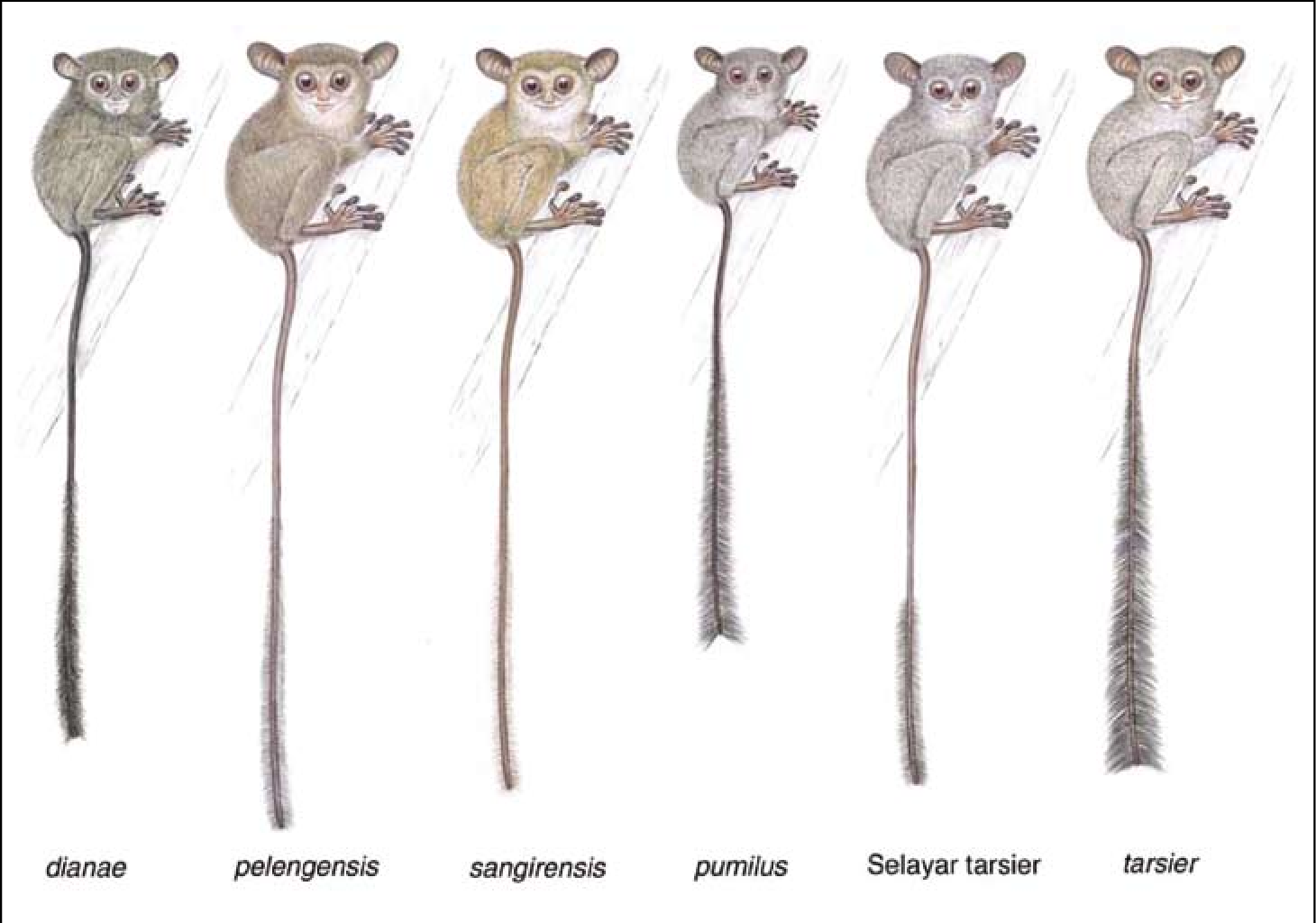
Indonesia’s tiniest primate species, the pygmy tarsier, is about the size of a small mouse or a grapefruit. Weighing less than 2 oz (57 g) and measuring less than 4 in (10 cm) from head to tail, with the tail accounting for most of this length, pygmy tarsiers are about 75 percent the size of other tarsier species. Yet, relative to their diminutive size, Mother Nature has fitted pygmy tarsiers with long limbs.
Any sexual dimorphism between male and female pygmy tarsiers is barely perceptible, with some scientific accounts suggesting that females are slightly larger.
Lifespan for these tiny primates is unknown, although scientists posit it to be between 12 and 20 years. Scientific postulation is based, in part, on the known lifespan of other tarsier species.
Appearance
Newspaper accounts heralding the rediscovery of the pygmy tarsier in 2008 describe the tiny primate as a “Furby-like” creature—a reference to the big-eyed talking gremlin toy that was all the rage in the late 1990s. Indeed, pygmy tarsiers bear a resemblance to this fad toy—but without the psychedelic pelage. Rather, a modest reddish-brown or gray-colored pelage cloaks their diminutive body. Their soft fur is longer and thicker than other tarsier species, an adaptation to the sometimes cold and wet climate of their forested montane habitat, and their long, scaly, and rat-like tail is hairless from its base to about one-third of its total length, before it turns into a furry plume. Their naked ears are faintly pink and almost translucent. A creamy patch of fur adorns the top crevice between each ear and the rounded skull.
But it’s the eyes that arrest all those who gaze upon this littlest prosimian. Large, luminous, and otherworldly, the amber-colored orbs give this diminutive, unusual-looking being the appearance of a forest spellcaster. In fact, each one of its eyes is heavier than its brain, with the enormity of the eyes also serving a more practical purpose: enhanced night vision. Unlike many other nocturnal animals, tarsiers’ eyes lack the light-reflecting layer known as the tapetum lucidum. Instead, as in human primates, their eyes are equipped with closely packed cones, or photoreceptor cells, an adaptation that gives them sharp central vision, also known as “foveal” vision. However, tarsiers are unable to move their eyes. Not to worry. A special adaptation in the vertebrae of its short neck allows the pygmy tarsier to rotate its head 180 degrees in each direction.
Pygmy tarsiers are able to wiggle their ears. And because Nature chose not to connect their upper lip to their nose, these miniature primates are capable of a wide range of facial expressions. As with all tarsiers, the pygmy tarsier has a short, dry snout.
Their small, compact bodies are fitted with short forelimbs, long hind limbs, and elongated ankles. The third finger of the pygmy tarsier is about as long as its upper arm, an adaptation for their unique clinging and leaping lifestyle. This feature, combined with sticky pads on their fingertips, allows them to grip vertical surfaces and branches with incredible strength, enabling them to move through their arboreal habitat with agility. They also have claw-like nails on each of their spindly fingers of both hands to help them with grasping moss-covered trees as they feed and move through the forest. The scaly underside of a pygmy tarsier’s tail assists in providing stability to this vertical-clinging primate, as he presses his tail against a tree trunk for support while clinging to a branch. Claws on the first and second digits of spindly toes, referred to as “grooming” or “toilet” claws, assist with grooming.
Nature has given female tarsiers two pairs of mammary glands: one set is situated at the breast, and the second set is at the groin area.

Diet
Tarsiers are the only completely carnivorous primates; you won’t find a vegan or a vegetarian in the bunch. Mostly, they eat insects and arthropods, explaining why they live at the edge of the forests where prey is more abundant. Pygmy tarsiers favor arthropods with heavily keratinized exoskeletons, such as spiders. Larger arthropods are less plentiful in the primates’ upper montane habitat. Small vertebrates are also included in the pygmy tarsier meal plan. Seasonal changes impact the types of prey they consume. Scientists believe that the pygmy tarsier’s small size may be an adaptation to its damp montane environment, which lacks a wide variety of food sources.
Another biological adaptation relates to metabolic rates. Whereas most tarsier species have a slow metabolism (causing their bodies to burn fewer calories from the foods they eat), scientists believe that pygmy tarsiers may have a high metabolism (causing their bodies to burn calories, or energy, from the foods they eat at a faster rate). The pygmy tarsiers’ high metabolic rate means that they require more caloric energy from their food.
Behavior and Lifestyle
Tarsiers are nocturnal animals (active at night) with crepuscular tendencies; that is, they are most active just before dawn or just after dusk. They are primarily arboreal (tree-dwelling).
Daylight hours are spent sleeping in dense vegetation of the forest canopy, either clinging to a tree or inside the hollow of a tree. Pygmy tarsiers do not build nests, and they prefer large trees. A scarcity of large trees in their upper montane habitat leads scientists to believe that these tiny primates may revisit sleeping sites.
Unlike many primates, the pygmy tarsier, like all other tarsiers, is typically solitary but will occasionally form mated pairs that share a territory but seldom interact.
Nodding off and head bobbing are not exclusive behaviors of human primates. Pygmy tarsiers have been observed dropping their head downward between their shoulders as they sleep. Upon waking, they furl and unfurl their ears. Think of this activity as a big morning stretch—except using ears instead of arms!
Thanks to their long hind limbs (a morphological adaptation), tarsiers are amazing leapers, and pygmy tarsiers are no exception. Their frog-like leaps take them as much as 5.6 ft (1.7 m) from tree to tree and upward almost 2 ft (0.6 m) vertically. As they leap, they carry their long tail arched over their back.
The species name “tarsier” refers to the primates’ elongated tarsus bone, a cluster of seven articulating bones in each foot. The genus name Tarsius also refers to this physical trait. When on the ground, tarsiers hop… rather than walk.
Tarsiers are extremely shy animals who fare poorly in captivity. They are sensitive to bright lights, loud noises, and physical contact. They are easily stressed and have been known to harm themselves—even kill themselves—by banging their head against the bars of their caged enclosure. Instances of “tarsier suicide” with captive Philippine tarsiers (Carlito Syrichta) have been reported.
The pygmy tarsier can jump 40 times its body length, leaping up to 16.5 feet (5 meters) in a single jump.
Tarsiers are the only exclusively carnivorous primates.
Pygmy tarsiers have proved challenging to scientists trying to study them in the wild. Little information is available about family composition and group dynamics, beyond the group that scientists rediscovered in 2008: comprised of two adult males, one adult female, and the individual who eluded being captured in the mist net. Contrast this group composition to Sulawesi’s lowland spectral tarsiers (Tarsius tarsier), who typically live in family groups of one adult male, one to two adult females, and their offspring. (Pygmy tarsiers were once regarded as a subspecies of spectral tarsiers.)
Scientists think that the group composition of pygmy tarsiers may be influenced by the ecological constraints of their high-altitude montane habitat. They further suspect that the population density of pygmy tarsiers may be significantly lower than that of other tarsiers. As example, during a three-month survey that included 60 nights of attempted trapping, only three individual pygmy tarsiers were found. Contrast to another three-month survey, when 100 spectral tarsiers were observed.
Because pygmy tarsiers have proved so difficult to track, little is known about their home range. Females are thought to have a home range of at least 3 acres (1.2 ha); the possible home range for males, who are more elusive than the females, is not documented. Males and females are believed to have different travel patterns.
Tarsiers spend a lot of time scanning for prey from low positions on tree trunks. Their wide field of vision is facilitated by their ability to rotate their head 180 degrees in each direction. They capture ground prey by leaping from tree trunks onto the body of an unsuspecting target. Biting down with their front teeth, they kill their prey, then chew its fresh carcass using a side-to-side motion until they’ve eaten the entire body.
Relative to pygmy tarsiers’ small size, the prey they consume is large. Pygmy tarsiers wash down these large meals by lapping water.
A wide field of vision is also helpful in scanning for predators. Pygmy tarsiers are tasty morsels to Sulawesi’s raptors, and the open canopy of upper montane forests leaves the tiny primates vulnerable to raptor attacks.
Should they detect a predator, particularly when startled awake from slumber, pygmy tarsiers clamber up and down the tree where they had been sleeping, baring their teeth as they face their threat—probably not much intimidation to a large bird of prey.
Unlike other tarsier species (and unlike the talkative Furby toys to which they have been compared), pygmy tarsiers are far less vocal. They are not conversationalists. Should they see a predator, they may emit an alarm call. However, if the predator is near their sleeping sites, these prosimians have been found to remain silent.
Nor are pygmy tarsiers known to frequently engage in male-female duets and family choruses, common to other lowland tarsier species, such as Wallace’s tarsier (Tarsius wallacei).
Although it appears that pygmy tarsiers have little to say to one another, scientists speculate that these tiny primates might be emitting high-pitched frequencies, heard by one another but undetectable to the human ear. It’s possible that the heavy fog and thick moss of the primates’ upper montane habitat hinders sound travel.
Some scientists suggest that pygmy tarsiers are territorial, like their spectral tarsier “cousins.” Spectral tarsiers actively chase intruders from their home range. However, spectral tarsiers are also known to use urine scent-marking to deter intruders, a practice that pygmy tarsiers do not follow.
Scientists who take an opposing view posit that a lack of vocalizations at boundary areas, coupled with a lack of scent marking, suggests that pygmy tarsiers are less territorial than spectral tarsiers. Or, it could be that pygmy tarsiers use other means of communication, unknown to field researchers, to claim their territory. Another possibility is that any scent deposits are quickly washed away, down the mountainside, by heavy rainfall.
Grooming is an important tactile activity among pygmy tarsiers (as it is with most nonhuman primates) that helps to instill social bonds with one another.
Their elusive nature and possibly low population numbers have kept the reproductive behavior and family life of pygmy tarsiers a bit of a mystery to scientists. Much of what is suggested is based on other tarsier species, particularly the spectral tarsier.
As a member of the same genus and as their closest geographic neighbor, spectral tarsiers are usually monogamous. A bonded adult pair mates twice annually: at the beginning of the rainy season and six months later at the rainy season’s end. Gestation (pregnancy) lasts about 178 days (or about six months), culminating in the birth of a single infant. Births occur during May, and again from November to December.
Infants are born fully furred and with open eyes. They continue to quickly develop. Within one day of being born, they are able to climb. At one month old, they can leap. At 42 days of age, young tarsiers are able to capture their own prey. Shortly thereafter, they are considered weaned.
Tarsiers reach sexual maturity (able to conceive and reproduce) by the end of their second year.
Young females remain with their parents until they become adults, while young male tarsiers leave their birth group as juveniles.
For clues into child-rearing, researchers again look to spectral tarsiers. With spectral tarsiers, mothers are the primary caregivers. Subadult females in a group may relieve a mother by providing allocare to her infant, but adult and subadult males rarely offer such help.
As insectivores, pygmy tarsiers help to keep the structure of insect populations in balance within their environment. Their diet impacts local food webs (interdependent food chains), and they, themselves, are prey for diurnal raptors.
Of course, pygmy tarsiers’ true role within the web of life that we share with them, as earth citizens, is unto themselves—designed by Nature and not scripted by humans or for human benefit.


Pygmy tarsiers are classified as Endangered by the International Union for Conservation of Nature (IUCN 2015), appearing on the IUCN Red List of Threatened Species.
They have a small area of occupancy and are known from only two isolated locations. In addition, the species is likely undergoing a decline in the quality of its habitat from expanding human settlements.
Because of the fairly recent “rediscovery” of pygmy tarsiers and the tiny primates’ remote location and fragmented populations, scientists have been unable to exhaustively study the species. Its distribution is, in all likelihood, restricted to isolated mountain tops; it is known to occur in only two isolated locations.
One threat to these habitats is the encroachment of human populations into montane regions to satisfy the needs of a growing human population. The destruction of montane forests in more densely populated South Sulawesi indicates that this fate may well be in store for Central Sulawesi’s montane forests as the human population expands.
Some areas of Central Sulawesi near known pygmy tarsier sites are conflict zones, where factional fighting has seen the dislocation of large human populations that are then resettled in refugee camps. The primates are unintended victims, casualties of human conflict.
Lastly, the growing of annual and perennial non-timber crops through agriculture and aquaculture endangers the pygmy tarsier through habitat destruction and fragmentation, increased human presence, and potential exposure to agricultural pollutants. The conversion of natural forest habitats to agricultural land reduces the area available for tarsiers, while increased human activity disrupts their behavior and leads to hunting or accidental harm.
Pygmy tarsiers, like all tarsier species, are listed in Appendix II of the Convention on International Trade in Endangered Species (CITES), an international agreement between governments whose goal is to ensure that international trade in specimens of wild animals and plants does not threaten their survival.
Scientists calling for the species’s conservation status to be reclassified as Endangered cite projected disturbances to pygmy tarsier habitat and the need for further study of the primates’ true distribution throughout their isolated mountaintop range.
Those pygmy tarsiers residing in Sulawesi’s Lore Lindu National Park are afforded some protections. They also likely receive some protection on Mount Rantemario. However, greater protections are necessary throughout the primates’ range if we are to ensure their survival in our world.
- https://www.iucnredlist.org/species/21490/9288636
- http://www.theprimata.com/tarsius_pumilus/
- http://pin.primate.wisc.edu/factsheets/entry/tarsier
- https://animaldiversity.org/accounts/Tarsius_pumilus
- http://animalia.bio/pygmy-tarsier
- https://www.unl.edu/rhames/courses/ppoint/heat-110.pdf
- http://citeseerx.ist.psu.edu/viewdoc/download?doi=10.1.1.594.7936&rep=rep1&type=pdf
- https://pajamadeen.com/animals/tiny-primate-thought-extinct-found-in-indonesia
- http://www.softschools.com/facts/animals/tarsier_facts/243
- https://en.wikipedia.org/wiki/Pygmy_tarsier
- https://thegoodtrip.ph/posts/tarsiers
- https://www.nbcwashington.com/news/archive/Real-life_Furbys_rediscovered/ https://kreuzer33.wordpress.com/2008/11/18/real-life-furbys-discovered-in-indonesia
- www.nbcnews.com/id/27786771/ns/technology_and_science-science/t/real-life-furbys-rediscovered/#.XY-Dw3dFwac
- https://en.wikipedia.org/wiki/Furby
- https://animalia.bio/montane-forest
- https://en.wikipedia.org/wiki/Pygmy_tarsier
- https://www.youtube.com/watch?v=pgo14umnNV0
- https://www.youtube.com/watch?v=6Jz0JcQYtqo
Written by Kathleen Downey, Oct 2019. Updated by Brenda Awuor, Jul 2025.