
Peleng Tarsier, Tarsius pelengensis
PELENG TARSIER
Tarsius pelengensis
Geographic Distribution and Habitat
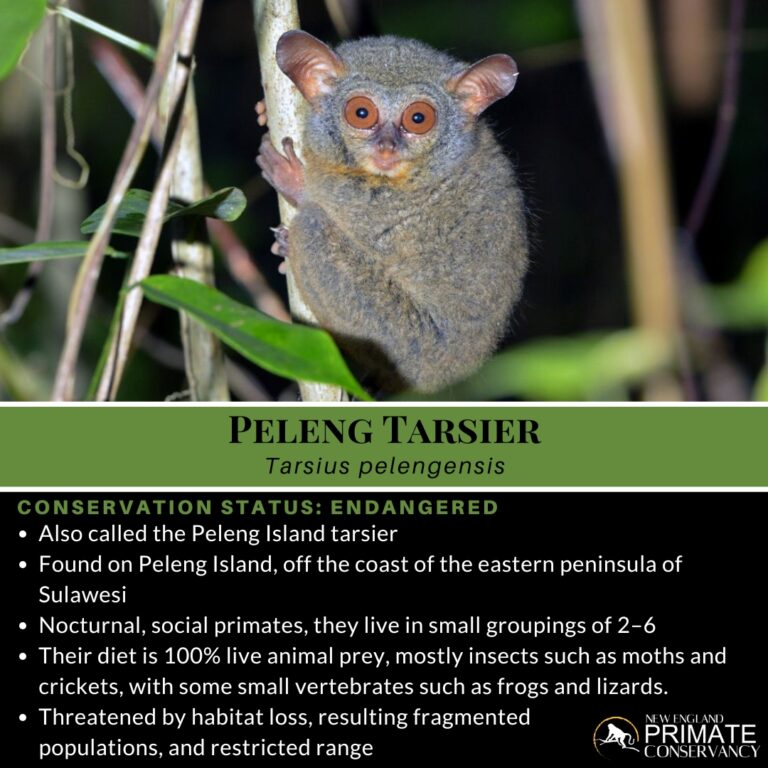
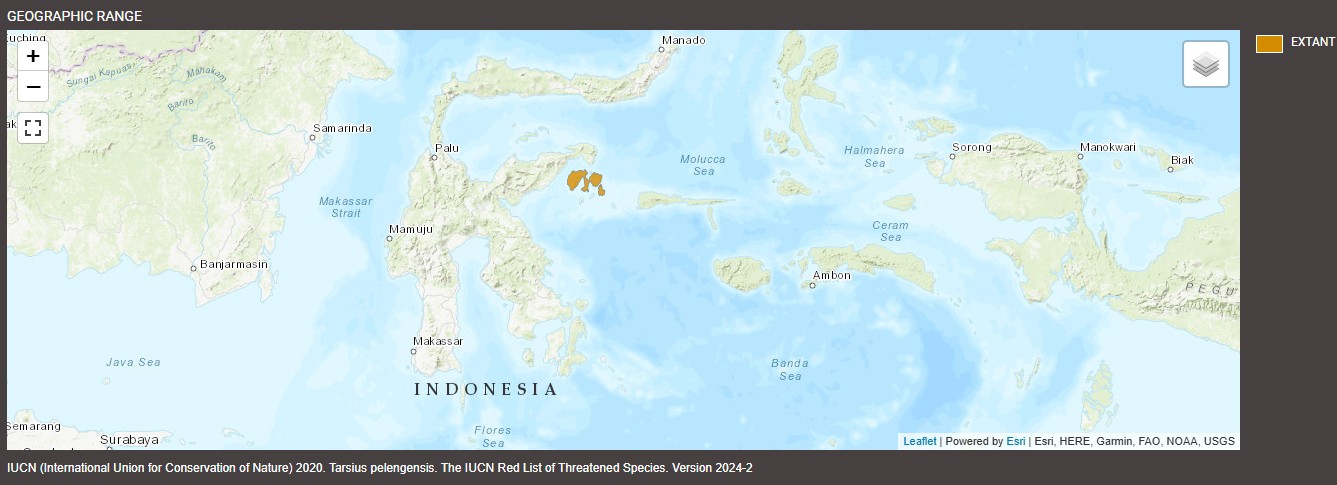
Peleng tarsiers are found only in Indonesia, specifically on Peleng and Banggai Islands, part of the Banggai Archipelago off the coast of Central Sulawesi. These primates are adapted to living in mangrove forests, which grow along flooded coastlines and in lowland forests. They have also been seen in gardens where human activity has spread into their natural habitat. Peleng tarsiers are considered sub-canopy dwellers. However, they stay higher in the trees than other tarsier species, usually between 10 and 32 feet (3 to 10 meters) above the ground.
The primate family Tarsidae and the genus Tarsius have undergone several taxonomic revisions, with significant updates as recently as 2010, when more tarsier species were distinguished from the previously broad classification of the Spectral tarsier (Tarsius spectrum). Taxonomic studies showed that many island-separated tarsier populations were distinct enough to warrant classification as separate species. The Peleng tarsier was once classified as a subspecies of Tarsius fuscus pelengensis and later of Tarsius spectrum pelengensis. Today, the Peleng tarsier is recognized as a monotypic species, Tarsius pelengensis, reflecting its restricted geographic range.
Tarsiers are, somewhat controversially, categorized as prosimians who share the suborder Haplorrhini with their dry-nosed simian cousins: monkeys, apes, and humans. Haplorrhines are considered to be less primitive than their prosimian cousins belonging to the suborder Strepsirrhini, or “wet-nosed” primates. While strepsirrhines retained their ability to make Vitamin C, haplorrhines (including tarsiers) did not. Another distinction between the two is the “disconnected” upper lip that characterizes haplorrhines, allowing for their facial expressions. Some scientists believe that tarsiers deserve a narrower taxonomic classification, asserting that tarsiers occupy a small evolutionary branch between haplorrhine simians and strepsirrhine prosimians.
Size, Weight, and Lifespan
Pelang tarsiers are relatively large for the genus, measuring 4.5-5.5 inches (12 to 14 cm) from their head to the base of their tail. Their long tails are about twice as long, around 10 inches (25 to 27 cm). The measurements of these species have been obtained from museum specimens, so weights have not been officially recorded or published. Closely related species weigh between 5 and 5.3 ounces (143-150g).
The oldest recorded age of a captive tarsier is 16 years, and it is assumed that Peleng tarsiers can live just as long. However, lifespans in the wild are typically shorter due to added pressures such as finding food in unpredictable environments and the constant threat of predators.
Appearance
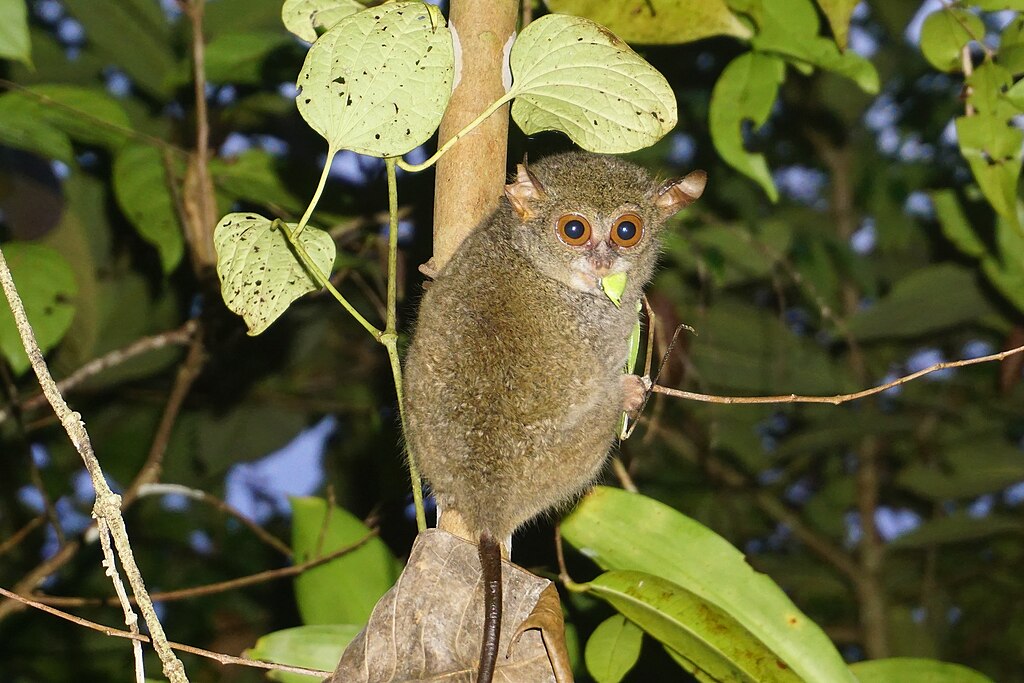
Peleng tarsiers are larger tarsiers than those of other species, with a dark brown coat and pale, whitish thighs. Their tail is long but relatively less furred than the rest of their body. Tarsiers have enormous eyes that stare out of small faces as they cling vertically to trees with large hands and feet. They also have large, rounded ears that protrude and constantly twitch as they listen for prey and predators. They can turn their heads almost 360 degrees around their spine, giving them an exceptional view behind them as they vertically cling to trees.
Tarsius, from the Latin word for ankle (“tarsus”), was inspired by the long leg bones that help these tiny primates leap many times their body length. Their muscular legs account for approximately a quarter of their total body weight.
Tarsiers have flat nails on all their digits except for the second and third toes, which have a curved grooming claw. They use these grooming or “toilet claw” to scratch dirt and pests from their fur.

Diet
Tarsiers are strictly carnivorous and depend entirely on animal protein for their nutrition. They mainly eat insects like moths, beetles, and crickets, but will also catch small vertebrates such as lizards and frogs. Their molars have large cusps that help crush the tough exoskeletons of their insect prey. This high-protein diet is essential for keeping their leg muscles strong, which they need for their active, leaping way of life.
Behavior and Lifestyle
Tarsiers are nocturnal (active at night), arboreal (tree-dwelling), and social primates.
If you’ve ever seen a dog or cat at night, you might have noticed how their eyes seem to “shine” in the dark. This phenomenon, known as “eye shine,” is common in nocturnal animals and is caused by a thin layer of tissue in the eye called the tapetum lucidum. This layer reflects light from the moon or a flashlight through the retina, enhancing night vision. Surprisingly, tarsiers lack this reflective layer and instead rely on the sheer size of their enormous eyes, which have a large fovea that contains many light-sensitive cells. A tarsier’s eyes are so large that each eyeball is bigger in volume than its brain. At night, tarsiers can fully dilate their pupils to let in as much light as possible, making the most of even faint moonlight and starlight. When fully dilated, a tarsier’s eye appears almost entirely black, with only a thin outline of the brown iris visible.
The tarsier’s large hands and long legs are perfectly adapted for life in the tree canopy. Their fingers are long, with flattened pads at the tips that help grip most surfaces. Although their thumbs are not opposable (they can’t rotate to touch the fingertips), their big toes are opposable and wide enough to anchor them to tree branches securely. Tarsiers predominantly move using a style called vertical clinging and leaping (VCL), where they rely on their long legs to generate a powerful burst of energy, to launch themselves off one tree and extend their arms mid-air before gripping their target with long fingers. Their long tail trails behind them as they leap, providing some counterbalance. Their strong thigh muscles allow them to leap an average of 4.6 feet (1.4 meters)—about nine times their body length! That’s like a 5.5-foot-tall human jumping a distance of 50 feet!
They also move quadrupedally (on all four limbs) and hop bipedally (using two legs) when they need to travel short distances.
Peleng tarsiers appear less social than other tarsier species, often in small family groups of just 2 to 7 individuals. These groups are closely bonded and spend their nights actively foraging in the forest canopy, hunting insects and small animals. During the day, they rest together in sleeping sites hidden in thick vegetation or inside tree holes, where they cluster for warmth and safety. Depending on environmental conditions, such as the presence of predators or heavy rainfall, they can change their sleeping sites each night and typically have three to five alternate locations. Although small, Peleng tarsiers are highly vocal and bold when faced with danger. If they detect a predator, such as a snake, they sound loud alarm calls and engage in a behavior known as mobbing. In mobbing, multiple individuals, sometimes even from different species, take turns approaching and harassing the predator to drive it away. This strategy alerts other animals in the area, uses group effort to overwhelm the threat, and often forces the predator to abandon the hunt.
Tarsiers are territorial, and males often patrol the edges of their home range to keep out other males. If a territorial male encounters an intruder, he will vocalize aggressively and actively chase the intruder away.
Peleng tarsiers sing duets at dawn, just before sleeping.
They are highly adaptable primates capable of living in secondary forests and gardens.
They are one of the larger tarsiers in the region.
Peleng tarsiers live in relatively small groups of 2-7 individuals.
As nocturnal primates, tarsiers begin their day just after sunset. They wake up at their sleeping sites and vocalize to gather the family before heading out to forage. More than half of their active time is spent traveling and hunting for prey. They take short breaks (about 15% of their active time) to groom themselves using their specialized grooming claws. Since they sleep in groups, the chance of spreading pests like fleas and ticks is high, so grooming is essential in keeping clean. Family members sometimes groom each other, a behavior called allogrooming. This not only removes pests but also gives the groomer an easy snack.
Tarsiers’ movement patterns can shift with the seasons, with less traveling during the rainy months. Male Peleng tarsiers travel farther than females since they are responsible for patrolling their territory and keeping out intruders. A single male may share overlapping home ranges with multiple females in polygynous groups. On average, males have a home range of about 24.7 acres (10 hectares), while females have slightly smaller ranges, around 19.7 acres (8 hectares).
Vocalizations are a significant form of tarsier communication. You can see a tarsier’s ears in constant motion, twitching like tiny satellite dishes as they scan for sounds across a wide frequency range. Many tarsier species produce species-specific calls that researchers can use for identification and classification. However, vocal behavior in Peleng tarsiers remains poorly studied, and there is not yet enough data to determine if their calls are distinct from those of other species.
Studying tarsier vocalizations poses challenges because they communicate not only in audible ranges but also in the ultrasonic spectrum (above 20 kHz), beyond the hearing capabilities of humans. This includes brief, high-frequency calls used in close-range communication and predator alerts. Among the vocalizations that humans can hear, the most recognized are vocal duets. These duets consist of coordinated, patterned sequences exchanged between a male and female, often used to reinforce pair bonds or signal territory occupancy. In Peleng tarsiers, duets are most frequently heard at dawn, just before the group returns to its sleeping site.
Tarsiers use some chemical signals to share important information like mating status, who they are, and which group they belong to. They leave scent marks, using urine and special secretions from glands on their chests and genitals. This helps them tell the difference between males and females, recognize family members, and spot rivals or strangers in their area. This communication method is called olfactory signaling and is common in many primates, especially prosimians. However, tarsiers rely more on vocal and visual signals rather than smell. Tarsiers are the only dry-nosed prosimian primates. Most prosimians, like lemurs, lorises, and galagos, have moist noses (like cats and dogs), which provide them with a highly developed sense of smell. Like simian primates, which are monkeys and apes (including humans), tarsiers’ noses are dry. Because of this, they rely more heavily on vision and sharp hearing for their nighttime activities than they do on scent.
Peleng tarsiers are often seen in pairs and can be either monogamous (one male and one female) or polygynous (one male with multiple females). They live in small family groups, usually made up of 2 to 7 individuals, including adult pairs and their young.
Not much is known about the specific mating behaviors of Peleng tarsiers. In general, tarsier mating involves vocalizations like chirping and behaviors such as genital sniffing before the male mates with the female. When a female tarsier is in estrus (when she is hormonally ready to become pregnant), her urine contains reproductive hormones that can signal nearby males to mate. Once a male detects this hormone, he stays close to the female and remains with her to mate. In some tarsier species, the male continues to stay near the female throughout her pregnancy and even after birth. This behavior helps protect the infants from intruding males, who may attempt to kill them—a behavior known as infanticide, by which an intruding male can cause the female to return to estrus and become ready to mate again, increasing his own chances of fathering her next offspring.
The gestation period (the time a female is pregnant) lasts about 5 to 6 months. Typically, a single infant is born weighing around 1 ounce (28 grams), about 20% of an adult’s body weight. Mothers usually carry their babies clinging to their bellies. Still, if they need to leap across large or risky gaps, they may carry them in their mouths instead. Newborns are born with fur and open eyes and can crawl a little, but they aren’t strong enough to leap until they are at least a month old.
In other tarsier species, mothers often “park” their infants, leaving them in a safe spot while they forage. However, this behavior has not yet been observed in Peleng tarsiers.
Peleng tarsiers play an essential role in maintaining the balance of their forest ecosystems. As insectivores, they help control populations of insects like moths, beetles, and crickets, many of which feed on plants. By keeping insect numbers in check, tarsiers indirectly support the health of the forest vegetation. In turn, tarsiers serve as prey for larger animals such as pythons, civets, and owls. This makes them a key part of the food chain, maintaining the energy flow through the ecosystem and supporting biodiversity.


The International Union for Conservation of Nature lists the Peleng tarsier as Endangered (IUCN, 2015), appearing on the IUCN Red List of Threatened Species.
Habitat change is the most immediate threat to the Peleng tarsiers. Human agriculture has heavily impacted the ecology of the Indonesian islands. One standard method of clearing land for farming is setting fires, which temporarily creates nutrient-rich soil. However, these fires destroy wildlife habitats and often kill animals. The soils also lose their nutrients quickly, and eventually farmers must rely on fertilizers to continue growing crops. Eventually, the land is abandoned, and a new section of forest is burned, causing more widespread damage to the ecosystem.
Despite these changes, Peleng tarsiers are more adaptable than previously thought. They have been found living in secondary forests, which regrow after fire, and in human-disturbed areas like gardens. This flexibility helps them survive in changing environments, unlike species that depend entirely on undisturbed primary forests. Because of this adaptability, some experts believe that the conservation status of Peleng tarsiers could be downgraded to “Vulnerable.”
The Peleng tarsier is listed in Appendix II of the Convention on International Trade in Endangered Species (CITES), an international agreement between governments whose goal is to ensure that international trade in specimens of wild animals and plants does not threaten their survival.
There are no protected areas on Peleng Island that offer undisturbed habitat for the Peleng tarsier, and they are not currently protected by national or international laws. Small, community-led projects funded by external grants have progressed in documenting sightings and promoting local conservation efforts. However, given how little we know about the ecology of Peleng tarsiers, it’s clear that more research is needed to better understand and protect these unique primates.
- Ankel-Simons, F. (2007). Brain. Primate Anatomy (Third Edition), 199-222. https://doi.org/10.1016/B978-012372576-9/50008-5
- Fleagle, J. G. (2013). The Prosimians: Lemurs, Lorises, Galagos and Tarsiers. Primate Adaptation and Evolution (Third Edition), 57-88. https://doi.org/10.1016/B978-0-12-378632-6.00004-5
- Groves, C. and Shekelle, M., 2010. The genera and species of Tarsiidae. International Journal of Primatology, 31, pp.1071-1082.
- Indrawan, Mochamad & Syahrullah, Fakhri & Maddus, Un & Gursky, Sharon & Kartawinata, Kuswata. (2022). From the Heart of Wallacea: The Endangered Peleng Tarsier Tarsius pelengensis. 10.1016/B978-0-12-821139-7.00212-9.
- Nowak, R.M., 1999. Walker’s Primates of the World. JHU Press.
- Russell A. Mittermeier, Anthony B. Rylands & Don E. Wilson, 2013, Tarsiidae, Handbook of the Mammals of the World – Volume 3 Primates, Barcelona: Lynx Edicions, pp. 236-242 : 240
- Russell A. Mittermeier, Anthony B. Rylands, Don E. Wilson (2013): Tarsiidae. In: Handbook of the Mammals of the World – Volume 3 Primates. Barcelona: Lynx Edicions: 236-242, ISBN: 978-84-96553-89-7, DOI: http://doi.org/10.5281/zenodo.6631893
- Shekelle, M. 2020. Tarsius pelengensis. The IUCN Red List of Threatened Species 2020: e.T21494A17977515. https://dx.doi.org/10.2305/IUCN.UK.2020-3.RLTS.T21494A17977515.en. Accessed on 30 May 2025.
- Syahrullah, F.N., Maddus, U., Mustari, A.H., Gursky, S. and Indrawan, M., 2023. Distribution and abundance of peleng tarsier (Tarsius pelengensis) in Banggai Island group, Indonesia. Scientific Reports, 13(1), p.11445.
Written by Acima Cherian, June 2025