
WHERE PRIMATES LIVE
WHERE PRIMATES LIVE

Activities for understanding where primates live and the importance of preserving and protecting their natural habitats
Where in the world do nonhuman primates live? They inhabit some of the most biologically rich and diverse ecosystems in the world—ecosystems that supply most of the Earth’s oxygen, including the oxygen that you and I breathe in every moment, no matter where in the world we live.
As indicator species of the health of their ecosystems, if nonhuman primates are at risk, so are all other species with whom they share their ecosystems…ultimately putting us all at risk. Protecting one species protects many.
In this lesson, the video is the inspiration piece. It takes you on a tour of the world’s continents to learn where the habitats of nonhuman primates naturally occur and which species live in each region. The video and lessons promote discussion and understanding of the need to preserve and protect natural habitats and those who live in them.
Have fun while learning!
WATCH THE VIDEO
Five activities bring you on a journey to discover where in the world primates live and why we need to preserve and protect their natural habitats. Students can work in teams or individually.

Who and What Are Primates?
Primates are mammals that typically have large highly developed brains, forward-facing color vision, flexible hands and feet with opposable thumbs, and fingernails. (Typically, but not always.)
Primates have slower developmental rates than other similarly sized mammals, reaching maturity later in life, but with longer overall lifespans than many similarly-sized species.
With the exception of humans, who live throughout the globe, most primates live in tropical or subtropical regions. But don’t be fooled. Some also live in semi-deserts, alongside swamps, in cold mountainous regions, on rocky cliffs, or in cities.
Are all primates monkeys? NO!
Are all monkeys primates? YES!
Did you know that you are a primate? In fact, you are a great ape.
So, if all primates are NOT monkeys, who and what are primates?
Watch, Think, Explore
- On which three continents or regions are nonhuman primates naturally found today?
- If nonhuman primates are found naturally in only certain parts of the world, how did they get to the places where they live today? Give two examples from the video.
- Where are nonhuman great apes found? Where are small apes, or gibbons, found?
- Where are tarsiers found, and what makes them unusual among primates?
- Madagascar is about 250 miles (400 km) from mainland Africa. How are the ancestors of today’s lemurs thought to have reached the island?
- What evidence supports the theory that the monkeys of Latin America descended from African monkeys?
- The video shows that not all primates live in tropical rainforests. Name at least four other kinds of habitats where primates live.
- How can where a primate lives influence its physical or behavioral adaptations? Give an example from the video.
- Why can living on an island make a primate species especially vulnerable when its habitat is destroyed or it is heavily hunted?
- The video ends by saying that humans need to “share space with wildlife and leave space for wildlife.” Based on what you learned in the video, why is coexistence important for primates, people, and ecosystems?
Here are a few definitions to help.
Genus (plural, genera): A biological classification, or ranking, of living beings that includes a group(s) of species that are structurally similar or “related” to one another through evolution.
Placental Mammals: Any member of the mammal family characterized by the presence of a placenta, which facilitates exchange of nutrients and wastes between the blood of the mother and that of the fetus.
Opposable thumb: A thumb that can be placed opposite the fingers of the same hand. Opposable thumbs allow the digits to grasp and handle objects and are characteristic of primates.
Primates live in different parts of the world—and where they live can tell us a lot about them.
Monkeys native to Latin America and monkeys native to Africa and Asia have been separated for millions of years. Over time, they evolved different physical characteristics and adaptations to life in their environments.
Take a look at the characteristics below. What similarities and differences do you notice? And what might those differences tell you about how these primates live?

- Found from southern Mexico to Central and South America, except in desert regions, coldest ecosystems, and the highest mountains
- They mostly inhabit tropical rainforests
- Their noses are flatter and nostrils are further apart and side-facing, that is, pointing outward rather than downward
- Most have 36 teeth
- They are smaller-bodied and more slender with long narrow hands
- Their thumbs, when present, are not opposable
- Most have prehensile or partially prehensile tails
- Many lack trichromatic vision, sometimes based on gender within a species
- Most are arboreal, some living so high in the canopy that studies of their behaviors and lifestyles are limited (because humans can’t effectively observe them)
- Some live in small monogamous family groups; some live in troops of up to 500 individuals
- They include the only nocturnal monkey and the world’s smallest monkey
- They descend from African simians that colonized South America about 35 million years ago
- Include capuchin monkeys, howler monkeys, marmosets, muriquis, night monkeys, saki monkeys, spider monkeys, squirrel monkeys, tamarins, titis, woolly monkeys, and uakaris
- No nonhuman apes are endemic to the Americas
- No tarsiers or strepsirrhines are endemic to the Americas

- Found throughout Africa, except the most arid deserts, and in southern Asia, with a few species as far north as Japan and the mountains of China
- They inhabit a wide variety of ecosystems including tropical rainforests, savannas, shrublands, and cold mountains
- Their nostrils are close together and tend to point downward
- They have 32 teeth
- Most are medium to large monkeys and include the largest of the world’s monkeys
- Most have opposable thumbs
- Their tails are never prehensile
- Many species have cheek pouches to hold food, and many have thick pads (ischial callosities) on their buttocks
- Some are arboreal, some terrestrial, and some both (referred to as semi-terrestrial)
- Most have trichromatic vision
- They are more closely related to the apes and, therefore, humans than they are to the American monkeys
- Include baboons, colobus monkeys, drills, geladas, green monkeys, grivets, guenons, kipunjis, langurs, leaf monkeys, macaques, malbroucks, mandrills, mangabeys, langurs, patas monkeys, proboscis monkeys, snub-nosed monkeys, surilis, swamp monkeys, talapoins, tantalus monkeys, and vervets
- All apes are found in Afro-Eurasian regions of the world
- Tarsiers are found in Asia
- Strepsirrhines are found in Afro-Eurasian regions
Compare and Explore
- What characteristics do American monkeys and Afro-Eurasian monkeys have in common?
- What are some of the physical differences between American monkeys and Afro-Eurasian monkeys?
- Compare their noses. What differences do you notice in the shape and position of their nostrils?
- How are their tails different? Are there exceptions to the general pattern?
- What is a prehensile tail, and how might having one be useful to a primate living in the trees?
- Look at the information about hands and thumbs. What differences do you notice, and how might those differences affect the way a primate moves or finds food?
- Based on what you’ve learned, why wouldn’t a single characteristic—such as having a tail—always be enough to tell you whether a monkey is from Latin America or Africa and Asia?
- Imagine you discover a monkey you’ve never seen before. What physical characteristics would you examine for clues about where in the world it naturally lives? Explain your reasoning.
Here are a few definitions to help.
Opposable: Capable of being placed opposite to something else.
Prehensile: Adapted for seizing, grasping, or taking hold of something.
Cheek pouches: A sac in the cheek of certain animals in which food may be carried.
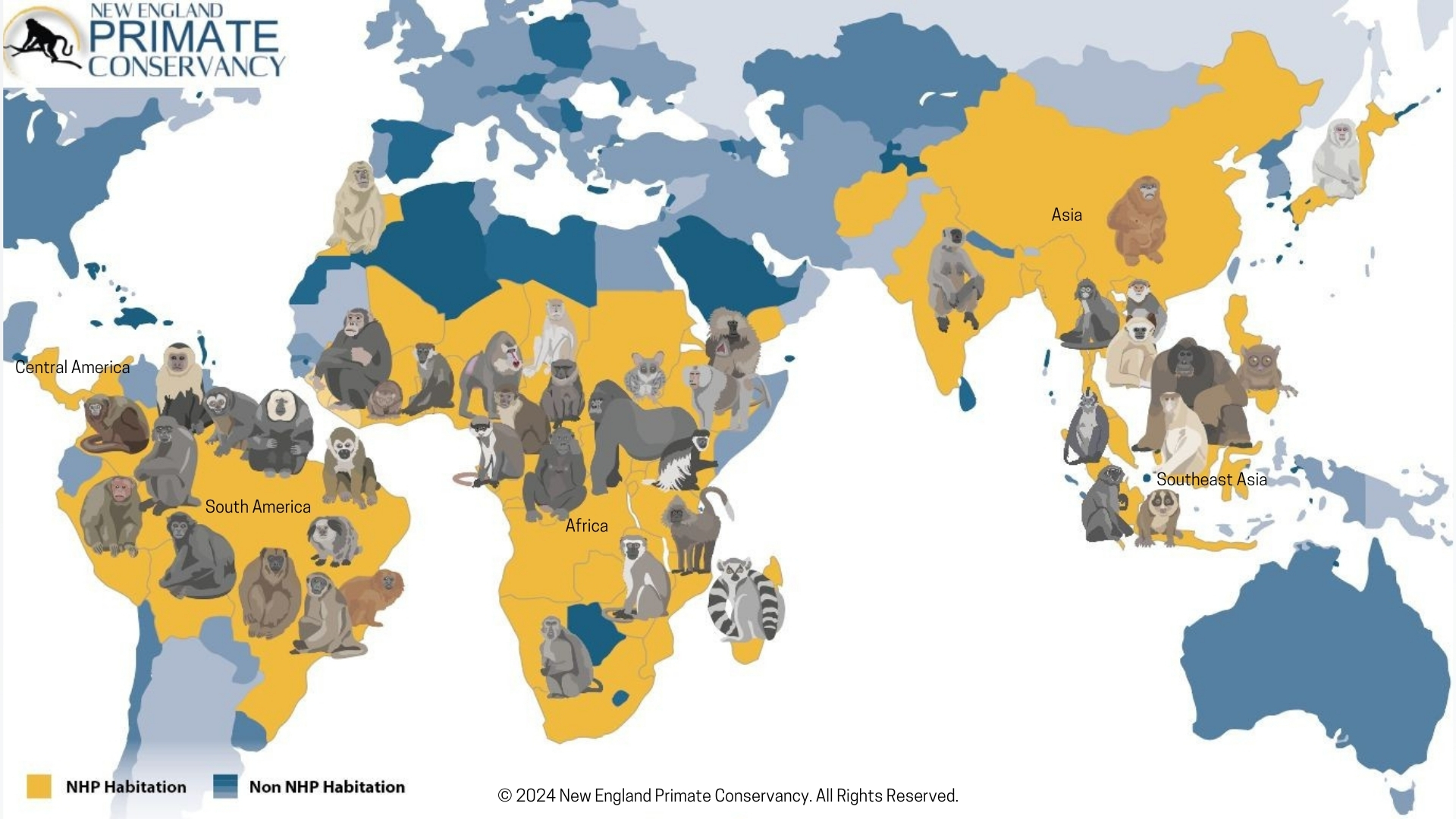
WORLDWIDE DISTRIBUTION OF NONHUMAN PRIMATES
Explore and Learn
Take a look at the world map. It depicts the natural worldwide distribution of nonhuman primates.
In what countries and regions do nonhuman primates NOT naturally live?
- Why do you think they do not live in those countries or regions of the world?
- Why do they naturally live where they do?
- Why might they be found in countries and regions in which they do not belong?
- What are the physical and ethical dilemmas of keeping them in countries outside of their native habitats? Or as pets? Or in research? Or in other captive environments and situations?
Become a Primate Pro For Your Favorite Species

The mandrill is an African monkey and the largest monkey species in the world. Who is your favorite?
The Where in the World Do Primates Live? video lists the primate species that live on their home continents. The Primate Species Profiles page of this website lists species by the region in which they live, as well as by their biological order. To find your favorite primate species, go to the Primate Species Profiles index page, click on your favorite primate or primates, and learn more about them. You might even consider selecting a species that you’ve never heard of, rather than your favorite. You might be surprised by what you learn.
How to become a “pro” about your favorite species: write an essay or draw a picture that depicts:
- Where the primate species lives
- Whether the species is from the American or the Afro-Eurasian regions
- How they live
- What they eat
- How they communicate
- How their habitat influences what they eat, how they behave, and how they communicate
- Some fun facts about the species
- The species’ conservation status
- The threats to the future of the species
Learn While Playing
Activities for introducing the diversity of nonhuman primate species and the habitats in which they live.
Did you know that some monkeys live in cities? That some live in semi-deserts? And some live in snow-covered mountains?
Learn about some of the surprisingly diverse habitats that nonhuman primates call home while playing fun card games.
36 game cards are divided into 27 primate cards and 9 habitat cards. Select from 4 card games. And have fun!
Visit Primates and Their Habitats to download the card deck and for game instructions.
Here’s what the cards look like:

LEARNING GOALS AND OBJECTIVES
Here’s What You’ll Learn
- World geography as pertains to natural primate distribution and habitats
- The continents on which nonhuman primates are native
- That human primates inhabit all continents
- The natural worldwide distribution of nonhuman primates
- What primates are and the differences in their biological order
- The differences between great apes, lesser apes, monkeys, tarsiers, and strepsirrhines
- The differences between Afro-Eurasian and American monkeys
Objectives
- Learn that human primates inhabit all continents and impact the viability of our nonhuman cousins
- Understand the need to protect nonhuman primate habitats and, thereby, the primates that live in them
- Understand where in the world nonhuman primates belong and where they do not belong
- Consider the ethical dilemmas inherent in keeping nonhuman primates where they do not belong
- Understand that over 64% of primate species are at risk of extinction
Lesson developed by Debra Curtin, revised 2026.
Copyright © New England Primate Conservancy 2016-2021. You may freely use, copy and share these Learning Activities for educational purposes.
For questions or comments, e-mail us at info@neprimateconservancy.org.