
White-Headed Black Langur, Trachypithecus leucocephalus
WHITE-HEADED BLACK LANGUR
Trachypithecus leucocephalus
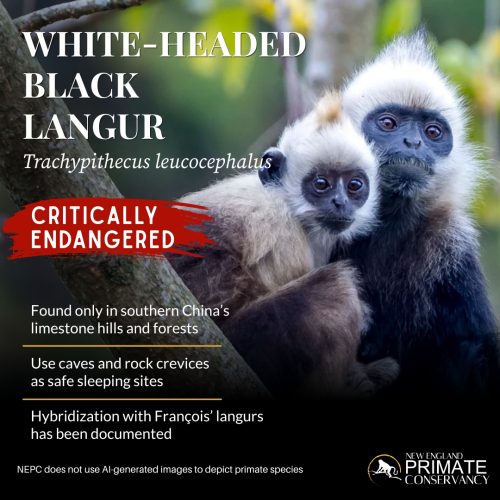
Geographic Distribution and Habitat
The white-headed black langur, also known as the white-headed langur, lives only in the Guangxi Zhuang Autonomous Region of southern China, near the border with Vietnam. Their restricted range lies between the Zuojiang and Mingjiang rivers and the Shiwan Mountains, primarily within Chongzuo, Fusui, Ningming, and Longzhou counties.
White-headed black langurs inhabit subtropical limestone karst forests. This rugged landscape is characterized by steep limestone hills and cliffs, caves, crevices, sinkholes, and underground waterways. Forest vegetation grows along the rocky slopes, providing the langurs with food and cover, while caves, ledges, and crevices provide resting and sleeping sites.
Most white-headed black langurs live in and around the Chongzuo White-Headed Langur National Nature Reserve, with a much smaller population in the Nonggang National Nature Reserve.
Their habitat has become increasingly fragmented by agriculture, roads, settlements, and other human development.These changes divide once-connected forests into isolated patches, making it more difficult for langurs to travel between groups and suitable habitat.
The region has a subtropical monsoon climate with distinct wet and dry seasons. Across their range, annual rainfall averages approximately 45–61 inches (1,150–1,550 mm), with most precipitation falling from April through September. The drier months generally extend from October through March. The mean annual temperature is about 72°F (22°C). Seasonal changes in rainfall and temperature affect the availability of leaves, fruits, flowers, and other foods, influencing how white-headed black langurs forage and use their habitat.
Over the years, the classification of the white-headed black langur has changed. It was once classified as a subspecies of François’s langur (Trachypithecus francoisi) and later as a subspecies of the closely related Cát Bà langur (Trachypithecus poliocephalus) of Vietnam.
Today, the white-headed black langur is recognized as a distinct species, Trachypithecus leucocephalus.

Size, Weight, and Lifespan
White-headed black langurs show some sexual dimorphism, or differences in size between males and females. Adult males have a head-to-body length of approximately 1.8–2 feet (55–62 cm) and weigh about 18–21 pounds (8–9.5 kg). Adult females have a head-to-body length of approximately 1.5–1.8 feet (47–55 cm) and weigh about 15–18 pounds (6.7–8 kg).
Their tails are considerably longer than their bodies and help them maintain balance as they climb, leap, and move across steep limestone surfaces. Adult males have tails measuring 32.3–35 inches (82–89 cm), while females have tails measuring 30.3–32.3 inches (77–82 cm).
White-headed black langurs have an estimated lifespan of about 20–25 years.
Appearance
Adult white-headed black langurs have predominantly black fur, offset by a distinctive crown of pale fur. White fur also surrounds the cheeks and chin and extends around the neck and shoulders. Their dark faces are nearly hairless.
Their long tails begin dark near the body and gradually become white toward the tip. In addition to helping distinguish the species, the tail assists with balance as the langurs move through trees and across rocky terrain.
Newborns look dramatically different from adults. Infants are born with bright orange fur, which gradually darkens as they mature. Dark hairs become increasingly visible during the juvenile period, and young langurs develop the characteristic black-and-white adult coloration at around two years of age.
White-headed black langurs also have ischial callosities, thickened pads of skin on their rumps that provide support while they sit on branches and rocky surfaces.

Diet
White-headed black langurs are primarily folivorous, meaning that leaves make up most of their diet. They eat both young and mature leaves and supplement them with fruits, flowers, shoots, seeds, bark, and other plant material. Their exact diet varies according to season, habitat, rainfall, temperature, and food availability.
Their digestive system is specially adapted to a leaf-rich diet. White-headed black langurs have a multichambered stomach containing microorganisms that ferment fibrous plant material. This process allows them to extract nutrients from leaves and other plant foods that are difficult for many mammals to digest.
Habitat conditions also influence what they eat. White-headed black langurs living in more fragmented areas may consume a wider variety of foods and make greater use of vegetation growing close to the ground. This dietary flexibility helps them respond to changes in the availability of preferred foods. A 2024 review of dietary studies found that fragmentation, rainfall, and average annual temperature all influenced food choices. In more fragmented forests and during dry periods, the langurs tend to rely more on fibrous foods and a broader selection of plant foods.
Seasonal changes also affect their diet. When young leaves and fruits are abundant, the langurs can take advantage of these nutrient-rich foods. During periods when preferred foods are less available, they rely more heavily on mature leaves and other vegetation. In a study of four groups from September 2016 to August 2017, young leaves accounted for 77.4 percent of feeding time in the rainy season and 62.3 percent in the dry season. Mature leaves increased from 10 percent to 23.4 percent as conditions became drier.
Females adjust their food choices during reproduction. Lactating females select foods that help meet the increased nutritional demands of producing milk, including greater use of nutrient-rich young leaves when they are available.
Behavior and Lifestyle
White-headed black langurs are diurnal, or active during the day. They divide their time among resting, feeding, traveling, and interacting with other members of their group. One published activity budget summarized in All the World’s Primates reports that they spent 51.9 percent of their time resting, 13.4 percent foraging, 14.5 percent traveling, 18.9 percent socializing, and 1.2 percent on other activities. These proportions vary among groups and habitats.
Reported home ranges span approximately 75–388 acres (30.5–157 ha), and daily travel distances of about 3,273 feet (997 m). However, a 2016–2017 study of four groups in Chongzuo found a considerably shorter average daily travel distance of 1,434 feet (437 m).
They are both arboreal and terrestrial and move through their karst habitat by walking on all fours, climbing, and leaping among trees and limestone surfaces. Their long limbs and tails help them balance and maneuver across steep and uneven terrain.
Temperature affects how they use their habitat. During cooler weather, white-headed black langurs may bask on exposed limestone surfaces warmed by the sun. In hotter conditions, they spend more time in shaded vegetation.
At night, groups sleep on limestone cliffs, using caves, crevices, and rocky ledges. A group may use several sleeping sites within its home range. These locations provide shelter from weather and can reduce exposure to predators and other disturbances. Before entering sleeping sites, langurs become more watchful and keep a low profile, behaviors that may help them avoid detection. Steep cliffs also offer protection from potential ground-dwelling predators, such as leopard cats, while caves provide cover from aerial threats, including large birds of prey such as crested serpent eagles.
The importance of these sleeping sites also influences communication and territorial activity. Adult males use long-distance calls that can help protect sleeping areas from neighboring groups.
In local cultural traditions, the white-headed black langur’s distinctive coloring has an explanation. One story describes langurs wearing white coverings on their heads and dipping their tails in white to honor a respected elder who had died. Their descendants, according to the story, retained those markings.
Groups typically contain one or two breeding males, several adult females, and their offspring, although their size and composition vary. Groups of approximately 8–12 white-headed black langurs are common, and larger groups also occur.
Females generally remain in their natal groups, maintaining long-term relationships with female relatives. Young males usually leave their natal groups as they mature. They may live alone or join all-male groups before attempting to enter a reproductive group.
Competition between adult males can be intense. A male may challenge another male for access to a group, and infanticide has been documented following some male takeovers.
Studies have reported different patterns of dominance within groups. Observations from 1993 described a dominant male who outranked females, as well as a hierarchy among females in which higher-ranking individuals sometimes took food from lower-ranking ones. A 2004 study, however, found little evidence of a clear adult hierarchy and infrequent aggression, except when resident females confronted newly arrived females at feeding sites.
Adult males in groups with only 2 males have been observed working together to drive away intruding males. In one account, the dominant male shared feeding space with the other male and tolerated his mating with females in the group.
Group members maintain social relationships through grooming, play, proximity, and other interactions. These relationships contribute to group cohesion and allow individuals to care for young, respond to threats, and share access to resources.
Male dispersal makes connections between habitat patches particularly important. Young males must be able to travel through the landscape to reach other groups. Roads, agricultural land, settlements, and other barriers can restrict these movements, reducing opportunities for reproduction and genetic exchange between populations.
White-headed black langurs use calls, facial expressions, body postures, grooming, and physical contact to communicate with one another.
Alarm calls warn other group members of potential danger, while other vocalizations help individuals maintain contact and communicate with neighboring groups. Adult males also produce loud, long-distance calls that travel across the limestone landscape. Adult males have been described as producing a loud “a, a” alarm when the group needs to move away from danger and a “ka, ka” call to assemble group members. Males displaced from their groups may also give an irregular call resembling the alarm call.
These long-distance calls play an important role around sleeping sites. Adult males call more frequently in areas where neighboring groups may compete for access to cliffside sleeping locations, helping to defend these important resources.
Tactile communication is also important. Grooming and other forms of physical contact help maintain relationships and reinforce social bonds among group members.
Reproduction generally follows a polygynous mating system: one adult male typically mates with multiple adult females within a group. Males generally initiate mating, which has been reported to last from 15 to 80 seconds. Other females sometimes interrupt or harass the mating pair.
Females generally first give birth at approximately five to six years of age. After a gestation period of approximately six to seven months, a female usually gives birth to a single infant. Births can occur throughout the year but are most common during the cooler, drier months, particularly from November through March. Infants are born with bright orange fur that gradually changes to the black-and-white coloration characteristic of adults.
Successful births typically occur at intervals of about two years. Infants nurse for an extended period and are generally weaned at around 19–21 months.
Mothers provide most direct infant care, but other group members may also interact with and care for infants. This alloparental care gives young langurs opportunities to interact with individuals other than their mothers as they develop.
The nutritional demands of reproduction also influence a mother’s feeding patterns. Lactating females adjust their diets according to food availability and reproductive needs, selecting nutrient-rich foods such as young leaves when available.
As infants grow, they gradually become more independent, exploring their surroundings, playing with other young langurs, and learning the social and ecological skills they need to function within the group.

Their feeding habits influence the limestone forests around them. By eating leaves and other plant material, white-headed black langurs affect the vegetation within their habitat.
Because leaves make up much of their diet, they act as browsers, selectively removing leaves and other plant material. This feeding can influence plant growth and vegetation structure. They also consume fruits, flowers, seeds, shoots, and other plant material and contribute to nutrient cycling as food passes through their digestive systems and returns to the environment.
Their movements connect these ecological processes across different parts of their home ranges. By feeding, traveling, and depositing waste in different locations, white-headed black langurs help move nutrients through the karst ecosystem.
White-headed black langurs also occupy a place in the local food web as potential prey. Large raptors, including crested serpent eagles, and terrestrial carnivores such as leopard cats are considered possible threats. Published observations of actual predation on this species are limited, however.
Their dependence on forest vegetation also demonstrates the close relationship between the langurs and their habitat. Changes to plant communities, forest cover, and connections between habitat patches affect not only where white-headed black langurs can live, but also the ecological interactions in which they participate.


The white-headed black langur is classified as Critically Endangered by the International Union for Conservation of Nature (IUCN, 2020), appearing on the IUCN Red List of Threatened Species.
White-headed black langurs were once much more severely threatened by hunting and habitat destruction. Hunting for food and traditional medicine contributed to their historical decline, along with the conversion and fragmentation of their limestone forest habitat.
Stronger protection and enforcement have greatly reduced hunting in the main Chongzuo population. Habitat loss, degradation, and fragmentation now pose some of the most significant threats to their continued recovery.
Agriculture, roads, settlements, plantations, and other development divide suitable habitat into isolated patches. Even when a group can survive within one forest fragment, isolation can prevent individuals from moving safely between populations. Over time, restricted dispersal can reduce opportunities for reproduction and genetic exchange.
Despite these pressures, the population has increased substantially. The most recent official monitoring results, released in 2026, recorded 1,481 white-headed black langurs in 162 groups. This represents a reported increase of 55.67 percent since 2011, with the population increasing for 15 consecutive years.
Their recovery is encouraging, but fewer than 1,500 individuals remain within a very restricted geographic range. A growing population still depends on having enough connected habitat to support additional groups.
Climate change may further affect that habitat. Changes in temperature and rainfall, combined with continued human land use, could reduce the amount and distribution of suitable habitat and alter the availability of important food plants.
Pollution is another emerging concern. White-headed black langurs sometimes forage near forest edges adjoining agricultural areas, particularly when food is scarce. Recent evidence indicates that plants in some of these areas can expose langurs to elevated levels of mercury. The long-term effects require further study, but the findings demonstrate how activities outside protected habitat can affect animals living within it.
White-headed black langurs receive legal protection in China, and much of their remaining population lives within protected areas, particularly the Chongzuo White-Headed Langur National Nature Reserve and Nonggang National Nature Reserve.
They are also listed in Appendix I of the Convention on International Trade in Endangered Species of Wild Fauna and Flora (CITES), an international agreement between governments designed to ensure that international trade in wild animals and plants does not threaten their survival.
Anti-poaching enforcement, ranger patrols, habitat protection and restoration, population monitoring, conservation education, and community involvement have all contributed to the recovery of white-headed black langurs. Camera traps, drones, and other monitoring tools also help track populations and document how groups use their habitat.
As the population grows, reconnecting fragmented habitat has become increasingly important. Ecological corridors can provide routes between otherwise isolated forest patches, allowing individuals to disperse between groups and helping maintain genetic exchange among populations.
White-headed black langurs already use some experimentally restored connections. They feed from trees planted within corridors and have crossed agricultural areas using shorter corridors and strategically placed boulders. Longer corridors have not always been used, indicating that corridor length, vegetation, food resources, structure, and location can affect whether langurs will travel through them.
Conservation planning is increasingly identifying priority connections between remaining habitat patches so that restoration can focus on areas where it may provide the greatest benefit.
The increase in white-headed black langur numbers shows the impact that sustained conservation can have. Their continued recovery now depends not only on protecting individual groups, but also on protecting and reconnecting enough habitat for those groups to move, reproduce, and grow.
- Bleisch, B., & Long, Y. (2020). Trachypithecus leucocephalus. The IUCN Red List of Threatened Species. https://doi.org/10.2305/IUCN.UK.2020-2.RLTS.T39872A17988378.en
- Lai, Y., Chen, Y., Zhang, K., & Huang, Z. (2024). Diets of white-headed langurs (Trachypithecus leucocephalus) inhabiting limestone forests: The effects of habitat fragmentation and implication for conservation. Ecology and Evolution, 14, e11716. https://doi.org/10.1002/ece3.11716
- Tang, H., et al. (2024). Population dynamics and conservation status of the white-headed langur in the Chongzuo forest fragments, Guangxi, China. Oryx, 58(2), 179–182. https://doi.org/10.1017/S0030605323000029
- Song, Y., Yi, B., Tao, M., Nong, D., Zhou, Q., & Fan, P. (2025). The long-distance calling of white-headed langurs (Trachypithecus leucocephalus) serves a defensive function for their sleeping sites. Acta Theriologica Sinica, 45(6), 820–830. https://doi.org/10.16829/j.slxb.151048
- Liu, X., et al. (2025). Construction and optimization of habitat ecological network of the white-headed langur (Trachypithecus leucocephalus) under landscape dynamics. American Journal of Primatology, 87(12), e70097. https://doi.org/10.1002/ajp.70097
- Evaluating corridor efficacy for movement: A case study on white-headed langurs and their food tree connectivity. (2026). Biological Conservation, 313, 111563. https://doi.org/10.1016/j.biocon.2025.111563
- Huang, R., et al. (2026). Balancing reproductive demands and seasonal food availability: Foraging strategies of adult female white-headed langurs in karst habitats. American Journal of Biological Anthropology. https://doi.org/10.1002/ajpa.70352
- National Forestry and Grassland Administration of China. (2026, August 10). Guangxi terrestrial wildlife monitoring results (2025). https://www.forestry.gov.cn/lyj/1/dzbhdt/20260810/683770.html
- American Society of Mammalogists. Mammal Diversity Database: Trachypithecus leucocephalus. https://www.mammaldiversity.org/taxon/1000707/
- Jin, T., Wang, D.-Z., Zhao, Q., Yin, L.-J., Qin, D.-G., Ran, W.-Z., & Pan, W.-S. (2009). Reproductive parameters of wild Trachypithecus leucocephalus: Seasonality, infant mortality and interbirth interval. American Journal of Primatology, 71(7), 558–566. https://doi.org/10.1002/ajp.20688
- Zhao, Q., Tan, C. L., & Pan, W. (2008). Weaning age, infant care, and behavioral development in Trachypithecus leucocephalus. International Journal of Primatology, 29, 583–591.
- Seasonal mercury in an endangered primate from fragmented karst forest: Does behavioral observation advance ecotoxicological risk assessment? (2025). Journal of Hazardous Materials. https://www.sciencedirect.com/science/article/pii/S030438942503081X
- Chen, X., et al. (2025). Two ways of new bisexual group formation in the white-headed langur. Acta Theriologica Sinica. https://www.mammal.cn/EN/abstract/abstract3832.shtml
- Primate Conservation, Inc. (n.d.). White-headed langur (Trachypithecus leucocephalus). All the World’s Primates. https://alltheworldsprimates.org/ (species account details supplied by NEPC fact-checker Jacob Zinn).
- From isolation to connectivity: A graph theory approach for optimising karst protected areas using an umbrella species. (2025). Biological Conservation. https://www.sciencedirect.com/science/article/pii/S0006320725003325
- Diet, food availability, and climatic factors drive ranging behavior in white-headed langurs in the limestone forests of Guangxi, southwest China. (2021). Zoological Research, 42(4), 406–411. https://doi.org/10.24272/j.issn.2095-8137.2020.292
- Habitat use of the white-headed langurs in limestone forest of Southwest Guangxi, China: Seasonality and group size effects. (2022). Ecology and Evolution. https://doi.org/10.1002/ece3.9068
- Sleeping site use of the white-headed langur Trachypithecus leucocephalus: The role of predation risk, territorial defense, and proximity to feeding sites. (2011). Current Zoology, 57(3), 260–268. https://doi.org/10.1093/czoolo/57.3.260
Written by Allie Dixon, November 2026