
Rio Acari Marmoset, Mico acariensi
RIO ACARÍ MARMOSET
Mico acariensis
Geographic Distribution and Habitat
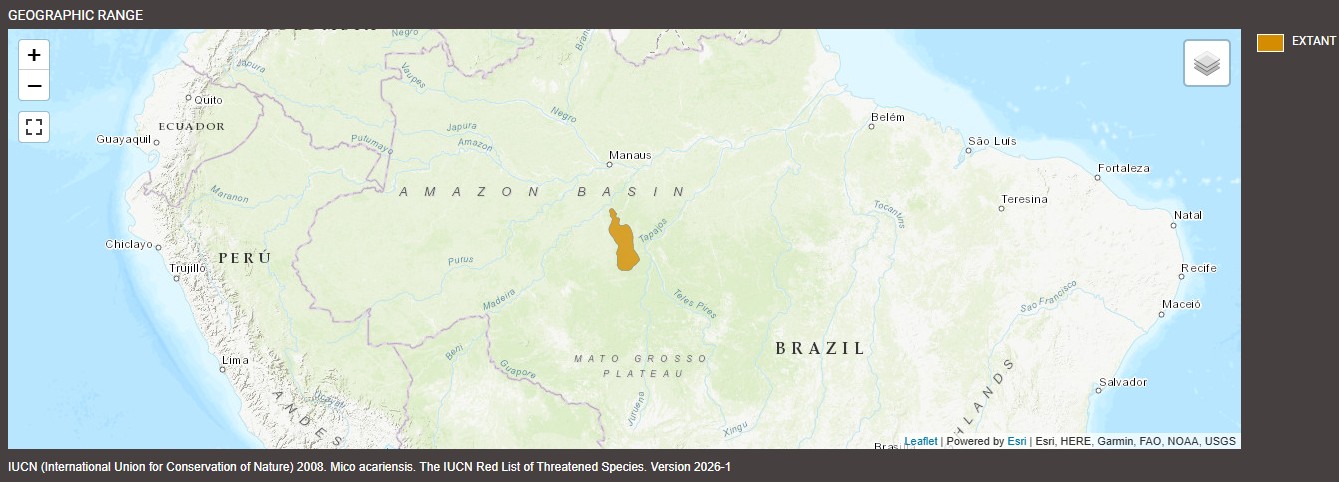
The Rio Acari marmoset is endemic to Brazil, where they are known only in the state of Amazonas. Their known range lies in the Amazonian lowlands, particularly between the Acarí and Sucundurí rivers. The Rio Acari marmoset was originally described from a young female monkey who had been found in a small settlement along the lower Acarí River and raised in captivity. Although they were not observed in the wild when the species was first described, subsequent field expeditions have confirmed their presence at several localities along the Sucundurí River. They remain one of the least-known marmosets, however, with very little information available about their behavior, ecology, and population.
Subsequent fieldwork has provided a clearer, although still incomplete, picture of their distribution. Researchers recorded Rio Acari marmosets at several localities along the western bank of the Sucundurí River, confirming that their range extends beyond the original locality. Current records indicate that the species occurs between the right bank of the Acarí River and the left bank of the Sucundurí River, extending south toward the Trans-Amazonian Highway. This known range covers approximately 6,750 square miles (17,480 km²).
Within these regions, the Rio Acari marmoset inhabits lowland Amazonian rainforest, including primarily terra firma forest, which grows on land that is not regularly flooded. They appear to favor well-drained forest with a medium to high canopy, where trees and lianas provide food and cover. The forests of this region have tall, dense canopies, high rainfall averaging 59-79 inches (1,500-2,000 mm) annually, and several layers of vegetation extending from the forest floor to the upper canopy. Temperatures are generally stable, ranging from approximately 68-82°F (20-28°C), while humidity can remain high, commonly ranging from 70–90%. These warm, humid conditions support the dense vegetation and abundance of insects found throughout the region.
Although some marmosets are known to use flooded forests, the available information for the Rio Acari marmoset is much more limited. The species has been associated primarily with terra firma forest rather than seasonally or permanently flooded habitats. More field surveys are needed to determine the full range of habitats they use.
Their geographic range may also extend beyond the areas where they have been recorded. Researchers have suggested that the boundaries between the Rio Acari marmoset and closely related marmosets may be more complicated than current records indicate, particularly farther south around the headwaters of the Acarí River. Because so few records exist, additional surveys are needed to establish the species’ complete distribution and better understand the habitats they depend on.
The Rio Acarí marmoset was originally described in 2000 as Callithrix acariensis. At the time, some classifications treated Mico as a subgenus of Callithrix, so the scientific name was sometimes written as Callithrix (Mico) acariensis. As scientists refined the taxonomy of marmosets, Mico came to be recognized as a separate genus. The Rio Acarí marmoset is now classified as Mico acariensis.
The Rio Acari marmoset shares some genetic and physical characteristics with other members of the Mico genus, including Emilia’s marmoset (Mico emiliae) and the white marmoset (Mico leucippe). Despite these similarities, researchers recognize the Rio Acari marmoset as a distinct species based on a combination of characteristics that distinguish them from their relatives.
Size, Weight, and Lifespan
Rio Acari marmosets have an average head-and-body length of approximately 9.4 inches (24 cm), with a tail measuring about 13.8 inches (35 cm). They weigh approximately 0.9 pounds (420 g).
However, these measurements are based on a single female Rio Acari marmoset. She was found as a juvenile, when she was less than two months old, and was later raised to adulthood in captivity. As a result, researchers do not yet know how closely these measurements represent the typical size and weight of Rio Acari marmosets.
Their lifespan in captivity is estimated at 12 to 15 years, although their longevity in the wild remains uncertain because so little is known about their populations and natural history.
Appearance
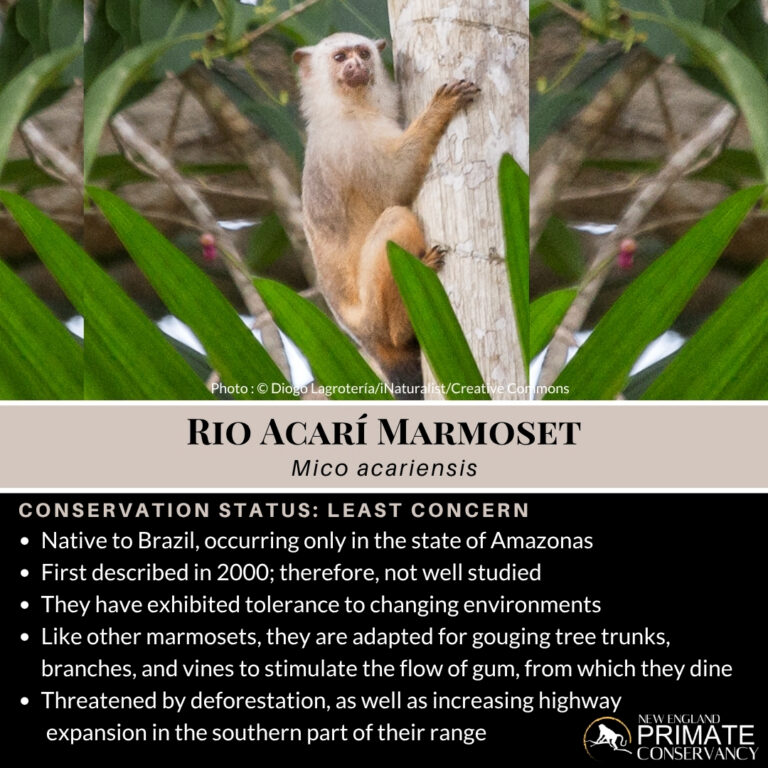
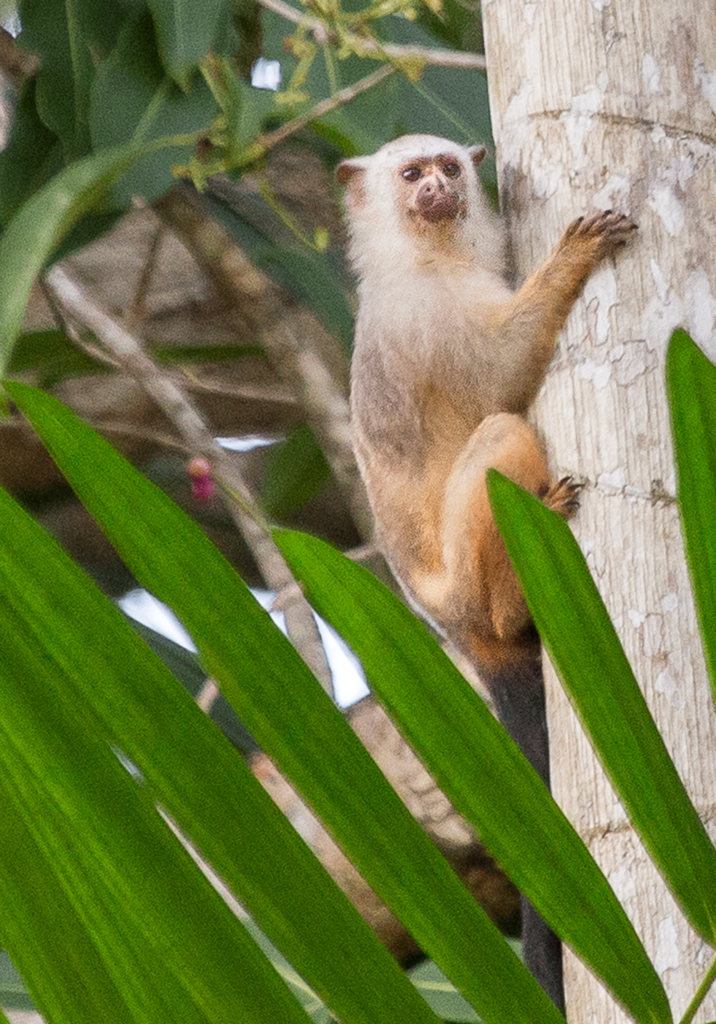
Rio Acari marmosets have been described as colorful marmosets whose bodies are covered in a combination of pale gray, white, orange, and black dense fur that gives them a distinctive appearance among Amazonian marmosets.
Their back and head are covered in snow-white to cream-gray fur, sometimes with a subtle silvery appearance. The pale coloring continues across the neck and chest, creating a striking contrast with their intensely colored underside. Their belly, thighs, and lower legs are a vivid orange to golden color, with the coppery coloring particularly noticeable on the thighs and lower body.
Their tail is long and densely furred, with most of its length appearing black. The base of the tail, however, is orange, creating a distinctive transition between the brightly colored body and the dark tail. Their arms and hands show a mixture of gray and orange, while the inner surfaces of their legs are white before becoming orange toward the feet.
The Rio Acari marmoset’s face is mostly bare and pink, with dark patches between the eyes, around the sides of the nostrils, and on the chin and lower lip. Their small ears are partly covered by short, light-colored hairs and lack prominent ear tufts. Their large, forward-facing eyes give their face an alert appearance and help them judge distances as they move through the forest canopy.
Their elongated lower incisors are also well suited to the marmoset’s characteristic feeding strategy of gouging trees to obtain plant exudates such as sap and gum. Together, their vivid coat, contrasting facial markings, and specialized features give the Rio Acari marmoset a distinctive appearance that sets them apart among the colorful marmosets of the Amazon.
Diet
The Rio Acari marmoset is an omnivore whose diet is expected to include a variety of plant and animal foods. Like other marmosets, they are particularly adapted to feeding on plant exudates, including tree sap, gum, and resin, as their elongated lower incisors allow them to gouge the bark of tree trunks, branches, and vines, creating openings from which these nutrient-rich substances can flow.
Plant exudates can provide an important and dependable source of food for marmosets because they remain available even when fruits and other foods become scarce. Their small size and specialized feeding adaptations allow them to exploit this resource by repeatedly returning to trees where exudates are available.
Marmosets also eat a variety of other foods, including fruits, flowers, nectar, and animal prey such as insects and other small animals. The Rio Acari marmoset is likely to have a similarly varied diet, although the specific foods they consume in the wild have not been studied in detail. Their diet may include insects and other invertebrates, as well as fruits and other plant foods encountered while foraging through the forest canopy.
Their feeding adaptations are closely connected to their forest environment. The Amazonian forests inhabited by the Rio Acari marmoset contain numerous trees and vines capable of producing exudates, as well as the fruits, flowers, and insects that can supplement their diet. By combining specialized exudate feeding with a broader omnivorous diet, the Rio Acari marmoset can make use of several food sources within the forest.
Behavior and Lifestyle
Rio Acari marmosets are active, agile monkeys that spend their days moving through the forest canopy in search of food. Like other marmosets, they are diurnal, meaning they are active during the day, with daily activity concentrated in the morning and later afternoon, when they travel through the forest, forage, and interact with other members of their group.
Their small bodies and strong limbs are well suited to life among the branches. They move primarily on all four limbs, but can also make quick leaps between branches and cling vertically to tree trunks while searching for food. Their claw-like nails provide a secure grip on rough surfaces, while their long tails help them maintain balance as they move through the vegetation.
Their specialized feeding habits also shape how they use the forest. They can cling to trunks and branches while using their elongated lower incisors to gouge trees and access plant exudates such as sap and gum. They also move through different levels of the forest to locate fruits, insects, and other foods.
As with other marmosets, their lifestyle is likely to involve close social relationships within family groups.
Built for tree sap: Like other marmosets, they have elongated lower incisors that allow them to gouge tree bark and obtain plant exudates such as sap and gum.
Their home is squeezed between two rivers. Their known range lies between the Acarí and Sucundurí rivers in the Brazilian Amazon, covering approximately 6,750 square miles (17,480 km2).
A living palette: From silvery gray and white to brilliant orange and deep black, the Rio Acari marmoset carries a vivid palette of colors through the forest canopy.
Rio Acari marmosets live in social groups that contain approximately 4 to 15 individuals. Living together allows them to travel through the forest, search for food, and use the same areas of their home range. Their groups occupy home ranges of approximately 25 to 99 acres (10-40 ha), with the size of the range depending in part on the availability and distribution of food resources and areas of secondary forest.
During the day, group members travel through the forest canopy along routes that may be used repeatedly as they move between feeding areas. Their small size and agile climbing abilities allow them to travel along branches and through the middle and upper levels of the forest while searching for exudates, fruits, insects, and other foods.
Social grooming is an important part of marmoset life. In addition to helping keep the animals clean, grooming can strengthen social bonds between group members and help reduce tension within the group. These interactions contribute to the close social relationships that characterize marmosets.
At night, Rio Acari marmosets retreat to sheltered sleeping sites. Marmosets commonly use protected places such as tree cavities and dense tangles of vegetation, where several group members can remain together while they rest to conserve heat and avoid predators.
Because relatively little field research has been conducted on this species, researchers still have much to learn about Rio Acari marmosets. Continued observations of wild groups will provide a clearer picture of their daily lives and social relationships.
Like other marmosets, Rio Acari marmosets are expected to rely on a combination of vocalizations, scent signals, and body language to communicate. Marmosets use a variety of high-pitched calls to maintain contact with group members, alert one another to potential threats, and coordinate their movements through the forest. These vocal behaviors have not been studied in detail in Rio Acari marmosets, however, so their specific calls and the situations in which they use them remain poorly understood.
Marmosets can also communicate through scent marking, using urine and secretions from scent glands to leave chemical signals in their environment. Subtle changes in posture, facial expressions, and other body movements may provide additional social signals. These forms of communication are well documented among marmosets generally, but further observations are needed to determine how closely Rio Acari marmosets follow these patterns.
As researchers learn more about Rio Acari marmosets in the wild, they may uncover a richer picture of how these primates specifically communicate, recognize one another, and coordinate their lives within family groups.
Family life is central to the social world of marmosets, and Rio Acari marmosets live in groups of approximately four to 15 individuals. The groups have several adults, although reproduction may be concentrated among one breeding female within a group. Like other marmosets, they are thought to have a cooperative approach to raising young, with more than one adult contributing to the care and protection of infants, a behavior known as alloparenting. Older siblings and other adults may carry, groom, protect, and otherwise assist with the care of infants. Sharing these responsibilities allows the breeding female to receive help while the young develop.
Twin births are common among marmosets, and newborn marmosets are highly dependent on their caregivers. They spend their early lives being carried by adults as they develop the strength and coordination needed to move independently. As they grow, young marmosets gradually become more independent while continuing to rely on members of their group for protection and care.
Many of these reproductive and family behaviors are well documented in marmosets generally, but researchers have not yet established how closely Rio Acari marmosets follow these patterns. The species’ reproductive season, age at sexual maturity, gestation period, weaning age, and age of dispersal from the family group remain poorly documented.
Further study of wild groups will help reveal how Rio Acari marmosets form families, raise their young, and pass from infancy into adulthood.
As an omnivore living in the Amazonian forest canopy, the Rio Acari marmoset is part of a complex network of interactions between plants, insects, and other animals. Their feeding habits connect them to several parts of the forest ecosystem, particularly through their consumption of fruits, insects, and plant exudates.
Like other marmosets, Rio Acari marmosets may contribute to the movement of seeds through the forest when they eat fruits and later deposit the seeds elsewhere. Their consumption of insects and other small animals also places them within the forest’s food web, while their own presence provides a food source for predators such as eagles and snakes. However, the extent to which Rio Acari marmosets contribute to seed dispersal, insect regulation, or other specific ecological processes has not been studied in detail.
Additionally, their specialized habit of gouging trees to obtain plant exudates may also influence the trees they feed on. By creating and repeatedly using feeding wounds, marmosets interact directly with the plants around them, although the broader ecological effects of this behavior in Rio Acari marmosets remain unclear.
The Rio Acari marmoset’s restricted distribution and limited number of confirmed records also make them scientifically important. Learning more about where they live, which habitats they depend on, and how they interact with other organisms can help researchers better understand the ecology of the forests they inhabit. Continued study of wild populations will be especially valuable for determining their ecological role and identifying the conditions they need to persist.


The International Union for Conservation of Nature lists the Rio Acari marmoset as Least Concern (IUCN, 2018), appearing on the IUCN Red List of Threatened Species.
The Rio Acari marmoset has a relatively restricted known distribution in the Amazonian forests between the Acarí and Sucundurí rivers. Deforestation and the expansion of highways are potential threats, particularly toward the southern part of their distribution. Roads can contribute to the loss and fragmentation of forest, potentially making it more difficult for animals that depend on connected habitat to move between forested areas. However, the available evidence does not currently indicate that these threats are having a significant impact across the Rio Acari marmoset’s known range.
There is also limited information about hunting or capture for the pet trade. Researchers have suggested that Rio Acari marmosets are probably not heavily hunted, although some individuals may be kept as pets. Because so little is known about their populations, Further research into their population size, distribution, habitat requirements, and response to forest fragmentation will help determine whether current threats remain limited or become more significant as development expands into the region.
The Rio Acari marmoset is listed in Appendix II of the Convention on International Trade in Endangered Species (CITES), an international agreement between governments whose goal is to ensure that international trade in specimens of wild animals and plants does not threaten their survival.
The primate has been recorded within Juruena National Park (PARNA Juruena), providing some protection through its occurrence in a designated conservation area. Protecting forests within and around the marmoset’s known range is particularly important because their distribution is restricted to a relatively small part of the Amazon.
Research also remains one of the most important conservation needs for this little-known primate. Further surveys are needed to determine the full extent of their geographic range and to establish more about their population size, distribution, habitat requirements, and reproductive biology. Because relatively few wild individuals and groups have been documented, additional field research could also help researchers identify emerging threats and determine how Rio Acari marmosets respond to changes in their forest environment.
- https://doi.org/10.62015/np.2000.v8.443
- https://doi.org/10.62015/np.2007.v14.659
- https://doi.org/10.5194/pb-10-7-2023
- https://www.iucnredlist.org/species/41580/192400051
- https://alltheworldsprimates.org/
- https://doi.org/10.1002/ajp.22615
- https://www.nature.com/articles/s41597-025-04951-8
- https://planetmarmoset.com/en/acari-marmoset/
- https://treatment.plazi.org/GgServer/xhtml/DF668780FFD2FFC2FF3FF7876987E24E/9
- https://uh.app/lib/en/R%C3%ADo-Acari-Marmoset
- https://neprimateconservancy.org/marmosets/
- https://www.marmosetcare.stir.ac.uk/understanding-behaviour/calls.html
- https://www.bioexplorer.net/animals/mammals/monkeys/rio-acari-marmoset/
Written by Brenda Awuor, September, 2026