
Likweli, Colobus congoensis
LIKWELI
Colobus congoensis
Geographic Distribution and Habitat
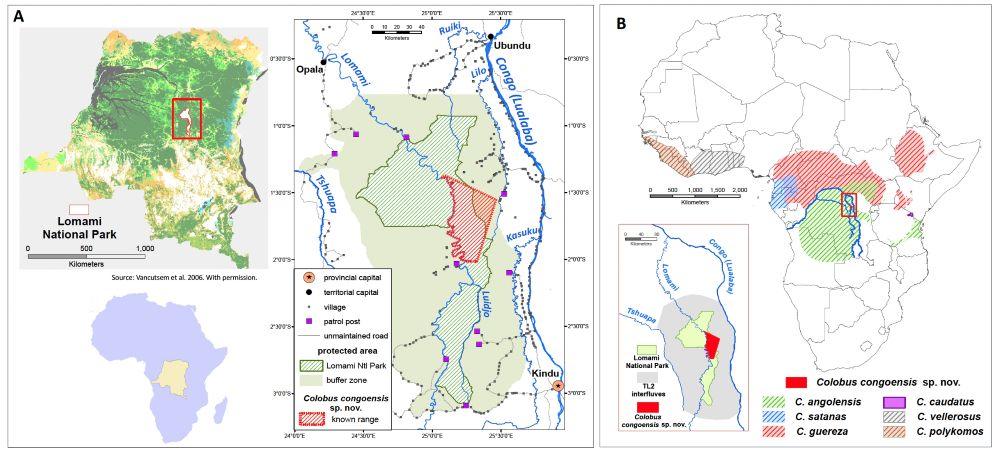
The likweli is found in a tiny, restricted range of roughly 660 square miles (1,700 km²) of lowland rainforest in east-central Democratic Republic of the Congo (DRC). This newly described monkey is confined to an area between the Lomami River and Lilo River, mostly inside Lomami National Park. This National Park is part of a remote, heavily forested region in east-central DRC known as the Lomami–Lualaba interfluve, a land area sandwiched between the Lomami River to the west and the Congo River (known locally as the Lualaba River) to the east.
A lover of the treetops, the likweli resides high up in the closed canopy of forests, which sit on deep clay soils. Likwelis have also been spotted among the “islands” of terra firma (dry land) forests found amongst their limited range. Likwelis are found at 1,280-1,640 feet (390-500 m) above sea level.
The likweli’s habitat has a hot, humid equatorial climate, characteristic of the central Congo Basin. Temperatures remain relatively stable throughout the year rather than having pronounced hot and cold seasons. Across Lomami National Park, mean monthly temperatures are generally around 73-79°F (23-26°C). The region receives substantial rainfall throughout the year, although precipitation is strongly seasonal. Importantly, the recently published species description by PLOS (which will be known as the “PLOS publication” for the rest of this profile) provides rainfall measurements from two sites bordering the likweli’s range: annual rainfall averaged approximately 68-74 inches (1,720–1,870 mm). Unlike areas with one long wet and one long dry season, rainfall around the likweli’s range follows a bimodal pattern, with two rainy periods separated by a relatively short dry period:
- First wet season: March–April — among the wettest months, with average monthly rainfall of approximately 7.91-10.6 inches (201-269 mm).
- Second wet season: October–December — the other major rainy period, also receiving roughly 7.91-10.6 inches (201-269 mm) per month during the wettest months.
- Short dry season: June–July — these are the driest months, with monthly rainfall averaging approximately 1.34-4.37 inches (34-111 mm). The broader Lomami region is likewise described as having a dry season lasting less than two months, generally June and July.
The missing months of January, February, May, August, and September don’t neatly fit into either category.
As the likweli was only formally announced as a unique species in July 2026, direct information about how climate affects their behavior is still very limited. The species description provided by the PLOS publication gives useful observations, however, and some cautious ecological inferences from their habitat and from what is known about colobine monkeys can be made. The following should not be taken as established facts, but rather as inferences.
Let’s look at how the geography impacts food availability. The likweli dwells primarily in mature, high-canopy forests growing on deep clay soils. These forests are particularly diverse when compared with those on nutrient-poor white sands, or seasonally inundated soils. The researchers suggest that this high plant diversity may be important to the likweli’s distribution. The seasonal rainfall pattern—two rainy periods separated by the driest period in June-July—probably influences when different plants produce young leaves, mature leaves, flowers, fruits, and other edible plant material. However, the researchers explicitly state that the likweli’s diet has not yet been adequately studied, so it can’t be currently determined which foods peak during particular months. In fact, they recommend dietary research to determine whether differences in food availability help explain why the species avoids nutrient-poor white-sand forests. A reasonable interpretation is that the relatively wet, warm climate allows vegetation to remain productive for much of the year, while the short dry season may temporarily alter the abundance of particular foods. The likweli’s apparent dependence on diverse clay-soil forests could therefore mean that the quality and composition of vegetation are more important than simply the amount of rainfall.
The ecosystem also determines their movement patterns. The likweli is strongly arboreal, or tree-dwelling. They were observed primarily in the canopy and middle levels of mature forest, with only two documented exceptions: individuals briefly descended to the ground, and one group moved into the understory while being attacked by a crowned eagle. The wet/dry cycle probably affects movement indirectly through vegetation and forest conditions. During periods of heavy rain, dense vegetation may provide abundant food and cover, potentially allowing the monkeys to remain within relatively small areas of suitable forest. During the drier months, changes in food availability could encourage movements between feeding sites, although seasonal changes in likweli ranging behavior have not yet been demonstrated. There’s stronger evidence for habitat-driven movement than climate-driven movement. Researchers repeatedly encountered likweli groups in particular areas, suggesting that groups may revisit favored patches of mature clay-soil forest rather than ranging indiscriminately through the landscape. The species is also rarely found in seasonally inundated forest or white-sand forest.
The warm, humid rainforest climate means the likweli doesn’t have to cope with the extreme seasonal temperature changes experienced by mammals found in temperate regions. Instead, rainfall and the dense forest canopy are likely more important environmental influences. The species appears to spend most of their time above the ground, where the canopy provides food, shelter, and protection from terrestrial predators. Their calls are particularly notable: local people reported hearing them mostly around dawn, and dawn call surveys were specifically used by researchers to locate the monkeys. This suggests that early morning is an important period of activity or communication, although the study doesn’t yet provide a complete daily activity budget. Guess what that will mean for the Daily Life and Group Dynamics section later in this profile? Go on, guess. The species’ tendency to associate with other primates may also help them exploit the forest efficiently: 45 of 62 observations in which group composition was known involved mixed-species groups, sometimes containing two to six primate species.
Finally, there is currently not enough evidence to establish a seasonal behavioral cycle for the likweli. Interestingly, researchers observed adults accompanied by young in February, April, July, August, and September. That distribution across both relatively wet and dry months suggests that reproduction may not be restricted to one short season, although the observations are too few to determine a breeding pattern.
All in all, the likweli’s warm, humid climate supports year-round rainforest growth, while seasonal rainfall likely causes fluctuations in food resources and forest conditions. However, because the species is newly described, direct evidence of seasonal changes in their diet, ranging, or activity is still lacking.
Size, Weight, and Lifespan
While the newly published species description on the likweli provides actual field measurements, there is an important limitation: the sample is extremely small—only one adult male and two pregnant adult females were available as specimens, and the authors cautioned that the current weight data are insufficient for a firm estimate of sexual size dimorphism.
A head-body length has not been properly established for the likweli. Instead, the researchers recorded total length and tail length separately as standard external measurements. Like other colobines, the likweli was confirmed to have a very long tail. Sorry, folks! You’ll need to wait for further research to be conducted in order to get proper measurements.
The likweli weighs approximately 15 pounds (6.8 kg). However, this is more an approximate adult body mass, rather than a firmly established average for the species. The researchers weighed living specimens using a spring balance accurate to 0.22 pounds (0.1 kg), but their sample consisted of a young adult male and two pregnant females, which makes calculating a representative adult average problematic.
The likweli appears to exhibit little to limited sexual dimorphism (differences based on gender) in body size and weight. The authors specifically state that the available measurements suggest limited body-mass sexual dimorphism. However, they caution that the sample is too small to establish the magnitude of the difference confidently: the male was a young adult, while both females were pregnant, potentially affecting the comparison. There is some structural difference between the sexes. The single male had a somewhat more robust skull, whereas the two females had more gracile, or slender, skulls. But, as mentioned, these observations come from only three specimens and should not be interpreted as definitive species-wide sexual dimorphism.
Ultimately, the likweli is a relatively small colobus monkey despite the long tail, but their precise head-body and tail length statistics have not yet been adequately established. The researchers of the PLOS publication themselves emphasize that additional body-mass data are needed to clarify sexual size dimorphism. In addition, due to how little the likweli has been studied thus far, their average lifespan in the wild is not known. Other Colobus species can live for roughly 20 years or more in the wild, so only time and further research will tell whether this is the case with the likweli.
Appearance
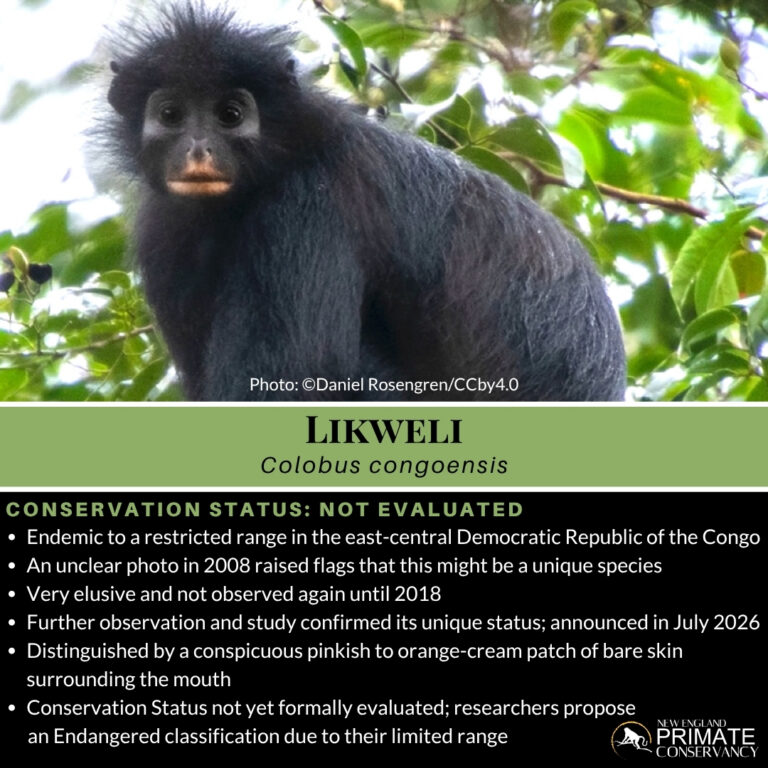
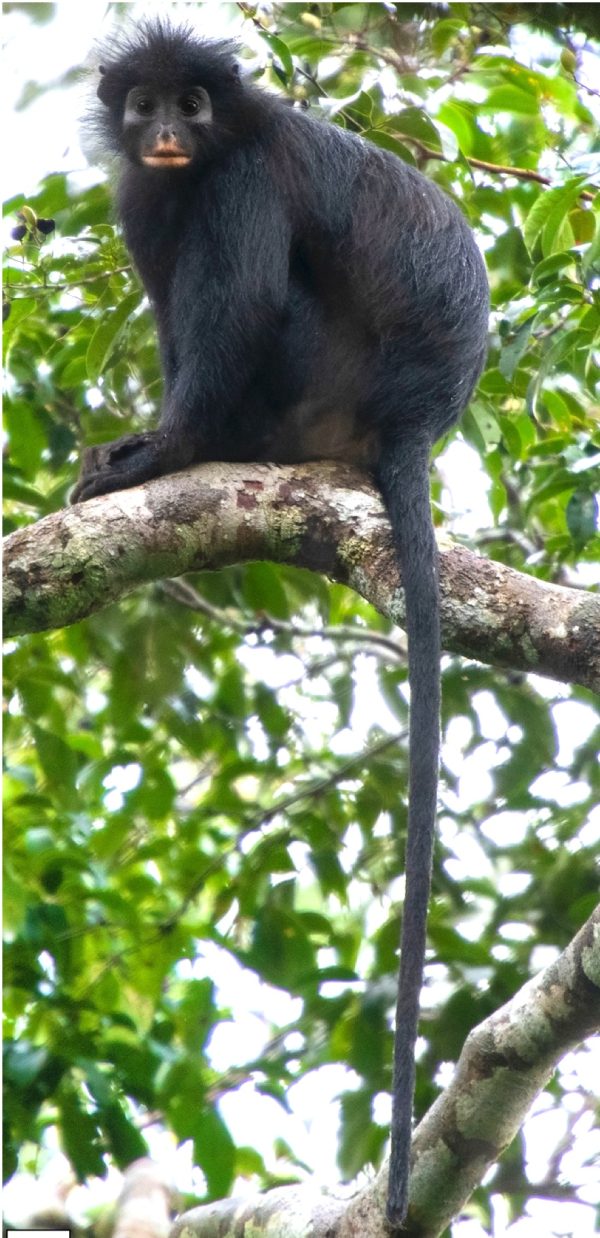
Unlike many other Colobus species, which have conspicuous black-and-white coats, the likweli’s limbs and torso are essentially entirely black. They are especially similar in their overall black pelage to their closest relative, the black colobus.
The coat is somewhat shaggy, with the longest hairs occurring across the shoulders and upper back, giving some individuals a glossy, cape-like appearance. Males have longer mid-back hair—about 3.54-4.92 inches (9-12.5 cm)—than the females examined, whose corresponding hairs measured about 2.36-3.15 inches (6-8 cm). This longer hair down the middle of the back may contribute to the species’ distinctive silhouette, although its specific adaptive function has not been demonstrated. The head is framed by long black hair on the forehead and sides of the face, approximately 1.57-2.36 inches (4-6 cm) long. This creates something resembling a small crest or crown. Interestingly, the researchers noted that the likweli’s facial appearance—including the light-colored facial skin and crown-like hair—is reminiscent of some Asian colobines.
The most distinctive feature of the likweli is the piebald facial pattern. Most of the face is dark and hairless, but a conspicuous pinkish to orange-cream patch of bare skin surrounds the mouth. It extends upward along the upper lip to the base of the nose, and reaches the lower portions of the nostrils. The extent varies among individuals: in some, the pale area covers much of the lower face, while in others it is concentrated mainly around the mouth up to the base of the nose. The skin around the pronounced cheekbones and temples is dark gray, while the eyelids and skin immediately surrounding the eyes are black. Together, these contrasting areas give the likweli’s face a striking mask-like appearance. The function of the unusual facial coloration is not yet known. It could potentially aid visual recognition between individuals or group members, particularly in the dim, cluttered environment of a rainforest canopy, but that would be speculative. The researchers treat the facial pattern primarily as a diagnostic characteristic distinguishing the likweli from other Colobus species.
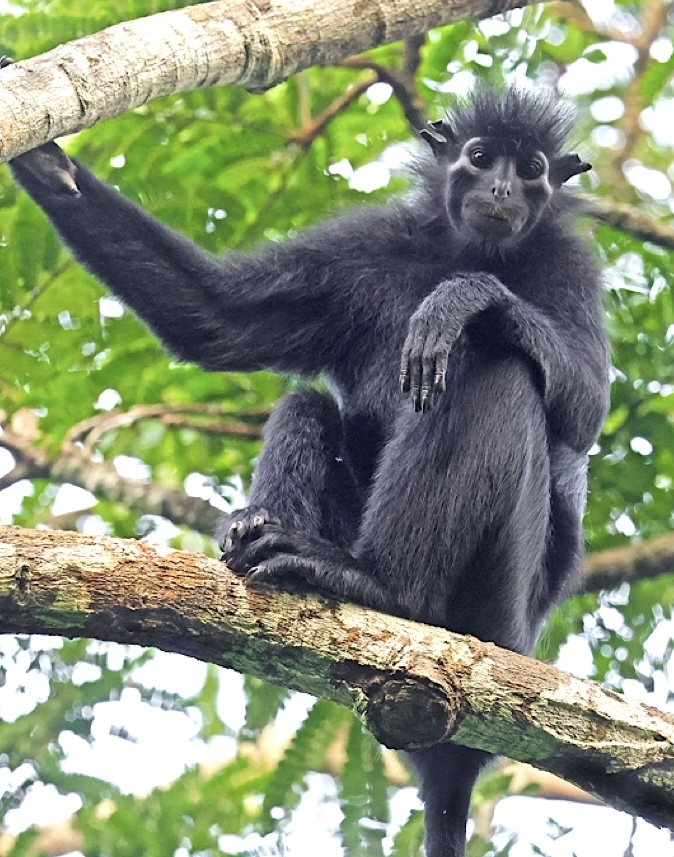
The ears are large, black, and distinctly folded, with crenulated (scalloped or ridged) margins. This feature is shared to some degree with the black colobus. The skull is relatively small compared with other Colobus monkeys, consistent with the likweli’s small overall body size. The skull has a relatively narrow, elongated basicranium, which is the bottom part of the skull that supports the brain and connects to the face and spine. The skull also has a modest frontal “bulge” or saddle-shaped profile. These characteristics are useful for identifying the species but are unlikely to have an obvious ecological function that can currently be established.
The likweli has the grasping hands and feet characteristic of colobine monkeys, allowing them to maintain a secure grip on branches while moving through the canopy. This is particularly important because field observations found that likwelis spend most of their time in the canopy and middle levels of mature forest. They only rarely descend to the ground.
More importantly, their dentition (teeth) shows clear specialization for a leaf-heavy colobine feeding strategy. Like other colobines, they have molars with high cusps and relatively low crowns, features associated with processing fibrous plant material. Their dental anatomy differs in several respects from other Colobus, however, and the researchers suggest that these differences may indicate a distinctive dietary ecology. Exactly what the likweli eats remains insufficiently studied.
The tail is predominantly black and very long, contributing substantially to the likweli’s overall length. Unlike the black colobus, they don’t have a large tuft of elongated hair at the base of the tail. Instead, the hair is relatively short, becoming only slightly longer near the base—approximately 0.78-1.9 inches (2-3 cm) there versus about 0.39-0.59 inches (1-1.5 cm) along the remainder. The likweli’s tail is non-prehensile, meaning it is not used for grabbing or grasping. The long tail is particularly useful for an arboreal monkey because it can function as a counterbalance while moving along branches, helping maintain stability during climbing and leaping. That general function is well established for arboreal primates, although the PLOS publication did not experimentally examine how likwelis use their tail.
Both sexes possess a conspicuous white patch around the anus, between pale orange sitting pads. This is unusually extensive for a Colobus monkey: it measures approximately 3.54 by 1.97 inches (9 × 5 cm) in the male and 4.72 by 2.36 inches (12 × 6 cm) in the female examined. This is also where the most obvious sex difference in external appearance occurs: in males, the white patch is sparsely covered with fine white hairs, while in females, the patch is largely hairless. Thus, although males and females have very similar overall pelage coloration, the texture of this conspicuous white patch differs between the sexes. The function of the patch is not yet known. Its conspicuousness raises the possibility that it plays a role in visual communication or social recognition, but this has not been demonstrated. There is one other possible sex difference: the single male specimen possessed a small black terminal tuft at the end of the tail, which was not observed on either of the two female specimens. However, because only one male was examined, the researchers couldn’t establish whether this is genuinely a male-specific characteristic or simply individual variation.
Older likwelis may develop gray hairs along the back of the tail and rear portion of the body. One of the examined females displayed this graying along with heavily worn teeth, indicating advanced age. There is no evidence of a dramatically different infant coat comparable to the strikingly different infant coloration seen in some other primates. The researchers observed young likwelis in February, April, July, August, and September, and specifically noted that the young already possessed the full black coloration and characteristic piebald facial pattern of adults.
Diet
The likweli’s diet has not yet been directly documented. The PLOS publication explicitly identifies diet as an important area for future research. Therefore, a diet can be classified provisionally from the likweli’s anatomy and relationships with other Colobus, but this profile will not give a precise percentage breakdown or claim that particular plant species are regularly eaten.
The likweli is best described as a primarily folivorous herbivore, probably consuming a mixture of leaves, fruits, seeds, flowers, and other plant material. However, their exact diet and the relative importance of these foods remain unknown. The strongest evidence comes from the likweli’s anatomy. Colobus monkeys generally consume substantial amounts of mature and/or young leaves, and their dental morphology is associated with leaf consumption and, in some species, considerable seed eating. The likweli’s teeth are particularly interesting because they do not resemble the highly seed-specialized dentition of their closest relative, the black colobus. The researchers therefore concluded that the likweli is probably less granivorous (seed-eating) than the black colobus, and may rely on seeds even less than other Colobus species, with a dietary profile potentially more similar to red colobus monkeys (genus Piliocolobus).
At present, a safe description of the likweli’s diet can be summarized as this:
- Leaves: probably an important component, consistent with the feeding ecology of Colobus.
- Young leaves: potentially particularly valuable, because they are generally less fibrous and chemically defended than mature leaves.
- Fruits: likely consumed when available, although their importance in the likweli’s diet has not been measured.
- Seeds: probably eaten, but apparently not a major dietary specialization like they are for the black colobus.
- Flowers and buds: potentially supplementary foods, as they’re eaten by other Colobus species.
- Other plant material: stems, bark, or shoots could potentially contribute to the diet, but there’s currently no species-specific evidence establishing their importance.
Behavior and Lifestyle
The likweli is predominantly arboreal and diurnal, or most active during daylight hours. As mentioned previously, they tend to spend most of their time in the canopy or middle levels of mature forest, and are rarely observed on the ground. A formal daily activity budget has not yet been established. Their characteristic roaring calls, which will be mentioned again in the Communication section, have been heard throughout the day, but particularly in the morning, suggesting that the early part of the day may be an especially important period for communication.
The species typically lives in small groups, with observed groups ranging from one to 20 individuals and averaging around six individuals. Which primates they co-mingle with specifically will be discussed in the next section. These associations may allow individuals to exploit the complex canopy environment while potentially benefiting from increased vigilance against predators, although the specific advantages of these mixed-species groups have not yet been studied.
The likweli is highly adapted to life in the forest canopy. They normally move through the canopy and middle levels of mature forest, where their long tail and grasping hands and feet help them maintain balance and move between branches. The long tail is particularly useful as a counterbalance during climbing and movement along narrow or unstable branches. Direct observations of their precise locomotor techniques are still scarce, so it’s not yet possible to determine how frequently they leap, climb, or walk quadrupedally (on all fours). The species’ preference for high, closed-canopy forest nevertheless suggests that their movements are primarily arboreal rather than terrestrial. In the few observations in which individuals descended from their normal position, they quickly returned to the middle or higher levels of the forest.
Very little is known about the likweli’s resting or sleeping behavior. Researchers have not yet documented whether they construct sleeping nests, reuse particular sleeping trees, or select specific locations for overnight refuge. Consequently, no reliable description of its sleeping sites or nightly behavior can currently be provided. Their consistent use of the canopy and middle levels of mature forest may nevertheless provide protection from some terrestrial dangers. More research is needed to determine whether likweli select particular canopy locations for sleeping and whether these choices are influenced by predators, weather, or proximity to other members of their group. However, observations of closely related colobus monkeys suggest that likweli probably sleep in elevated trees rather than on the ground and likely rest directly on branches rather than constructing elaborate sleeping nests. Other colobus monkeys commonly select tall trees that provide protection from terrestrial predators and may reduce vulnerability to aerial predators. Sleeping sites are also often located near important feeding areas, potentially allowing groups to reduce travel costs and begin foraging soon after becoming active. Other colobus species tend to use multiple sleeping trees rather than returning to the same site every night, which may make their locations less predictable to predators. These patterns are plausible for the likweli given their strongly arboreal lifestyle and dependence on mature forest, but, once again, species-specific research is needed to determine whether they follow the same strategies.
The likweli’s most clearly documented predator is the crowned eagle, a major forest raptor capable of hunting monkeys. During one observation, a group of approximately 10 likweli was attacked by one of these eagles. Rather than remaining in the canopy, the monkeys moved into the understory, demonstrating that they can change their position within the forest in response to an aerial predator. During the attack, the group also produced an intense bout of rapidly repeated roars. Likweli produce these calls in a variety of circumstances, including apparently normal social interactions and situations involving potential danger. Multiple individuals have been observed roaring together, and the particularly intense vocal response during the crowned eagle attack suggests that vocal communication may help coordinate group members or warn them of danger. Living in groups and frequently associating with other primates may provide additional opportunities for detecting predators. A greater number of individuals scanning the surrounding forest can increase the likelihood that an approaching predator will be detected, although this specific function has not yet been demonstrated in the likweli. Their preference for high, closed-canopy forest may also influence predator avoidance. Remaining above the ground reduces exposure to terrestrial threats, while the dense structure of mature forest provides numerous branches and layers into which an individual can escape. When confronted by an aerial predator, however, likwelis can reverse this strategy by moving downward into the understory, as documented during the crowned eagle attack.
Ultimately, more research is needed to discover more fascinating information about the behavior and lifestyle of the likweli.
“Ribbit!” Says the… Monkey!?: The likweli’s vocalizations have been described in news publications as sounding very frog-like! How interesting is that!? Don’t believe me, give this clip a listen!
A Long Time in the Making: The likweli first caught scientists’ attention in 2008, but it wasn’t until 2018 that researchers got their first clear look at it. Years of study followed, eventually confirming that the likweli was a unique species.
New Discoveries, Every Day: The likweli represents the fifth new species of African monkey to be described in the last 75 years!
As mentioned previously, likweli typically live in small groups, with observed groups ranging from one to 20 individuals and averaging around six individuals. Small groups appear to be typical, although solitary animals and substantially larger groups have also been recorded. Another gap of knowledge regarding the likweli is group composition. The PLOS publication doesn’t provide a ratio of adult males to females in a group, nor does it have enough information to determine whether likweli groups are normally one-male/multifemale, multimale/multifemale, or another arrangement. The researchers did, however, observe adults accompanied by young in February, April, July, August, and September. This confirms that groups include dependent or immature individuals alongside adults, but the available observations are insufficient to determine the proportion of juveniles or the age structure of a typical group.
At present, there is no evidence to sufficiently describe a likweli dominance hierarchy or identify a particular individual as a leader among likweli groups. There has been no long-term study (yet) of identified individuals that would allow researchers to determine whether males, females, or particular age classes consistently influence movement, access to food, vigilance, or conflict resolution. Their vocal behavior, however, provides an intriguing avenue for future research. Likwelis produce loud roar-like calls, and their vocalizations are structurally similar to those of the black colobus, although the details of the calls differ between the species. Since loud calls in colobus monkeys can function in spacing, contact, alarm, or coordination, these vocalizations may have social significance, but we shouldn’t assign a specific function to the likweli’s calls until behavioral observations via research establish what individuals are doing when they call.
With regard to group dynamics and life history, there is currently no published information establishing whether likweli males or females normally disperse from their natal groups, at what age they do so, or whether they form new groups or join established ones. In some Colobus, young males eventually leave their natal groups and may attempt to establish themselves in another group, while social organization can vary considerably between populations. For example, Rwenzori colobus can have both one-male and multi-male core units, demonstrating that even closely related colobus monkeys do not necessarily follow a single rigid social model. Therefore, for the likweli, the safest conclusion is simply that natal dispersal and group formation remain unknown.
Now, for associations with other primates, here’s where things get a bit interesting. Likwelis frequently travel in mixed-species groups with other primates; 45 of 62 observations in which group composition was known involved associations with two to six primate species, including Angolan colobus and Lomami red colobus. These mixed-species associations could potentially provide several advantages, including greater vigilance against predators, improved detection of threats, or increased foraging efficiency. However, these functions have not been demonstrated specifically for likwelis yet, so more research is needed.
The best-documented form of communication in the likweli is vocal. Researchers recorded six roaring events in Lomami National Park during 2020 and 2021. Although they couldn’t determine the sex of the callers, more than one individual was heard calling during several recordings, and multiple individuals were directly observed vocalizing together. The calls were recorded at locations 1.86-9.32 miles (3-15 km) apart, probably representing different social groups.
The likweli’s principal documented vocalization is a deep, loud roar. Roaring occurred throughout the day, but was particularly common in the morning. The researchers identified two forms within roaring sequences: a louder, more prominent primary roar, and a shorter, less pronounced secondary roar. Primary roars generally showed frequency modulation and were usually preceded by a short snort. Secondary roars were less strongly modulated and, unlike that in the closely related black colobus, were not consistently preceded by another snort. The calls are acoustically distinctive enough to help distinguish the likweli from other colobus monkeys. While their roars most closely resemble those of the black colobus, likweli roars have higher frequencies on several acoustic measures, a distinctive frequency pattern, and characteristic differences in the structure and sequencing of primary and secondary roars. They can also be distinguished in the field from those of the Angola colobus by their relatively rapid pulse rate, and a distinctive snort occurring between some roar sequences. This is significant because the vocal differences were part of the evidence used to establish the likweli as a distinct species. The precise social function of the roar has not yet been established. The researchers observed roaring in several different circumstances, so it would be premature to label it exclusively as a territorial, contact, mating, or alarm call.
The likweli has one unusual visible feature that becomes especially conspicuous during vocalization: the pale pinkish-to-orange-cream skin surrounding the mouth. Researchers observed that this bare facial area produces a distinctive visual display when an individual roars. The contrast between the dark face and pale mouth region makes the mouth especially conspicuous as it opens during a vocal bout. While this is a documented visible effect, its communicative function remains uncertain. The researchers did not document that other likwelis responded to the mouth coloration independently of the roar itself. In addition, no detailed observations have yet established a repertoire of facial expressions, threat postures, gestures, or other visual signals in the species.
With regard to tactile, or touch-based communication, there’s currently no published behavioral study documenting this in the likweli. As a social colobine, they presumably have opportunities for physical interactions among group members, but the available field observations have not established the frequency or function of behaviors such as grooming, embracing, infant carrying, play, or physical reassurance. The same goes for scent-marking, or other chemical-based communication; there’s currently insufficient evidence to determine whether olfactory, or scent-based cues play an important role in maintaining social relationships, recognizing individuals, or communicating between groups.
Despite being documented in mixed-species associations with other primates, no studies have yet demonstrated that likwelis and these other primates deliberately interpret or respond to one another’s calls. It’s safest to say that the likweli lives within a community in which multiple primate species communicate vocally, while it cannot yet be claimed that they have a documented system of interspecific (between-species) communication. If we circle back to the crowned eagle attack, the likweli’s calls could potentially interact with the alarm behavior of other species in these mixed-species communities, but this has not yet been documented.
Once again, more studies are needed to unlock more information on the communication repertoire and relevant responses among the likweli.
At present, the age at which male and female likweli reach sexual maturity is unknown. The researchers have specifically identified reproductive biology as an area requiring further study. Likewise, the likweli’s mating system has not been documented. There’s not enough evidence to classify it confidently as polygynous (one male-multiple female), monogamous (one male-one female), or another mating system. This is particularly important because social structure alone does not establish a mating system. As mentioned in an earlier section, likwelis have been observed in groups averaging about six individuals, including groups containing adults and young, but the available observations do not establish which individuals mate with one another, or whether reproduction is concentrated among particular males or females.
Their reproductive signals are also unknown. No published study has established whether individuals use particular vocalizations, postures, facial displays, genital presentations, scents, or other behaviors to indicate reproductive condition or interest. There is also currently no species-specific estimate for likweli gestation length. Similarly, researchers have not yet documented whether births are normally singletons or twins, nor whether reproduction follows a distinct breeding or birth season.
What can closely related colobus monkeys tell us? Black colobus are generally described as polygynous, with males and females living together in social groups, and they generally give birth to a single infant after a gestation of approximately 195–200 days. Females reach sexual maturity at roughly four years and males at roughly six years. Other Colobus species show broadly similar reproductive patterns. For example, Angolan colobuses have been reported to have a gestation of approximately 147–178 days, usually produce a single infant, and have a relatively long period before weaning. These similarities suggest that the likweli may well share the generally slow reproductive pace characteristic of colobus monkeys, but these are inferences, not facts.
Surprise, surprise (not), infant and juvenile behavior among likwelis is almost entirely undocumented. We know that groups can contain young individuals, establishing that reproduction occurs and that offspring remain associated with groups after birth. However, observations so far have not provided enough information to establish a developmental timeline. In particular, we do not yet know the ages at which likweli infants: begin moving independently of their mothers, begin eating solid foods, become less dependent on being carried, begin participating extensively in social interactions, become weaned from their mother’s milk, or reach full social and reproductive maturity. Nor is it known whether juveniles remain in their natal groups until maturity or whether males and females have different dispersal patterns.
Although we can’t yet describe the likweli’s reproductive schedule, their ecology provides an important context for understanding why a slow reproductive strategy would be plausible. Colobus monkeys generally have relatively long developmental periods compared with many smaller mammals, and their arboreal lifestyle places substantial demands upon infants. Young must develop the strength, coordination, and behavioral skills necessary to move through the canopy while remaining close enough to caregivers to avoid predators and other dangers. For the likweli specifically, the environment is characterized by high-canopy forest, a diverse primate community, and predators like crowned eagles. The species’ documented response to a crowned eagle attack shows that predation is a genuine danger. However, we should resist claiming that predation causes a particular likweli birth rate or developmental schedule. There simply isn’t enough data yet.
As a primarily leaf-eating primate, the likweli likely influences the vegetation of their forest habitat through feeding. By consuming leaves, shoots, flowers, and other plant material, they remove portions of vegetation and may influence plant growth and nutrient cycling within the forest. If fruits and their seeds make up a significant part of their diet, which remains to be determined, the likweli could also contribute to forest regeneration by dispersing seeds through their feces as they move through the canopy. Finally, as an arboreal primate, they form part of the forest food web and serve as prey for predators within their range.
However, because the likweli was only recently described, the specific ecological effects of their feeding, seed dispersal, and role as prey have yet to be studied.


The International Union for Conservation of Nature has not yet listed the likweli on the IUCN Red List of Threatened Species.
The researchers who discovered this species have proposed an Endangered listing. The reasoning behind this listing is due to the likweli’s extremely restricted geographic range, small, localized population size, and potential threats that are expected to become more serious in coming decades. Importantly, the PLOS publication notes that most of the known range is currently inside Lomami National Park, and that there is no evidence that hunting or habitat loss have already caused a major historical decline. Thus, some of the threats below are projected or emerging, rather than documented causes of a past population collapse.
The likweli’s restricted distribution makes them particularly vulnerable to habitat loss and conversion. Likwelis depend heavily on mature, high-canopy forest, particularly those growing on deep clay soils and terra firma forest islands. Consequently, conversion of these forests for agriculture, settlements, logging, or other human activities could remove suitable habitat and fragment populations into increasingly isolated patches. The researchers identify habitat conversion and increasing human population pressure as important threats likely to affect the species in the future.
Hunting is another major concern. The researchers note that likwelis were apparently not specifically targeted by hunters historically, and local informants did not report a reduction in the species’ range within living memory. However, they warn that increasing hunting pressure could become a serious threat. Since likwelis occur in small, localized populations and have relatively low encounter rates, even moderate increases in hunting could remove a substantial proportion of the population. Hunting is therefore particularly concerning because it could reduce the number of breeding individuals before population declines become obvious.
Finally, the likweli’s dependence on high canopy, old growth forest which have trees which haven’t regrown after a period of human-caused disturbance adds another layer of vulnerability. The researchers identify characteristics that increase extinction risk in colobines which apply to the likweli: their dependence on high canopy, old growth forest, and their body mass of more than 11 pounds (5 kg). These characteristics can make colobus monkeys especially vulnerable to habitat disturbance and hunting.
The likweli is not yet listed in an Appendix of the Convention on International Trade in Endangered Species (CITES), an international agreement between governments whose goal is to ensure that international trade in specimens of wild animals and plants does not threaten their survival. Other species in their genus, Colobus, are listed in CITES Appendix II, including the black colobus, the likweli’s closest relative. However, this genus-level precedent doesn’t automatically extend CITES protection to the newly described likweli. An eventual CITES listing could provide additional safeguards against international trade if, such trade becomes a concern.
The likweli’s primary protection comes from Lomami National Park, within which most of their known range occurs. The park was established through collaboration between the Lukuru Foundation and the Congolese Institute for Nature Conservation (ICCN), the government agency responsible for protected areas and wildlife in the Democratic Republic of the Congo. The Frankfurt Zoological Society (FZS) supports the park’s ongoing co-management and protection, working with ICCN to safeguard the park and its buffer zone. However, legal protection does not guarantee the likweli’s security, as increasing hunting pressure and habitat conversion remain potential threats to their small, localized population.
Local communities are also an important part of conservation efforts. Researchers have worked with residents of communities surrounding the park to gather information about the likweli and their distribution, while park-awareness gatherings have been organized with local, administrative, and traditional authorities. The species’ describers specifically recommend continued engagement with local communities to discourage hunting of likweli. Since most of the species’ known population occurs within a protected area, combining effective park protection with community involvement will be particularly important for their long-term survival.
Continued research and monitoring are also needed. Field surveys have involved scientific researchers, ICCN eco-guards, and local community monitors, helping to document the species’ distribution and abundance. Further monitoring will be necessary to determine whether the likweli’s population is stable and whether threats such as hunting and habitat conversion are increasing. As a species only formally described in 2026, the likweli currently lacks a large, species-specific conservation program. Protecting their existing habitat and building effective partnerships with surrounding communities are their most immediate conservation needs.
- https://www.cambridge.org/core/journals/oryx/article/bushmeat-hunting-around-lomami-national-park-democratic-republic-of-the-congo/1EDAF3EEDD8E44D1EB881246888BC939
- https://ebs.publicnow.com/view/04FAE2AC637A7EFCCA65C1DDF372C0FD0BE1FBDC
- https://en.wikipedia.org/wiki/Likweli
- https://en.wikipedia.org/wiki/Lomami_National_Park
- https://www.eurekalert.org/news-releases/1135335
- https://fzs.org/en/news/striking-new-species-of-african-monkey-discovered-in-the-congo-rainforest/
- https://www.iflscience.com/mysterious-masked-monkey-is-the-fifth-discovered-in-africa-in-75-years-and-it-may-already-be-endangered-84109
- https://www.ivis.org/library/comparative-placentation/angolan-colobus-monkey-colobus-angolensis
- https://journals.plos.org/plosone/article?id=10.1371/journal.pone.0349857
- https://journals.plos.org/plosone/article?id=10.1371%2Fjournal.pone.0217666
- https://karger.com/fpr/article/92/1/35/144093/Diet-and-Activity-Budget-in-Colobus-angolensis
- https://www.mdpi.com/2673-4133/6/1/2
- https://news.mongabay.com/short-article/2026/07/new-colobus-monkey-likweli-confirmed-in-drc/
- https://news.yale.edu/2026/07/15/meet-likweli-new-monkey-species-discovered-congo-basin
- https://primate.wisc.edu/primate-info-net/pin-factsheets/about-the-primates/behavior-and-ecology/table-of-primate-reproduction-data/
- https://pmc.ncbi.nlm.nih.gov/articles/PMC8857510/
- https://pubmed.ncbi.nlm.nih.gov/9651650/
- https://www.sciencedirect.com/topics/agricultural-and-biological-sciences/colobus
- https://theconversation.com/meet-likweli-the-newly-named-monkey-that-hints-at-congos-hidden-secrets-288022
- https://www.washingtonpost.com/climate-environment/2026/07/16/new-monkey-species-likweli-is-found-congolese-rainforest/
Written by Sienna Weinstein, September 2026