
Green Monkey, Chlorocebus sabaeus
GREEN MONKEY
Chlorocebus sabaeus

Geographic Distribution and Habitat
The green monkey (Chlorocebus sabaeus), also called the Western green monkey or Sabaeus monkey, is native to West Africa. This widespread monkey is distributed over an area of 386,000 square miles (1,000,000 km²), with populations in Côte d’Ivoire, Ghana, Liberia, Burkina Faso, Guinea, Guinea-Bissau, Mali, Mauritania, Senegal, Sierra Leone, and The Gambia. Living south of the Sahara Desert, the western edge of their range in Dakar, Senegal, is at the Atlantic Ocean, while the eastern edge of their range in Burkina Faso and Ghana is marked by the Nakambé and Volta River system. A population of green monkeys is also found on the islands of the Bijagos archipelago in Guinea-Bissau.
European explorers took green monkeys as pets to places far from their native African roots, leading to wild populations being established on the islands of Cape Verde off the coast of Africa, and in the Caribbean nations of Barbados and Saint Kitts and Nevis. A feral population also exists in the mangroves of Southern Florida, established from escapees from a medical research facility.
Green monkeys live in diverse habitats in West Africa, including riverine woodlands, savannas, mosaic landscapes of savannas and forests, mangrove forests, plantations and orchards. They have adapted to a variety of conditions, being able to survive in dry thorn forests, swim in the sea and rivers, and navigate the tricky conditions of dense, wet mangroves. The elevation in their habitats ranges from 0 feet (0 m) at sea level, up to 3,281 feet (1000m) above sea level.
Outside of West Africa, introduced populations have successfully established themselves in diverse habitats too, ranging from the dense, dry, deciduous secondary forests in Barbados, mountain ranges in Cape Verde, and coastal mangroves in Florida.
Across their wide range in West Africa, green monkeys experience temperatures ranging from 34°F to 135°F (1°C to 57°C). The climate is characterized by two sharply defined seasons: the dry season from November to May, and the wet season from June to October. Rainfall is variable too, and can be as low as 0.004 inches/month (0.01 cm/month) in the dry season and up to 55 inches/month (140 cm/month) in the wet season in the southern parts of their geographical range in Côte d’Ivoire.
While the wet season brings bountiful resources, the dry season can be punishing, requiring green monkeys to travel over long distances to find food. At its worst, with temperatures up to 135°F (57°C), the hot and dry climate can cause a pause in reproduction, high mortality among adults, stillbirths, and miscarriages. Babies are usually born towards the end of the dry season, so that their infancy aligns with the beginning of the wet season, with plenty of food for the growing monkeys.
Historically, green monkeys, along with five closely related species, were all considered subspecies of a single widely distributed species, Cercopithecus aethiops, and all were called ‘vervet monkeys’. Modern analysis of physical and genetic differences resulted in these six ‘subspecies’ being reclassified as independent species in a distinct genus, termed Chlorocebus.
Various species of Chlorocebus are distributed across sub-Saharan Africa, with distinct ranges that overlap at the edges. For example, at the Volta River in Ghana, the green monkey’s range overlaps with the neighboring tantalus monkey. Some monkeys here look like intermediates between green and tantalus monkeys both physically and genetically, indicating that these species might occasionally mate and produce hybrids.

Size, Weight, and Lifespan
Green monkeys are estimated to live ~27 years in the wild. Male green monkeys are larger and heavier than females. This size difference between males and females gets smaller going from north to south of their range, and northern males are noticeably larger than their female counterparts.
On average, males have a head and body length between 16.5 inches and 23.6 inches (42 cm and 60 cm), while females are between 11.8 inches and 19.7 inches (30 cm and 50 cm). Their tails are often longer than their bodies, with males having tail lengths between 18.1 inches and 29.9 inches (46 cm and 76 cm), and females between 16.1 inches and 26 inches (41 cm and 66 cm). Male green monkeys weigh 11.2 pounds (5.1 kg) on average, with females being around 70% of their size, weighing 7.7 pounds (3.5 kg) on average.
Appearance
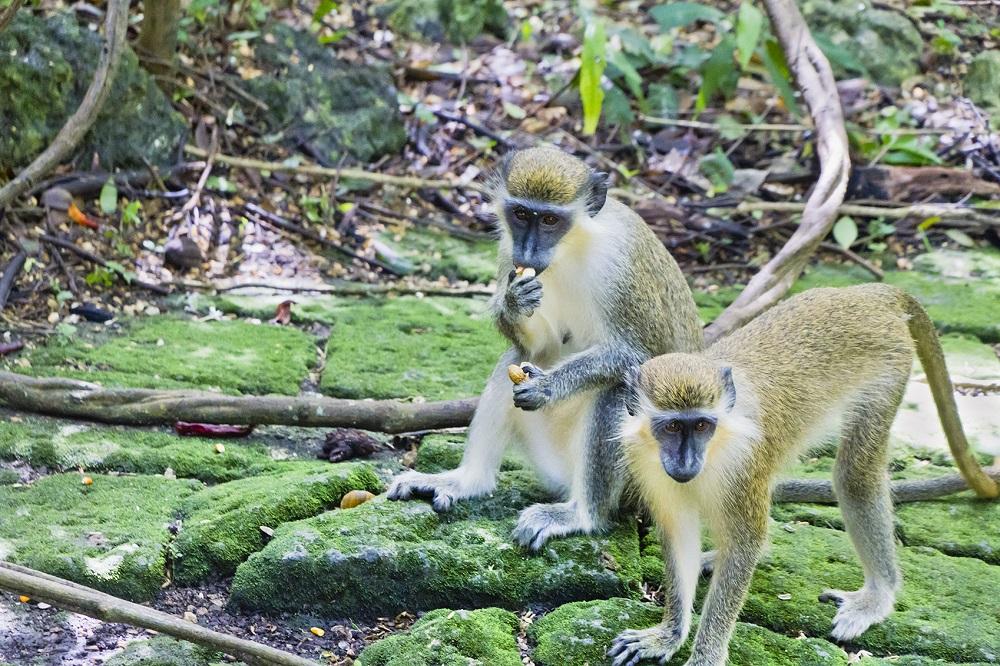
Green monkeys get their name from the bright golden-green fur on their crown, extending down the back of their head and neck, and onto the upper parts of their body. Their faces and ears are black, framed by lemon-yellow whiskers that give them a strikingly contrasting beard. In some populations, this beard can be orange-ish, standing out even more against their dark facial skin. Their eyes are a rich red-brown color, fringed with pale yellowish brows, which distinguishes them from other closely related species that have a much whiter, distinct brow-ridge. The lower part of their limbs, hands, and feet are light-grey colored, and their stomach and chest are off-white. Their long greyish tails have a pale yellow base and a golden-yellow tip. The fur color changes going from north to south, with northern green monkeys having yellower fur on their back. Babies are born with dark fur and pale faces, and gradually transition into having golden-green fur and darker faces as they grow up.
Males have a pale blue scrotum, covered with yellow hairs. This color can vary depending on the social status of the male, with dominant males having brighter blue scrotal skin. Their scrotum also lightens and becomes less blue as they age. Their red penis and blue scrotum are surrounded by white and yellow-orange hairs, and males use this contrast as a visual signal to exert their dominance. Differences in this scrotal color are another way in which closely related Chlorocebus species can be distinguished.
Diet
A varied and flexible omnivorous diet makes green monkeys adept at surviving in various habitats. They feed on all parts of plants, preferring fruits, young leaves, seeds, and flowers, and supplementing this with buds, young twigs, stems, bark, and gum. They even eat thorns of the red acacia tree.
In addition to being adept plant foragers, they are skilled hunters, and prey comprises almost half of their diet. They eat invertebrates such as insects and insect larvae, and vertebrates like bird eggs, birds like turtledoves and grey-headed sparrows, lizards, and small mammals like Nile rats and young hares. Their diverse palate includes unusual food items like fungi, bird poop, and soil from termite mounds. During the dry season, when food is scarce, they even dig out West African marbled lungfishes resting in their underground burrows.
Hunting such diverse prey requires varied skills. To capture Nile rats, green monkeys employ both passive and active strategies. They ambush rats by resting on the ground near their burrows and keeping a close watch for their scurrying movements. They also use their keen sense of smell to find crevices where the rats hide, digging them out and catching them. Adult males may chew whole rats at once, while other monkeys may bite the head off, turning the rats inside out to access the meat. No part of the hunted rat goes to waste, as young green monkeys feed on the discarded skin and organs.
To catch birds like turtledoves, green monkeys hunt among the branches. Large adult monkeys jump through the branches to startle turtledoves, jumping and catching them mid-air as they’re trying to fly away. Younger monkeys, being smaller, quietly sneak up on turtledoves resting on thin branches higher up in the canopy, inching closer till they can catch them off guard, and eating them among the higher branches where their catch is safe from the older, heavier monkeys. Once caught, they pluck the feathers of the birds prior to eating them.
Eating insects requires yet other strategies. Green monkeys jump and catch flying termites and tear off bark to extract hidden caterpillars. At early dawn, they search for and catch spiders, which are slower after being numbed from the cold overnight.
Their habitat can make them more exploratory in their diet too. In mangrove swamps, they feed on aerial roots of red mangrove trees, and prey upon fiddler crabs. To hunt these crabs, they reach into shallow burrows in the sand where the crabs hide. They also dig into the sand, choosing stable, non-collapsing mud holes, reaching deep for crabs that have burrowed farther in. Once a crab is caught, they pull off the larger claw, which is dangerous and too hard to eat, before opening up the crab to feed on the fleshy interiors.
In the wet season, they wade into flooded areas cautiously, standing upright on their rear legs and using their tail as additional support to find and eat water lilies.
Behavior and Lifestyle
Green monkeys are diurnal and semi-terrestrial, spending 28-61% of their time on the ground and 28-75% in trees, depending on the habitat. When in trees, they usually prefer lower heights and mostly stay between 0 feet and 32.8 feet (0m and 10m). Sometimes, they venture higher up to 65.6 feet (20m), but rarely go above this height. They are quadrupedal and use all four limbs to move and climb through trees. They can stand upright and use a bipedal stance for specific behaviors like watching for predators.
These monkeys can swim readily up to 328 feet (100m), and even mothers swim while carrying their infants. When traveling between islands at high tide, they use a combination of swimming and kangaroo-like jumping.
When crossing open areas, adults often move directly on the ground. Juveniles, often accompanied by guardian adult females, prefer moving through the canopy for safety from predators lurking on the ground. Usually, green monkeys feed and forage for ~24% of their day, travel for ~33%, spend ~34% of their time resting, and spend the rest (~9%) on social activity. But their daily life can vary a lot depending on the season and the habitat.
In mangrove forests, they have access to high-quality foods like fiddler crabs and plant roots that fulfill their nutritional needs quickly. Here, feeding can occupy as little as 8% of their time, traveling accounts for 20-25%, and rest is plentiful, occupying 43-64% of their day. In contrast, in the dry thorn forests of Northern Senegal, food is sparse and the dry season brings water scarcity. Foraging here takes up to 32% of their day, and constant travel in search of resources means that up to 48% of their time can be spent moving. Sleep takes a backseat, and green monkeys here may spend only 23% of their time resting. To combat the heat of extreme dry seasons, lactating females conserve energy by reducing their feeding time and increasing their rest. Once the rains arrive, these hungry mothers can feed for up to 55% of their day.
Green monkeys like sleeping in large, tall trees when possible, with a clear view of their surroundings, preferably along riverbanks, lakes and swamps. They share their sleeping trees with neighboring troops, and also with other primate species such as white-naped mangabeys and olive baboons. Sleeping in trees, they are often bitten by yellow-fever-infected mosquitoes, and as they travel long distances to different forest galleries and sleep in different trees over days, they spread yellow fever across their own and other species.
Their natural predators are mostly terrestrial, including leopards, pythons, spotted hyenas, wild dogs, and chimpanzees. Some large eagles also bring the threat of aerial predation. Young monkeys are easier prey and are hunted by smaller wild cats like caracals and servals, jackals, and even domestic dogs.
These monkeys have developed sophisticated responses to threats from predators. They have distinct alarm calls and vocalizations specific to different predators. When a leopard is spotted, or a fellow green monkey lets out an alarm call that is leopard-specific, they run up high into the trees to hide. When snake alarm calls are heard, the monkeys may stand upright and search for the snake, potentially to engage in mobbing behavior, cooperatively harassing or scaring off the snake.
In the Senegal River Valley, where domestic dogs owned by shepherds can be potential predators, green monkeys have developed the ability to recognize individual dogs and establish safety distances depending on how aggressive the dog is. Belligerent dogs trigger alarm calls from afar, causing the troop to retreat into the cover of trees. Non-threatening dogs, such as one handicapped by a stiff front paw, or one that is known to be calm, elicit no alarm calls, and adults monitor them closely while remaining seated on the ground.
Watching for predators is an important task to support the troop, and males or juveniles often act as sentinels. They position themselves conspicuously on tall branches, remaining vigilant to monitor threats, and diverting the attention of any predator that shows up while alarming the rest of the troop to flee by barking loudly.
An interesting contrast can be seen when examining predator responses of green monkeys that have been introduced to non-native environments like Barbados, where they face no native predators like leopards, pythons, or large raptors. These introduced populations, being separated from their ancestors and predators for ~350 years, have lost predator-specific alarm calls, with their calls becoming more generalized in structure. But they still maintain their ability to recognize the predator-specific alarm calls made by their West African relatives. When scientists in Barbados played recordings of leopard alarm calls made by West African green monkeys, for example, the island green monkeys reliably fled up into trees to hide.
How did green monkeys get to Florida? Scientists went on a detective mission to trace the origins of a feral population of green monkeys on Dania Beach. Using genetic techniques like analysing their mitochondrial DNA, they found that these Floridian green monkeys have ancestors that came from West Africa.
Their story begins in the 1940s, when wild West African green monkeys were imported from Freetown, Sierra Leone, to the Dania Chimpanzee Farm in southern Florida. This facility operated both as a roadside tourist attraction and as a supply farm providing primates for medical research, including the study of diseases like polio and tuberculosis. Around 1947-1948, a group of green monkeys escaped from an aviary-style enclosure in this facility. While some were found and brought back, a group of 12 to 15 individuals found their way to nearby mangrove swamps and evaded recapture. These resourceful monkeys adapted to their new home, successfully establishing a feral green monkey population that still lives in the mangrove swamps around Dania Beach, Florida today.
Another example of their resourcefulness at foraging comes from the Senegal River Valley. Here, West African marbled lungfish survive the dry season by entering into a state of dormancy, totally dehydrated and encased inside a mucus cocoon hidden within an underground nest. A small opening from this nest reaching above ground allows air to trickle into the resting fishes’ mouths, so that they can continue to breathe. Green monkeys use these openings to trace where the lungfishes are hiding, digging them up and eating them, a crucial nutrient-rich snack at a time when food is otherwise scarce.
Green monkeys are very social and live in groups with multiple males and females. Each troop usually has a dominant male, who plays an important role in territorial defense. Male status is also reflected in scrotal coloration: dominant males typically have a brighter blue scrotum, while subordinate males have paler coloration. This brighter scrotal color is important to establish male status, since darker males are dominant over those with paler scrotums.
In rich habitats, with annual rainfall >19.7 inches (>50 cm), resources are plentiful, and a small home range provides a reliable supply of food. Green monkeys live in small groups of under 36 individuals in such habitats, sometimes as few as 4-9 individuals per troop, occupying home ranges which are 37 acres to 74 acres (15-30 ha) in size. The troop’s dominant male defends this exclusive territory with ritualized displays and territorial barks. In resource-poor habitats, with annual rainfall <19.7 inches (<50 cm), availability of food in any area can be unpredictable and insufficient. In such environments, troops of green monkeys can have as many as 174 individuals, spread out over large home ranges of up to 346 acres (140 ha). These ranges can overlap between neighbouring groups without any territorial enforcement of boundaries. Such large groups may temporarily split up into smaller one-male, many-female subgroups during rainy and birthing seasons.
Availability of resources can also impact how far troops move during the day. Usually, green monkeys move between 1.25 miles and 5 miles (2 km and 8 km) in their range throughout the day, but the dry season can force them to move as much as 6.8 miles (11 km) each day in search of water. Territorial boundaries between neighboring groups can remain fairly stable, with scientists observing the same boundaries being maintained over 27 years without any obvious physical features separating them.
Female green monkeys typically remain with the group that they are born in for life, while males migrate out of their natal group as they reach puberty. Often, subadult and young adult bachelor males live on the edges of their troop’s home range, being pushed out there by the resident males, encouraging them to find a different social group to disperse into. Male green monkeys continue to move around between troops through their adulthood, repeatedly migrating to explore different social dynamics. Often, females direct aggression towards foreign or immigrating males, determining whether or not they can join the group. This aggressive behavior from females plays a crucial role in shaping male transfers and migration between neighboring green monkey troops.
Intergroup conflict between neighboring troops is often vocal and threat-based, very occasionally escalating into physical combat or injury. During such conflicts, male green monkeys make territorial calls near range borders, and both males and females may scream to show their aggression. Standing up on two legs, with the tail acting as a third support, is a visual threat that might be employed to assert dominance during conflict. When fights break out near shared food sources, they often remain restricted to the involved subgroups, rarely leading to the involvement of individuals from the whole troop.
While intergroup conflicts do occur, green monkeys are quite peaceful and good at sharing resources within and across troops. When a large, localized food source is available, such as a fruit-rich jujube orchard, multiple troops totaling up to 300 individuals can forage together without any aggressive interactions. At rich food patches that are smaller or more restricted in how many individuals can simultaneously feed from them, for example, a single fruiting tamarind tree, troops avoid conflict by queueing up. They wait their turn and access the resource group-by-group, allowing peaceful sharing of ample resources by individuals from various troops.
Beyond their own species, green monkeys can form mixed troops with other primates that share their habitats. These mixed-species groups can include Temminck’s red colobus monkeys, common patas monkeys, or both, in addition to green monkeys. In such mixed groups, grooming and exchange of sexual fluids can lead to transmission of diseases, such as Simian Immunodeficiency Virus (SIV), from one species to another.
Green monkey troops are also associated with non-primate animals such as antelopes, including bushbucks and elands. As the monkeys move through the trees foraging and dropping extra bits of food, these antelopes follow on the ground, opportunistically feeding on the dropped remains.
Living in groups means that communication is key, and green monkeys have a wide vocal repertoire that helps them with this. Different types of calls, grunts, and barks together comprise a whole language, with specific sounds being used for specific purposes.
Dominant adult males emit loud barks at dawn and sunset, from high up in the canopy, advertising their troop’s location, their ownership over their territory, and ensuring that spacing is maintained between neighboring groups. Intra- and inter-group conflicts or territory disputes can lead to noisy screams from both males and females. They also emit soft, friendly grunts during grooming, while handling infants, and to greet one another.
Vocalizations allow troops to maintain coordination during travel. Adult females often make loud screaming sounds to alert the group that it is time to get on the move. Once the group is moving, green monkeys make a specific repetitive vocalization, termed ‘cohesion grunts’, that go ‘cro-cro-cro-cro’, allowing them to keep track of one another’s position as they travel and forage.
Communicating about food is crucial, and dominant adults may make aggressive grunts around food sources to threaten subordinates to wait their turn. Possessive gasps and clicks are used to assert ownership over a piece of food that a monkey is holding, indicating that it is not to be shared. Satiated gasps and clicks may follow once a monkey is resting after foraging.
Subadults or low-ranking individuals may scream when they are experiencing threats or aggression from more dominant monkeys, or when they are startled or punished. They may also scream and make distressed calls to beg for food from high-ranking individuals, expressing submission and eliciting care instead of aggression.
Baby green monkeys make cooing sounds when they want an adult’s attention, and may shriek loudly if their mother prevents them from breastfeeding. A sudden movement or harm can lead to surprised shrieks from infants, while being separated from their mother can make them squeal and scream loudly.
A whole set of calls is dedicated to alerting each other about predators, with specific vocalisations for different threats. For example, if a leopard is spotted, males produce loud barks and females make longer, high-frequency ‘leopard-chrips’. Upon hearing these calls, other green monkeys flee high into trees to avoid predation from a leopard lurking on the ground. When the predator in question is a snake, males emit soft chutters, while females make shorter, lower-frequency ‘snake-chirps’. In response, while some monkeys flee, others stand up on their two hind legs to assess the threat, collectively mobbing the snake instead of running away.
Natural threats from aerial predators are relatively lower in many green monkey populations, since large monkey-eating raptors like eagles are absent from large parts of their range. However, some populations do have a distinct, aerial-predator-specific call. A striking example of their ability to distinguish threats and communicate it vocally comes from an experimental study. When scientists exposed green monkeys in the wild to a novel aerial threat, a flying drone, they responded with distinct aerial calls, different from leopard and snake calls, and very similar to aerial calls made by other closely-related monkey species when faced with predation from eagles.
The ability to make and recognize distinct predator-specific calls is very useful, since escaping from different predators can require different responses. In Barbados, where introduced green monkey populations have been separated from their native predators for over 350 years, these monkeys have lost their predator-specific calls and instead make a generalised alarm call in response to threats. However, they retain the ability to recognise predator-specific calls and respond appropriately when such calls recorded from their West African cousins are played in the Barbados monkeys’ habitats.
While vocalization is an important mode of communication for green monkeys, visual signals can play very crucial roles too. Adult males have a contrasting ‘Red-White-and-Blue’ display, wherein they present their red penis and blue scrotum against the surrounding white fur to assert their territorial and sexual dominance. During territorial disputes, they may also stand bipedally and display their bright white chest fur against their darker abdominal fur, along with jumping and shaking branches, as additional shows of strength. Scrotal color for males lightens as they grow older, and dominant males have brighter scrotums than submissive ones, so this visual signal plays a major role in sexual signalling of both age and status.
Body postures are important to assert dominance too, and high-ranking individuals often walk with a more confident, upright stance. Low-ranking individuals may crouch or cower while walking to signal submissiveness and avoid any physical aggression from the dominant individuals. Facial expressions serve similar roles, with bared teeth signalling submission, while open-mouth expressions signal threats.
Tactile communication via grooming and body contact helps soothe infants. Females and young adults also groom each other and males socially, reinforcing their group bonds. Juveniles might comfort each other by engaging in social suckling, and females may rub their chests against each other, all serving as ways to increase social cohesion in their troops.
Green monkeys are polygynandrous and have a flexible mating system, with one dominant male mating with multiple females in some situations and habitats, and both males and females mating with multiple individuals in other situations. Living in multi-male multi-female social groups allows for opportunities to mate with different individuals, based on the social ranks of both males and females. Each group usually has a dominant male, and females usually prefer to mate with him. But subordinate males also actively solicit and try to mate with females. A female’s social rank can influence how much control she has over who she mates with, since subordinate females are often less successful at rebuffing the attempts to mate from subordinate males, while high-ranking females are able to assert their preference for the dominant male more successfully. Additionally, close associations between females in a group can help in establishing and maintaining their preference for a mate, influencing or shifting the dominance status of males in the group.
Mating in green monkeys is peaceful and does not involve any biting. When they are ready to mate, females solicit males by presenting their genital area to them, putting their tail up. Males perform a stereotypical ‘hip-grab’, holding the female’s calves with their hind feet before mating. While females do not have any visible signs that indicate their reproductive status, males may sniff female genitals to evaluate their readiness to mate.
Lower temperatures in December and January stimulate male sexual motivation, and this leads to many more copulations during this time, often at early dawn. Mating in the cool season means that births are timed to occur between April and July, as the dry season is ending and the bountiful wet season is beginning. Infants grow up with plentiful resources, giving them a head start with nutrition during their early development.
After birth, infants remain dependent on their mother and nursing till they are 5 to 6 months of age. Their infancy leads into their juvenile life as they continue growing and learning till they are about 3 years old. Female subadults are usually between 3 and 4 years of age, attaining sexual maturity and becoming pregnant soon thereafter. Males remain subadults for slightly longer, and attain sexual maturity at around 5 years old. Usually, females produce one offspring a year.
Caring for infants is a communal activity for green monkeys. Females of different troops guard their offspring in common nurseries set up in large trees as they rest through the day. While some adults head out in the afternoon to forage, it is often too hot for the young to go with them. 2 or 3 adult females stay behind and supervise up to 15 young ones, often from different troops, in these day-nurseries. If the punishing heat continues for longer, females relieve each other in babysitting duties, making friendly grunts as they trade responsibilities.

Being expert navigators of open habitats like savannas and mangroves, green monkeys serve as ecological guides for other monkeys less familiar with these environments. In mixed species groups in Senegal, Temmenick’s red colobus monkeys depend on their green monkey group-mates to navigate degraded forest habitats. They wait for green monkeys to lead the way before following closely behind, counting on the green monkeys’ knowledge of local food availability, water sources, and places to rest. Since red colobuses usually live in canopies, they are not adept at defending against terrestrial predators like hyenas, a major threat in open habitats. They rely on green monkeys as sentinels for advance warning of such predators, emitting a series of their own alarm calls to warn each other whenever they hear green monkeys making predator-specific vocalisations. This ecological guidance from green monkeys has been crucial for red colobuses to cope with severe degradation of forests, and has allowed red colobuses to expand their niche into open habitats like mangroves, savannas and cultivated fields.
While green monkeys and red colobuses cooperatively forage in these habitats in mixed-species groups, scientists worry that things may change as forest degradation continues unabated. Green monkeys and red colobuses might become direct ecological competitors in the face of rapidly declining tree cover and dwindling resources.
Several predators hunt green monkeys, including terrestrial ones like leopards, feral dogs, snakes like pythons and mambas, other primates, specifically chimpanzees, and aerial predators like crowned eagles. Being avid hunters themselves, green monkeys serve as both prey and predators in their ecosystem. They feed on a variety of invertebrates like insects and their larvae, spiders and crabs, as well as vertebrates including lungfish, birds like turtledoves, and small mammals like Nile rats and young hares.
Green monkeys act as natural reservoirs for a wide variety of parasites. In The Gambia, they are hosts to a microscopic parasitic mite, called the African chigger mite, that attaches to or burrows into their skin. In Senegal, they host several intestinal parasites, including amoeba, threadworms, whipworms, and several kinds of roundworms. Infestation rates from these parasites decrease in the drier, northern regions of Senegal, where the thorny acacia tree abounds and serves as a stable food source for green monkeys. This plant is rich in natural anti-parasitic compounds and is used by local human populations for defense against intestinal parasites too.
They are also healthy carriers of the Simian Immunodeficiency Virus (SIV), with prevalence rates being as high as 46% in some populations. The prevalence of SIV is higher among adult monkeys than younger ones, indicating that it is transmitted sexually. However, young monkeys that have not reached sexual maturity also carry SIV, implying that non-sexual transmission, like bites or grooming, can also spread the virus. Green monkeys that host SIV do not get sick, and their immune systems have evolved to let them carry and transmit this virus with no adverse effects.


The green monkey is classified as Least Concern by the International Union for Conservation of Nature (IUCN, 2020), appearing on the IUCN Red List of Threatened Species. Their populations are facing declines across their range, but the total decline has not exceeded 30% over the last three generations, spanning 36 years from 1984 to 2020.
Humans are the major cause of their declining numbers. Green monkeys are losing habitats rapidly due to activities such as mining, agriculture, logging, and wood harvesting expanding in their home regions with increasing human populations. Green monkey populations are spread across a large area and remain quite fragmented, and entire vulnerable subpopulations have been wiped out due to habitat loss.
Green monkeys are killed for bushmeat, captured for trade as exotic pets, and face increasing hunting pressure as crop pests. Being adept foragers, they often venture into orchards, plantations, and farms for food, especially as their natural habitat declines due to human activity, and are routinely killed to protect agricultural yields. Since dominant male green monkeys begin and end each day with loud vocalisations announcing the location of their troop, often on a single large tree, they are easy targets for human hunters. However, as hunting pressure has increased and their population densities have decreased, they have adapted their behavior to become quieter, with troops dispersing into multiple different trees, protecting themselves from hunters.
Since green monkeys can carry SIV and remain healthy, they are often used as biomedical models to study the virus. SIV strains that have evolved to specifically infect humans are the Human Immunodeficiency Virus (HIV) strains, which can lead to the development of AIDS (Acquired Immunodeficiency Syndrome). Studying how green monkey immune systems can tolerate SIV without getting sick may enable scientists to understand how to prevent HIV from causing AIDS in humans. Every year, green monkeys are trapped in the Caribbean and imported by United States and Canada research and testing laboratories for use in medical research, to study the origin and spread of these viruses, vaccine development, and other therapies.
The green monkey is listed in Appendix II of the Convention on International Trade in Endangered Species of Wild Fauna and Flora (CITES), an international agreement between governments designed to ensure that international trade in wild animals and plants does not threaten their survival. They are also listed in Class B of the African Convention on the Conservation of Nature and Natural Resources.
Across their wide range, green monkeys live in both protected and unprotected habitats. The many protected areas in which they are present include the Niokolo-Koba and Saloum Delta national parks in Senegal; Comoé National Park in Côte d’Ivoire; Comoé-Léraba Hunting Reserve, Mare aux Hippopotames MAB Biosphere Reserve, Bontioli and Deux Balés Classified Forests in Burkina Faso; River Gambia National Park in the Gambia; Badiar and Haut Niger national parks in Guinea; and Boucle du Baoulé National Park in Mali.
In Côte d’Ivoire, traditional beliefs offer green monkeys extra safety, as they are sheltered in sacred forests and revered as sacred animals in certain villages like Soko, where local customs shield them from harm.
- IUCN: https://www.iucnredlist.org/species/136265/17958099
- Species plus (CITES info): https://speciesplus.net/species#/taxon_concepts/8199/legal
- Wikipedia: https://en.wikipedia.org/wiki/Green_monkey
- Richardson, M., Galat-Luong, A., Jaffe, K., & Galat, G. (2016). Chlorocebus sabaeus. In N. Rowe & M. Myers (Eds.), All the World’s Primates. Pogonias Press. (alltheworldsprimates.org).
- Galat, G., & Galat-Luong, A. (1976). La colonisation de la mangrove par Cercopithecus aethiops sabaeusau Sénégal. Revue d’Écologie (La Terre et La Vie), 30(1), 3–30.
- Galat, G., & Galat-Luong, A. (1978). Diet of green monkeys (Cercopithecus aethiops sabaeus) in Senegal. Recent Advances in Primatology, 1, 257–258.
- Galat, G. (1983). Socio-écologie du Singe vert (Cercopithecus aethiops sabaeus), en référence de quatre Cercopithécinés forestiers sympatriques (Cercocebus atys, Cercopithecus campbelli, C. diana et C. petaurista) d’Afrique de l’Ouest. Thèse de Doctorat d’État, Université Pierre et Marie Curie – Paris VI.
- Harrison, M. J. S. (1983). Age and sex differences in the diet and feeding strategies of the green monkey, Cercopithecus sabaeus. Animal Behaviour, 31(3), 969–977. doi: 10.1016/S0003-3472(83)80237-1.
- Keddy, A. C. (1986). Female mate choice in vervet monkeys (Cercopithecus aethiops sabaeus). American Journal of Primatology, 10(2), 125–134. doi: 10.1002/ajp.1350100204.
- Galat-Luong, A., & Galat, G. (2005). Conservation and Survival Adaptations of Temminck’s Red Colobus (Procolobus badius temminckii) in Senegal. International Journal of Primatology, 26(3), 585–603. doi: 10.1007/s10764-005-4369-1.
- Gonedelé Bi, S. et al. (2009). Distribution of the green monkey (Chlorocebus sabaeus) in the coastal zone of Côte d’Ivoire. Primate Conservation, 24(1), 91–97. doi: 10.1896/052.024.0107.
- Gerald, M. S. et al. (2010). Do females pay attention to secondary sexual coloration in vervet monkeys (Chlorocebus aethiops)? Naturwissenschaften, 97(1), 89–96. doi: 10.1007/s00114-009-0616-9.
- Hazevoet, C. J., & Masseti, M. (2011). On the history of the Green Monkey Chlorocebus sabaeus (L., 1766) in the Cape Verde Islands, with notes on other introduced mammals. Zoologia Caboverdiana, 2(1), 12–24.
- Burns-Cusato, M. et al. (2013). Barbados green monkeys (Chlorocebus sabaeus) recognize ancestral alarm calls after 350 years of isolation. Behavioural Processes, 100, 197–199. doi: 10.1016/j.beproc.2013.09.012.
- Cramer, J. D. et al. (2013). Variation in scrotal color among widely distributed vervet monkey populations (Chlorocebus aethiops pygerythrus and Chlorocebus aethiops sabaeus). American Journal of Primatology, 75(7), 752–762. doi: 10.1002/ajp.22156.
- Haus, T. et al. (2013). Mitochondrial diversity and distribution of African green monkeys (ChlorocebusGray, 1870). American Journal of Primatology, 75(4), 350–360. doi: 10.1002/ajp.22113.
- Price, T., & Fischer, J. (2014). Meaning attribution in the West African green monkey: influence of call type and context. Animal Cognition, 17(2), 277–286. doi: 10.1007/s10071-013-0660-9.
- Burns-Cusato, M. et al. (2016). Threats from the past: Barbados green monkeys (Chlorocebus sabaeus) fear leopards after centuries of isolation. Behavioural Processes, 126, 1–11. doi: 10.1016/j.beproc.2016.02.011.
- Wegdell, F. et al. (2019). Conserved alarm calls but rapid auditory learning in monkey responses to novel flying objects. Nature Ecology & Evolution, 3(7), 1039–1042. doi: 10.1038/s41559-019-0903-5.
- Gonedelé Bi, S. et al. (2020). Chlorocebus sabaeus. The IUCN Red List of Threatened Species, 2020, e.T136265A17958099. doi: 10.2305/IUCN.UK.2020-2.RLTS.T136265A17958099.en.
- Williams, D. M. et al. (2021). The history, taxonomy, and geographic origins of an introduced African monkey in the southeastern United States. Primates, 62(4), 617–627. doi: 10.1007/s10329-021-00890-1.
- Amrhein, R., & Eason, P. (2025). The vocal repertoire of Caribbean green monkeys (Chlorocebus sabaeus). International Journal of Primatology, 46(5), 993–1013. doi: 10.1007/s10764-025-00514-1.
- Colmonero-Costeira, I. et al. (2025). Population genomics and genetic load across insular and mainland populations of West African guenons. European Nucleotide Archive / GitHub Repository (PRJEB90502).
- Colmonero-Costeira, I. et al. (2025). Improving Information on Over-looked Generalists: Occurrence and Mitochondrial DNA Diversity of Campbell’s (Cercopithecus campbelli) and Green Monkeys (Chlorocebus sabaeus) in Guinea–Bissau, West Africa. International Journal of Primatology, 46(4), 785–810. doi: 10.1007/s10764-025-00496-0.
Written by Shraddha Lall, August 2026