
Calabar Angwantibo, Arctocebus calabarensis
CALABAR ANGWANTIBO
Arctocebus calabarensis
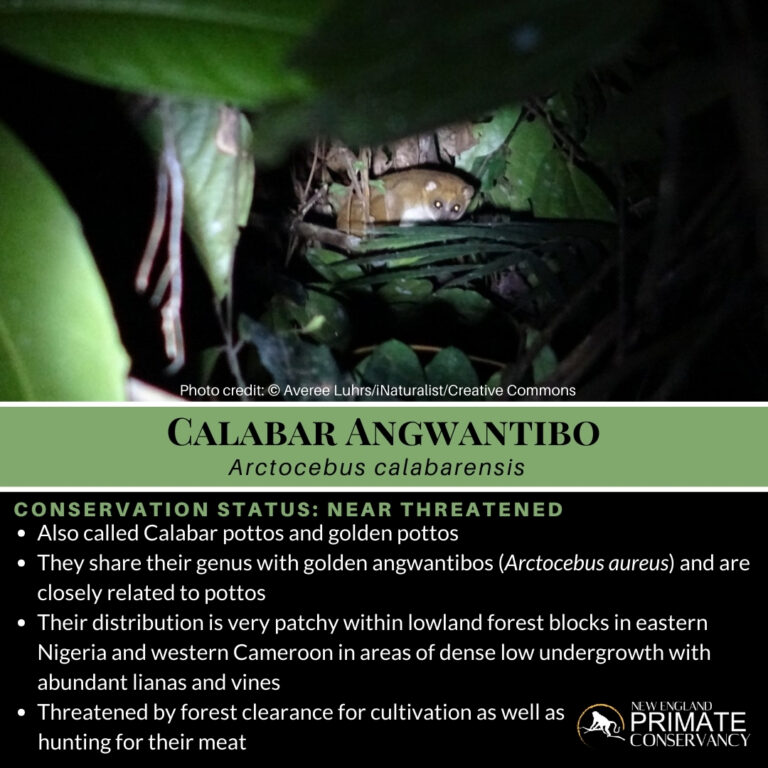
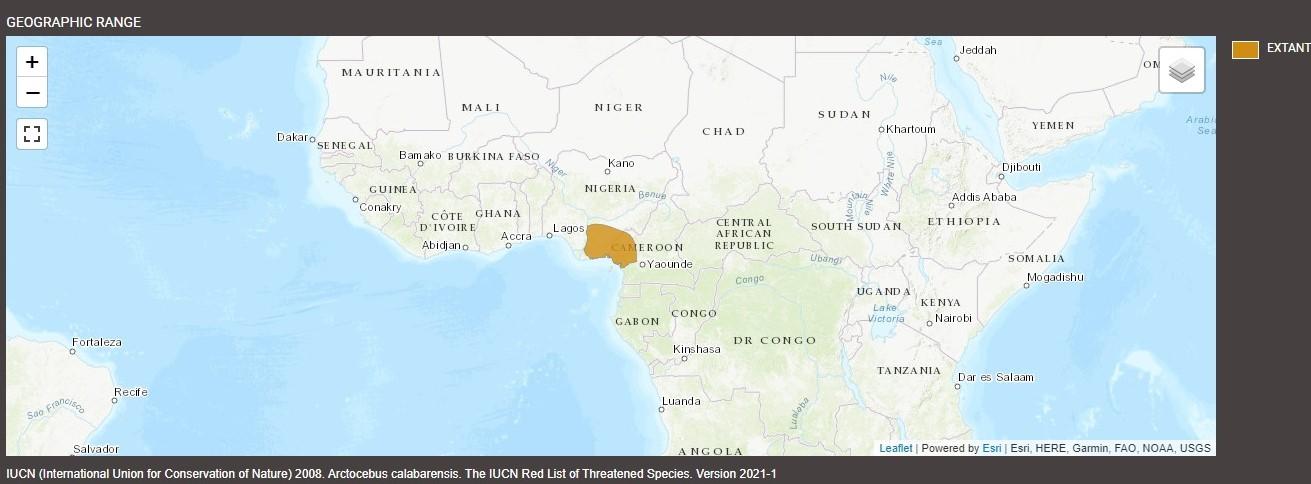
Geographic Distribution and Habitat
The Calabar angwantibo is a secretive, nocturnal primate endemic to southeastern Nigeria and southwestern Cameroon. It is highly adapted to life within the dense vines and understory vegetation beneath the rainforest canopy, typically occupying heights of about 10 to 16 feet (3 to 5 m) above the ground.
Although angwantibos can persist in secondary forests that regenerate after disturbances, such as logging or fire, they depend on dense vegetation structure. Interwoven shrubs, vines, and young trees provide the stable grasping surfaces they need for movement and foraging.
Angwantibos are strongly associated with areas of high liana density. Lianas are woody climbing plants that grow from the forest floor toward the canopy using trees for support. These plants form a microecosystem by creating structural connections between forest layers. Smaller plants use liana stems to access sunlight, while many animals travel along them to move above seasonally flooded forest floors.
Angwantibos were historically grouped with pottos (genus Perodicticus) because both are nocturnal African strepsirrhines, primates characterized by wet, hairless, snout-like noses. However, angwantibos differ in being smaller, more gracile (slender), and having a narrower geographic range.
They were later placed in the genus Arctocebus, from the Greek arcto (“bear”) and cebus (“monkey”), reflecting their hunched posture, large eyes, and rounded ears reminiscent of bears. Despite reclassification, they are still commonly referred to as Calabar pottos.
Until the 1980s, all angwantibos were classified as a single species, Arctocebus calabarensis. Today, two species are recognized: the Calabar angwantibo and the golden angwantibo.
Size, Weight, and Lifespan
Angwantibos are small primates, roughly the length of a sheet of paper, measuring 10 to 14 inches (26 to 35 cm) and weighing between 0.5 and 1 pound (230 to 465 g). They possess an extremely short tail, sometimes visible only as a small nub approximately 0.4 inches (1 cm) long.
Individuals may live up to 13 years in the wild.
Appearance
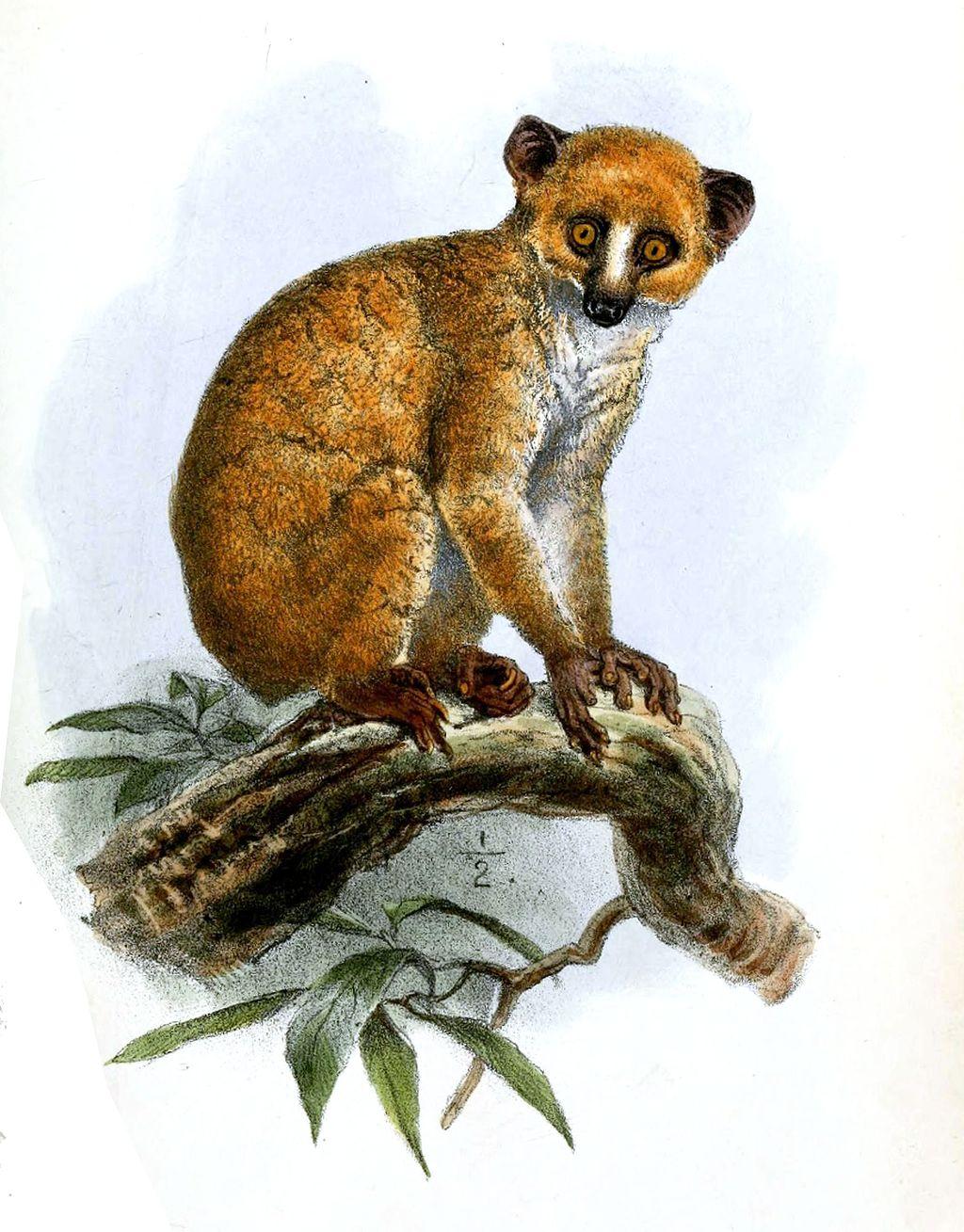
Angwantibos have a woolly appearance created by white-tipped guard hairs that cover a softer, yellowish-brown undercoat. They are brown on the dorsal (upper) side and white on the ventral (belly) side. This countershading provides camouflage: the white belly blends with the bright sky and canopy when viewed by ground predators. In contrast, the darker upper fur blends with tree bark and the forest floor when seen from above by aerial predators.
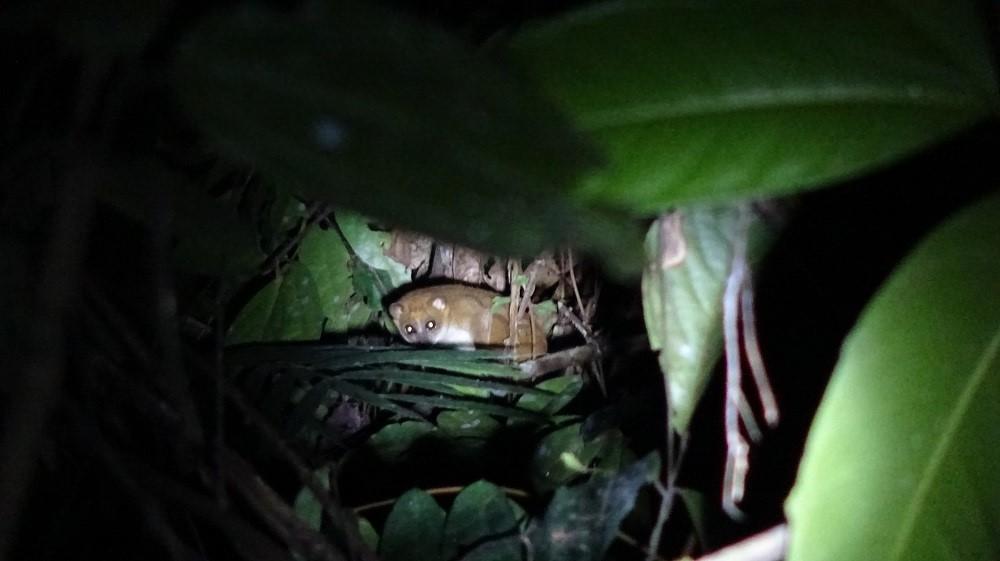
The only facial marking is a thin white line running from the brow to the nose. Their most distinguishing features are large eyes, a pointed muzzle, and short, rounded ears. These traits are well-suited to a nocturnal (active at night) life in the dense understory, as they rely heavily on their sense of smell and hearing to navigate thick vegetation.
Their eyes contain a reflective tissue layer called the tapetum lucidum, which reflects available light back through the eye and improves vision in low-light conditions. This feature is common in many mammals and causes the familiar “glowing eyes” effect seen when light shines on animals at night, such as cats and dogs. Angwantibos also possess a nictitating membrane, a translucent third eyelid that acts as a protective windscreen, shielding the eyes from dust and debris while preventing them from drying out. Because this membrane reduces the need for frequent blinking, it allows them to maintain visual focus for longer periods. Nictitating membranes are rare among primates and are more commonly found in birds and reptiles.
Their extremely short tail is vestigial (an evolutionary body part that was once larger and more developed in ancestral species) and can sometimes be mistaken for testes (male reproductive organs). As a result, males and females are difficult to distinguish in the wild, making the species sexually monomorphic.
Their thumbs are opposable and adducted (permanently flexed toward the palm), while the index and middle fingers are reduced. This hand structure functions like strong pincers, allowing them to firmly grasp narrow stems without straining their hands as they move through vegetation.
Diet
These nocturnal primates are primarily insectivorous (insect eaters), specializing in catching caterpillars, including hairy species that most predators avoid. Before eating their prey, angwantibos carefully squeeze and massage it, a behavior thought to remove irritating hairs and defensive spines. Their diet also includes beetles, snails, small lizards, and occasional fruit. This unusual “prey-massaging” behavior has even been observed in infant angwantibos that are not yet able to feed independently, suggesting the behavior is innate (hard-wired from birth rather than learned).
While hunting, angwantibos move slowly in a deliberate “cantilever” or “flag posture,” tensing their bodies as they silently stalk insect prey, much like a chameleon creeping toward its target. They advance branch by branch with careful precision, minimizing vibration that could alert prey. Once within reach, the angwantibo makes a rapid move to seize its prey.
Behavior and Lifestyle
Researching nocturnal and arboreal (tree-dwelling) animals such as angwantibos is challenging because they are difficult to spot and observe in the dark long enough to record and study their behavior. Angwantibos are especially cryptic (secretive) due to their small size, shy nature, and preference for dense understory vegetation.
Angwantibos rely on stealth to capture prey and are most often observed foraging alone. They display a distinctive movement pattern in which they hold their heads low along branches, allowing their noses to scent insects as they move. Generally slow movers, they carefully locate and grasp branches using their pincer-like hands. Their small hands limit the size of branches they can use, and they are rarely found on branches wider than 8 inchs approximately (20 cm). As a result, they tend to remain in the lower regions of the forest, where fine shrubs, vines, and lianas are abundant. Angwantibos may occasionally travel along the forest floor using quadrupedal (on all fours) locomotion to cross small gaps between patches of vegetation.
When startled, angwantibos raise their guard hairs and freeze in a defensive posture, extending their arms and legs while tucking their noses beneath their arms. This position protects the face and vulnerable belly while allowing them to bite at approaching threats from under the shelter of their limbs. They may also thrust their hindquarters toward a predator to create confusion and deter an attack. If a predator manages to bite an angwantibo, it often ends up with a mouthful of coarse guard hairs, which detach easily and are unpleasant to chew, potentially giving the angwantibo enough time to escape.
Angwantibos freeze instead of running, blending into vines and branches.
They may communicate using ultrasonic sounds beyond human hearing.
They eat hairy and toxic caterpillars avoided by other primates.
Mothers “park” infants in hidden spots while foraging at night.
Their nictitating membrane protects their eyes and keeps them moist for better night vision.
Calabar angwantibos are solitary (typically found alone), except for females caring for their young. Both males and females maintain individual territories and usually interact only during mating periods. In the wild, individuals rarely encounter one another and rely primarily on scent marking for communication. Most interactions recorded between wild individuals involve courtship behaviors. In captivity, where individuals are forced to live in closer proximity, males have been observed fighting each other.
Angwantibos remain understudied due to their secretive, nocturnal nature, and relatively little is known about their day-to-day activities. They become active only after sunset and spend most of the night foraging for insects. Before sunrise, they select sleeping sites within dense vegetation that provide protection from weather and predators, where they rest in an upright position.
Olfactory (sense of smell) communication is likely the primary mode of communication in angwantibos. They have numerous scent glands throughout their bodies and use glandular secretions and urine to leave chemical messages for one another. These scent marks likely convey information about an individual’s identity, age, sex, reproductive condition, and other details beyond human perception. In this way, scent marks function like a complex calling card, similar to a social media post left for others to interpret.
Although angwantibos can produce a variety of vocalizations, they tend to be relatively quiet in the wild. In captivity, they have been recorded making hissing calls when upset, groans when threatened, and soft clicking sounds used for communication between mothers and their young.
Researchers also suspect that angwantibos may communicate via ultrasonic frequencies, as do other nocturnal primates.
Mating occurs throughout the year. When females enter estrus (the hormonally receptive period for mating), their urine contains elevated estrogen levels that signal readiness to males. Males engage in courtship behaviors, often following females for several days until the females accept their advances. During this period, males and females also allogroom (groom each other through licking and rubbing fur), which helps strengthen social bonds.
When a female is receptive, the male climbs over her and rubs his scrotal gland across her fur in a behavior known as over-marking or “passing-over.” This scent-marking likely signals to other males that the female has already been mated.
The gestation period (the length of pregnancy) is about 4.5 months, after which the female gives birth to a single infant. Mothers typically give birth on a branch, and newborns immediately cling to the mother’s belly until they are strong enough to ride on her back. Infants appear fuzzier and duller in color than adults, which helps them blend into their mother’s guard hairs for camouflage. Females may mate again soon after giving birth, and another infant may be born within four to five months, meaning a mother can care for two young within a single year.
Mothers are the sole caregivers. When infants are about three to eight weeks old, females practice “infant parking,” leaving the young in a well-concealed location while they forage at night. The mother returns to retrieve the infant before settling to rest during the day. This strategy allows angwantibo mothers to hunt more effectively without the added burden of carrying and protecting their young, which is especially important given the species’ slow and deliberate hunting style.
Young are weaned from their mother’s milk at approximately three to five months of age. They reach sexual maturity between nine and ten months and transition to adulthood at around 13 months.
Despite being a small, rarely seen primate, the Calabar angwantibo plays an essential role in maintaining rainforest ecosystems. Angwantibos occupy a unique ecological niche in the rainforest, adapted to navigating the fine, narrow structure of vines and dense understory vegetation. Their presence reflects the high habitat complexity and biodiversity found in intact rainforest ecosystems.
Calabar angwantibos share overlapping ranges with galagos (bushbabies) and pottos, but direct competition is limited. Their slender bodies allow them to move through denser vegetation that other primates cannot easily access, and they specialize in consuming caterpillars—particularly hairy species that are unpalatable to many other predators.
Within the rainforest food web, angwantibos serve as both predator and prey. They are hunted by civets (weasel-like mammals), snakes, and raptors (predatory birds). As insect predators, they help regulate insect populations, especially hairy caterpillars that have relatively few natural enemies and could otherwise overwhelm the plant species on which they feed.


The International Union for Conservation of Nature lists the Calabar angwantibo as Near Threatened (IUCN, 2016), appearing on the IUCN Red List of Threatened Species.
The primary threat to their survival is habitat destruction caused by logging and slash-and-burn agriculture. Angwantibos are slow-moving and respond to danger by freezing in hollow logs or dense thickets, which makes them especially vulnerable when forest patches are burned or cleared. This defensive behavior also makes them easier for hunters to capture for bushmeat during deforestation events.
Although they can adapt to small habitat changes, angwantibos depend on dense understory vegetation with narrow branches that allow them to travel and hunt effectively. Their population density is estimated to be around 4,456 individuals.
The Calabar angwantibo is listed in Appendix II of the Convention on International Trade in Endangered Species (CITES), an international agreement between governments whose goal is to ensure that international trade in specimens of wild animals and plants does not threaten their survival.
While they are protected from hunting and export under national and international treaties, such as the African Convention, angwantibos are primarily safeguarded through habitat protection in areas such as Cross River National Park in Nigeria and Korup National Park in Cameroon. Expanding protected areas, where logging and agricultural practices are restricted, provides these primates with their best chance of survival.
Their ability to live in dense, inaccessible forest habitats also offers natural protection from human encroachment, and it is likely that angwantibos maintain small, undiscovered populations in regions that have not yet been fully surveyed.
- Jones, K. E., Bielby, J., Cardillo, M., Fritz, S. A., O’Dell, J., Orme, C. D. L., Safi, K., Sechrest, W., Boakes, E. H., Carbone, C., Connolly, C., Cutts, M. J., Foster, J. K., Grenyer, R., Habib, M., Plaster, C. A., Price, S. A., Rigby, E. A., Rist, J., Teacher, A., Bininda-Emonds, O. R. P., Gittleman, J. L., Mace, G. M., & Purvis, A. (2009). PanTHERIA: a species-level database of life history, ecology, and geography of extant and recently extinct mammals. Ecology, 90, 2648.
- Montagna, W., Machida, H., & Perkins, E. M. (1966). The skin of primates. XXXIII. The skin of the angwantibo (Arctocebus calabarensis). American Journal of Physical Anthropology, 25(3), 277–290. https://doi.org/10.1002/ajpa.1330250307
- Oates, J. F., & Svensson, M. S. (2019). Arctocebus calabarensis. The IUCN Red List of Threatened Species 2019: e.T2054A17969996. https://dx.doi.org/10.2305/IUCN.UK.2019-1.RLTS.T2054A17969996.en
- Omifolaji, J. K., Adedoyin, S. O., Ikyaagba, E. T., Khan, T. U., Ojo, V. A., Hu, Y., Alarape, A. A., Jimoh, S. O., & Hu, H. (2024). Population abundance and density estimates of poorly documented near-threatened Calabar angwantibo (Arctocebus calabarensis) in Oban Hills region. Animals, 14(9), 1374. https://doi.org/10.3390/ani14091374
- Oxnard, C. E., Crompton, R. H., & Lieberman, S. S. (1990). Animal lifestyles and anatomies: The case of the prosimian primates.
- Svensson, M. S., & Luhrs, A. M. (2020). Behaviour of pottos and angwantibos. In K. A. I. Nekaris & A. M. Burrows (Eds.), Evolution, ecology and conservation of lorises and pottos (pp. 204–209). Cambridge University Press.
- GBIF. (n.d.). Arctocebus calabarensis Gray, 1863. https://www.gbif.org/species/2436632
- Encyclopedia of Life. (n.d.). Arctocebus calabarensis. https://eol.org/pages/326536
Written by Acima Cherian, February 2026