
Ucayali Bald-Headed Uakari, Cacajao ucayalii
UCAYALI BALD-HEADED UAKARI
Cacajao ucayalii
Geographic Distribution and Habitat
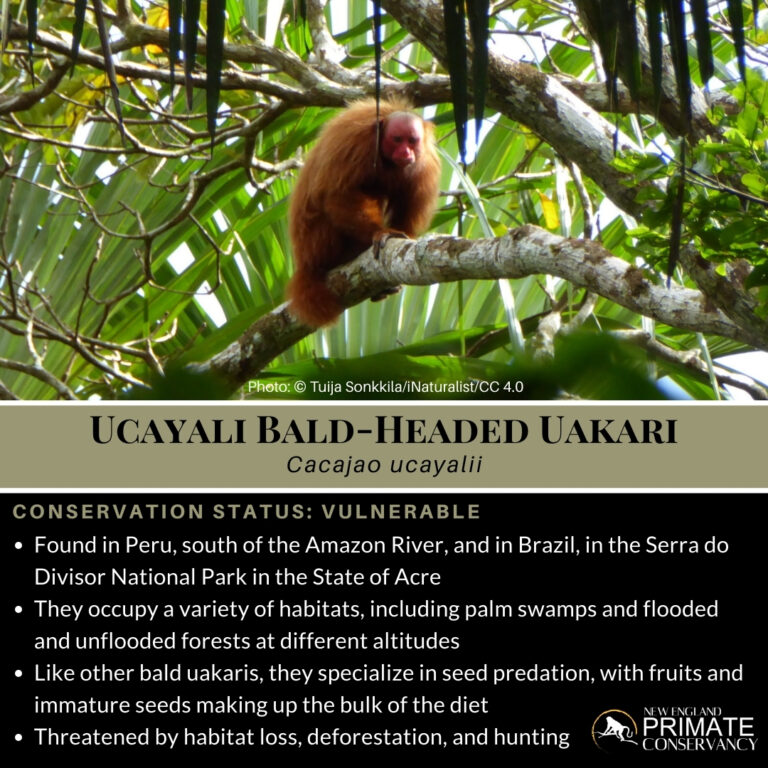
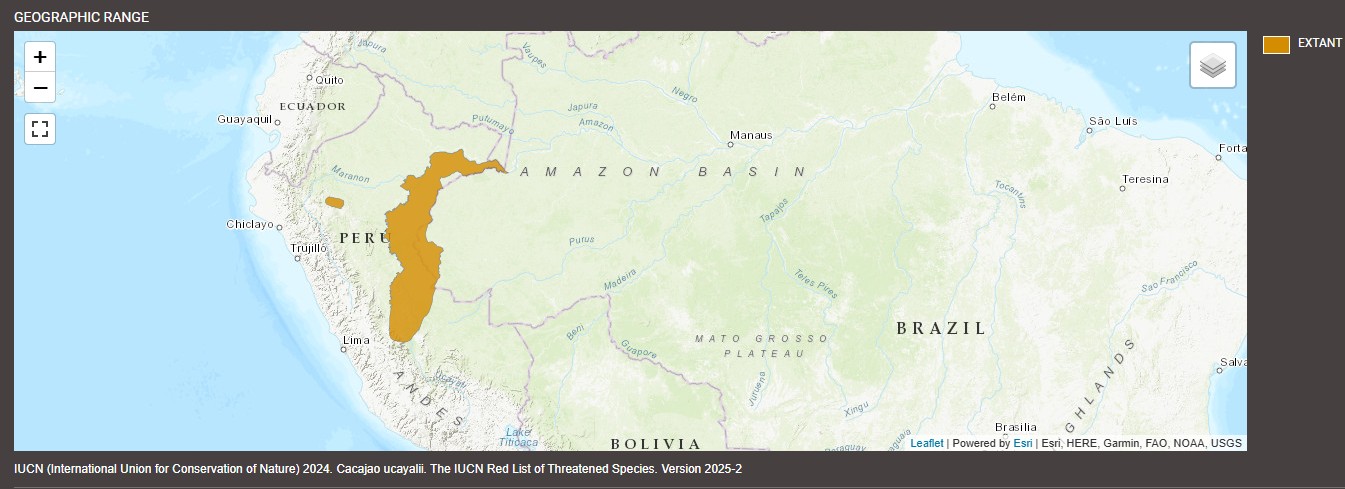
The Ucayali bald-headed uakari (pronounced “wakari”) is found primarily in Peru, between the Ucayali and Yavarí rivers. Earlier reports included parts of western Brazil within their range; however, the only confirmed Brazilian sighting has been in Serra do Divisor National Park in Acre.
The population is patchily distributed, with isolated pockets occurring along the Ucayali region. On the western bank of the Yavarí River, Ucayali bald-headed uakari populations are so low that some researchers believe they may be locally extinct, or extirpated, from this area.
These monkeys inhabit a variety of forest types, including partially flooded forests and palm swamps known as aguajal. The primary habitat requirement is the presence of their preferred food source: hard-shelled fruits.
They are also known as the Peruvian red bald-headed Uacari or the Ucayali bald uakari.
In 1987, the genus Cacajao was classified into four subspecies, with the Ucayali bald-headed uakari designated as Cacajao calvus ucayalii. Differences among these subspecies were primarily based on variation in pelage color. Subsequent studies of DNA demonstrated that coat color was irrelevant when compared to underlying genetic differences, leading to a taxonomic revision in 2022. As a result, the four subspecies were elevated to full species status, and an additional bald-headed uakari species was described.
The red-colored fur of the Ucayali bald-headed uakari closely resembles that of the red bald-headed uakari (Cacajao rubicundus). For this reason, the Ucayali uakari was initially classified as Cacajao rubicundus ucayalii and referred to as “Peruvian red uakaris” or simply red bald-headed uakaris. The similar naming of these closely related species can be confusing when determining which species was the focus of earlier studies. Given the geographic locations of most study sites, much of the earlier research appears to have focused on the Ucayali bald-headed uakari. Among the uakaris, this species is well studied; nevertheless, investigations of the diversity of this unique primate group are lacking.
Size, Weight, and Lifespan
Ucayali bald-headed uakaris are medium-sized, relative to other Amazonian monkeys. Average body length is approximately 18 inches (45.6 cm) in males and 17 inches (44 cm) in females. Their tails are short, measuring less than half their body length at about 6 inches (15 cm). Adults typically weigh between 6 and 7.4 pounds (2.75–3.35 kg).
In free-ranging populations, Ucayali bald-headed uakaris have an estimated lifespan of around 20 years. Under human care, they can live into their mid-thirties.
Appearance
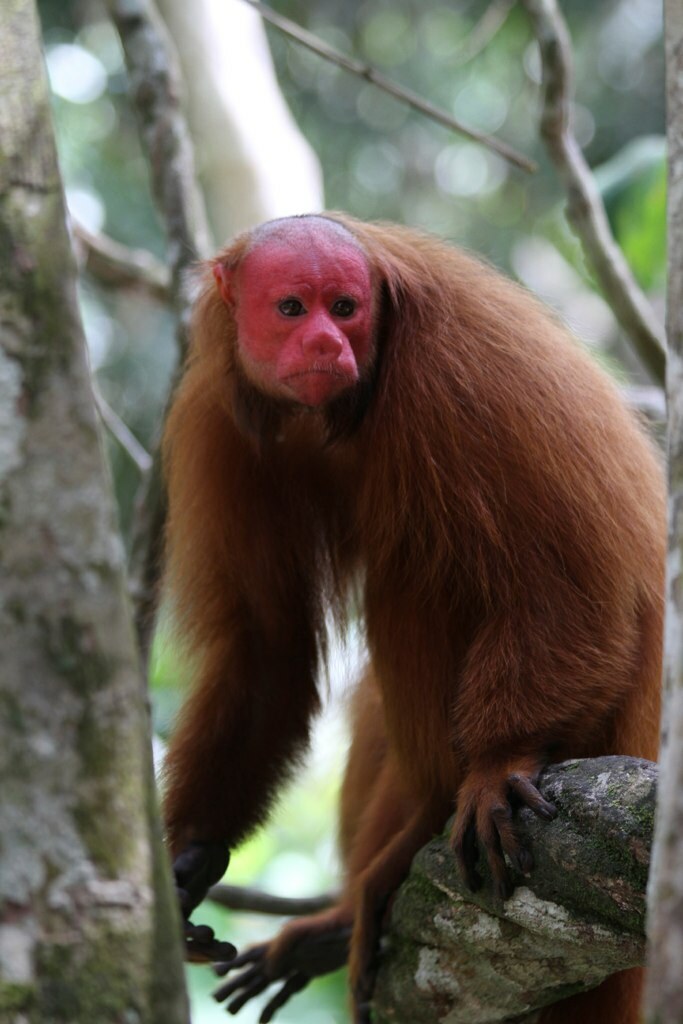
Ucayali bald-headed uakaris are covered in thick reddish-orange fur, with varying amounts of black along the whiskers and tail. As males age, scalp hair may fade or turn grey. Unlike the similarly looking red-bald-headed uakari, the Ucayali species lacks the white or yellowish fur along the back.
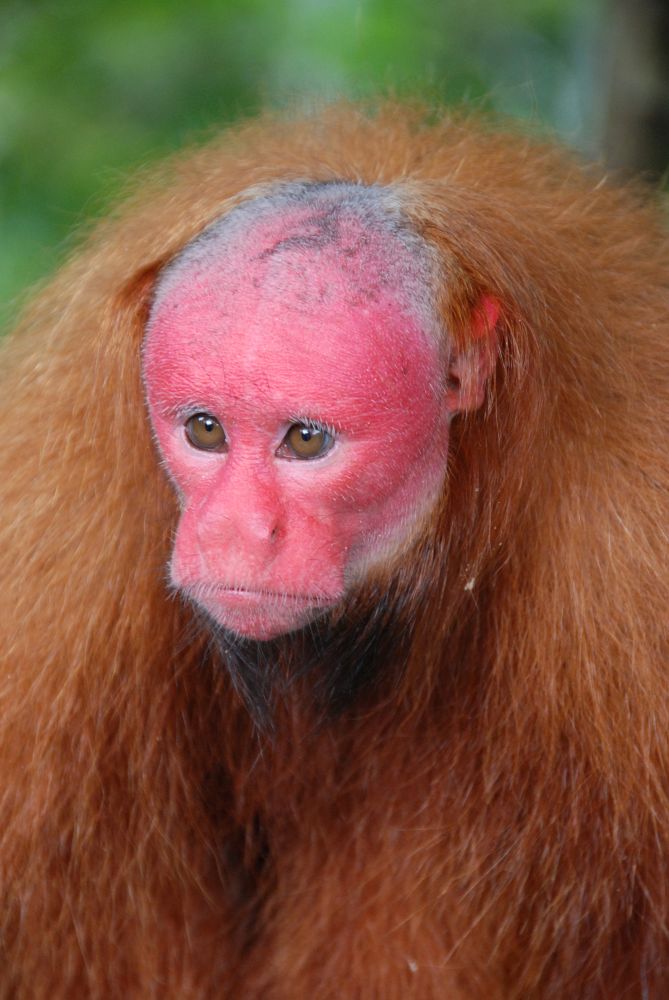
Like other bald-headed uakaris, they have bright red foreheads and faces. This coloration is caused by an extensive network of blood vessels beneath the thin facial skin. Scientists hypothesize that brighter facial coloration signals better health and reflects well-oxygenated blood flow throughout the body. When bald-headed uakaris are sick or stressed, their faces become noticeably pale. Interestingly, male bald-headed uakaris are color-blind and cannot distinguish red from green. As a result, the bright red facial coloration likely functions as a health signal primarily directed toward females, who can detect reds and greens, helping them select healthier mates and pass those genes on to their offspring.
These primates are also known for their bulbous jaw and forehead muscles, which are particularly developed in Ucayali bald-headed uakaris. These muscles are adaptations that generate the strong bite force required to open hard-shelled fruits.
Adult males have more pronounced jaw and head muscles, which may help distinguish the sexes. However, under field conditions, uakari groups often contain individuals of many ages, making body or jaw size an unreliable indicator of sex. Some researchers suggest that enlarged jaw muscles in males function not only to crack open large seeds but also to display dominance. In multi-male societies, like that of the uakaris, males compete for access to females, and larger males typically prevail. Many primate species use open-mouth displays that emphasize large canines to signal size and fighting ability to rival males. These displays often prevent physical confrontations, reducing the risk of serious or fatal injuries.
Bald-headed uakaris are stocky compared to other Amazonian primates, and their limbs are long relative to their body size. They typically move in a pronograde posture, meaning their bodies are parallel to tree branches when traveling, and they use their powerful arms and legs to propel themselves forward. This movement style is particularly effective at stabilizing the robust bodies of uakaris, especially since their short, non-prehensile tails cannot be used to grasp branches and provide little help when balancing.
Diet
Bald-headed uakaris feed primarily on hard-shelled fruits, using their large canines to pierce the shell and their incisors to scoop out the softer, fat-rich seeds. Their specialized teeth and associated jaw muscles are defining characteristics of the genus. Ucayali bald-headed uakaris rely on the moriche palm fruit (Mauritia flexuosa) for up to 20% of their diet.
Overall, their diet consists of approximately 50% unripe seeds, 37% ripe fruits, 3.7% flowers and nectar, with the remainder comprising invertebrates such as insects and spiders. Diet composition changes seasonally: unripe seeds are consumed most frequently between September and April, while during the fruiting season from May to August, they shift toward ripe fruits.
Behavior and Lifestyle
Ucayali bald-headed uakaris are arboreal (tree-dwelling), diurnal (active during the day) primates that begin foraging shortly after dawn. Because their food resources are seasonal, they may travel long distances to locate sufficient food.
Allogrooming, or cleaning each other’s fur, is common, with apparent sex-based differences in grooming behavior. Adult females groom more than any other age–sex class, while subadult males groom and receive grooming the least. Adult males groom both adult females and other males.
Males can be aggressive toward one another as they compete for access to females. Adult males bare their large teeth and display their powerful jaws to signal strength and dominance and to deter rivals.
The Ucayali bald-headed uakari lives primarily in Peru and is often confused with red bald-headed uakaris. Their reddish fur looks very similar, which led scientists to misclassify them for many years before genetic studies confirmed they are a separate species.
They have bulbous jaws and head muscles to crack hard-shelled seeds that many other primates cannot eat. Males have larger jaw muscles than females.
While most of their diet consists of unripe fruit, they shift their diet depending on what is available and will even consume insects and spiders.
Their bright red faces become pale when they are ill or stressed.
They perform allogrooming within their groups. Adult females groom other group members the most, while subadult males groom and receive grooming the least.
Group sizes can reach up to 200 individuals. Ucayali bald-headed uakaris live in fission–fusion societies, where smaller units temporarily join to form larger foraging groups, particularly when food is abundant. The typical family unit consists of one adult male, two adult females, their offspring, and two subadult males.
They spend approximately 38% of their active time traveling in search of food, 28% foraging, and 24% resting. The remaining time is devoted to behaviors such as grooming, vocalizing, and social interactions. Time spent feeding is inversely related to time spent resting, regardless of travel time to feeding sites. Before sunset, multiple families gather in the canopy to sleep.
In multi-male groups, adult males frequently display aggression toward one another for access to females. In contrast, subadult males receive relatively little attention from adult females.
Female-female interactions are generally peaceful. In closely related species such as the red bald-headed uakari (Cacajao rubicundus), more dominant, often older females have access to higher-quality food sources first. This dynamic gives mothers who are nursing or caring for young ones a better chance of meeting their demanding energy needs. Younger females are often unmated and, along with young mothers, end up getting smaller, less nutritious seeds.
Bald-headed uakaris communicate using olfactory, visual, and vocal signals. Their vivid red faces serve as honest indicators of health because the coloration reflects well-oxygenated blood. This trait likely evolved in response to intense male competition in large, multi-male groups, increasing a female’s ability to choose healthy mates.
Ucayali bald-headed uakaris also wag their short tails to signal their presence to nearby group members. In dense forest vegetation, movement is often easier to detect than body outlines, making tail wagging an efficient and low-effort communication method.
Researchers have documented several vocalizations in Ucayali bald-headed uakaris. The “hic” call, a steady single-note vocalization given singly or in series, is among the most common and is used by individuals of all ages and sexes to maintain contact. Adult males use this call less frequently than other age-sex classes.
Sharp “bark” calls are produced by individuals that are separated from the leading group. If unanswered, these calls may transition into a lower-pitched, guttural “rhork” call, which is rare and most commonly heard during heavy rain, when higher-pitched sounds are muffled.
Adult males use hiss-like “Rhä” calls paired with visual displays that expose their large canines during aggressive interactions. Screams occur during alarm situations, particularly when dominant males chase other individuals.
“Chick” calls warn group members of immediate danger. The intensity of this call likely reflects the level of threat. Loud “chick” calls are often associated with aerial predators such as eagles, prompting uakaris to become alert and scan the canopy.
In Peru, Ucayali bald-headed uakaris breed seasonally, from October to May. During this period, females enter estrus, when estrogen, the primary female reproductive hormone, levels are at their peak. Females release this hormone through urine, which males detect through scent and respond to by initiating mating.
The gestation or pregnancy period is approximately six months, with infants typically born between August and November. Females usually give birth every two years, mainly due to an extended developmental period, during which infants remain dependent on their mothers for food and protection for over a year.
Infants have grayish-brown faces with pink around the nose and measure about 10–25% of their mother’s body length. By 3–12 months of age, infants have pink-red faces (darker than adults) and reach approximately 25–60% of their mother’s length. During juvenile stages, individuals retain gray scalp hair, which eventually becomes reddish-brown in adulthood. Uakaris are considered juveniles until they reach around 3 years of age.
Subadult males often leave their natal groups and form bachelor groups with other males, often remaining on the periphery of family units.
Ucayali bald-headed uakaris play a crucial role in the flooded forests of the Amazon. As specialized consumers of hard-shelled seeds, they occupy a niche unavailable to many other primates, which typically prefer ripe fruits. By feeding on these seeds, uakaris help regulate populations of hard-shelled seed-producing trees and prevent dominance by a few species.
Trees produce thousands of seeds, yet only a small fraction survive to adulthood. In hard-shelled species, seed predation is mainly limited to rodents and a few specialized primates such as bald-headed uakaris. Uakaris coexist relatively peacefully with other primates through niche separation—other primates exploit different resources and use different heights in the trees than uakaris. Still, they compete directly with seed-eating rodents such as squirrels and cavies. Areas with high rodent densities often support fewer uakaris.
Raptors, including harpy eagles and crested eagles, are the primary predators of bald-headed uakaris. Together, dietary specialization, competition with rodents, and predation by raptors highlight the importance of intact flooded forests as safe havens for sustaining Ucayali bald-headed uakari populations.


The International Union for Conservation of Nature lists the Ucayali bald-headed uakari as Vulnerable (IUCN, 2024), appearing on the IUCN Red List of Threatened Species.
Habitat loss is the greatest threat to bald-headed uakaris. Deforestation driven by logging and associated infrastructure development, such as roads and bridges, reduces the availability of suitable habitat. Researchers estimate that up to 20% of the Ucayali bald-headed uakari habitat could be lost from 2025 to 2055.
Hunting is also a concern, particularly along the Yavarí River, where logging increases human access to previously remote areas. Sometimes young bald-headed uakaris are captured and kept as pets by locals. Ucayali bald-headed uakari populations are patchy and fluctuating, with density estimates ranging from 2 to 116 individuals per 247 acres (1 sq. km). Slow population growth, long developmental periods, and extended interbirth intervals mean that even slight declines can have severe long-term impacts.
Ucayali bald-headed uakaris are not currently listed under the Convention on International Trade in Endangered Species (CITES), an international agreement between governments to ensure that international trade in specimens of wild animals and plants does not threaten their survival. Still, they are expected to be included in Appendix I, similar to other members of the genus.
They are considered a flagship species for Peru’s forests, representing the region’s ecological complexity and serving as indicators of forest health. This designation helps focus conservation policies and protective measures on uakaris, benefiting many other species that share their habitat.
Organizations such as the Wildlife Conservation Society (WCS) and the Durrell Institute of Conservation and Ecology (DICE) conduct long-term monitoring and research, particularly in the Lago Preto–Paredón region, where populations have remained relatively stable.
Community involvement is critical to the success of conservation. In the Tamshiyacu Tahuayo Communal Reserve (TTCR), local communities and conservationists collaborate to reduce hunting, protect sensitive habitats, and develop sustainable ecotourism. This partnership, supported by conservation organizations and the Peruvian government, has led to a 35% increase in the population density of bald-headed uakaris in the Lago Preto Conservation Concession.
Researchers are also working to identify additional habitats to expand protected areas. Recently, the species’ range was extended to include the Pacaya Samiria National Reserve, where improved hunting management and protection may further support population recovery.
- Barnett, A.A., Bowler, M., Bezerra, B.M. and Defler, T.R., 2013. Ecology and behavior of uacaris (genus Cacajao). In: P.A. Garber, A.A. Estrada, J.C. Bicca-Marques, E.W. Heymann and K.B. Strier (eds.), Evolutionary biology and conservation of titis, sakis and uacaris. Cambridge: Cambridge University Press, pp.151–172.
- Bowler, M., Murrieta, J.N., Recharte, M., Puertas, P. and Bodmer, R., 2009. Peruvian red uakari monkeys (Cacajao calvus ucayalii) in the Pacaya-Samiria National Reserve—a range extension across a major river barrier. Neotropical Primates, 16(1), pp.34–37.
- Bowler, M., Valsecchi, J., Queiroz, H.L., Bodmer, R. and Puertas, P., 2013. Communities and uacaris: conservation initiatives in Brazil and Peru. In: P.A. Garber, A.A. Estrada, J.C. Bicca-Marques, E.W. Heymann and K.B. Strier (eds.), Evolutionary biology and conservation of titis, sakis and uacaris. Cambridge: Cambridge University Press, pp.359–367.
- Hershkovitz, P., 1987. Uacaries, new world monkeys of the genus Cacajao (Cebidae, Platyrrhini): a preliminary taxonomic review with the description of a new subspecies. American Journal of Primatology, 12(1), pp.1–53.
- Mammal Diversity Database, 2025. Cacajao ucayalii. Available at: Mammal Diversity Database, University of Michigan. Accessed 19 December 2025.
- Silva, F.E., 2020. Systematics, biogeography and conservation of bald uakaris (Cacajao Lesson, 1840). PhD thesis. Salford: University of Salford.
- Silva, F.E., Boubli, J.P., Shanee, S., Aquino, R., Calouro, A.M. and Cornejo, F.M., 2025. Cacajao ucayalii. The IUCN Red List of Threatened Species 2025: e.T3420A258887967. DOI: 10.2305/IUCN.UK.2025-1.RLTS.T3420A258887967.en. Accessed 14 December 2025.
- Wildlife Conservation Society (WCS), 2025. Bald uakari monkey. Available at: WCS Peru. Accessed 19 December 2025.
Written by Acima Cherian, Dec 2025