
Andean White-fronted Capuchin, Cebus yuracus
ANDEAN WHITE-FRONTED CAPUCHIN
Cebus yuracus
Geographic Distribution and Habitat
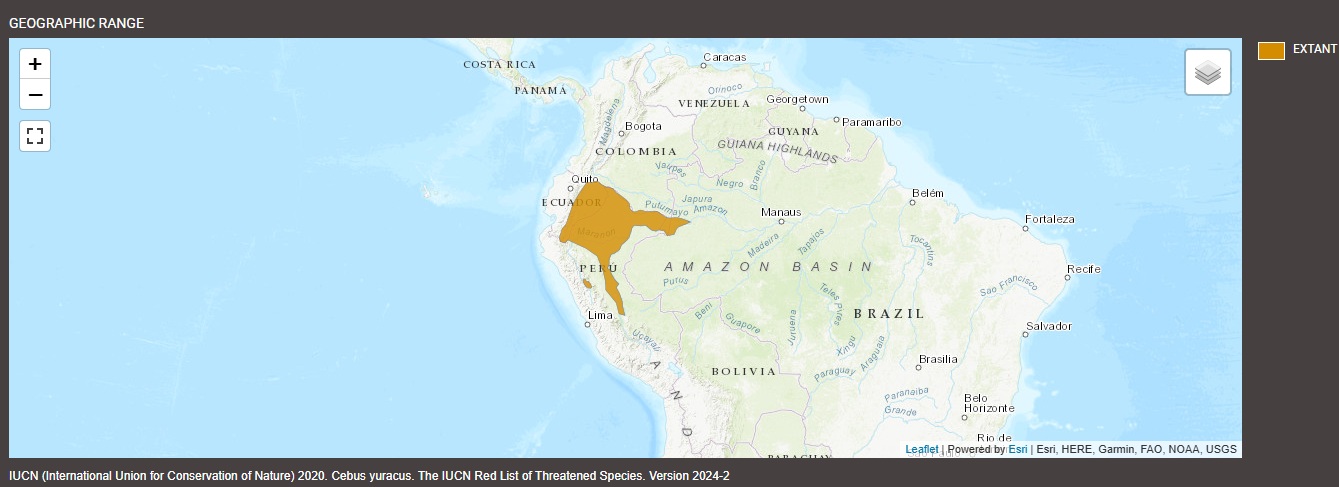
Andean white-fronted capuchins are endemic to Colombia, Ecuador, and Peru. Their territory spans from the lowland terra firma and seasonally flooded forests of the Upper Amazon Basin to the eastern montane forests.
Populations of Andean white-fronted capuchins can be found in several protected areas such as the Papaya-Samiria National Reserve in Peru and the following national parks in Ecuador: Sangay, Sumaco Napo Galeras, Yasuni, Pocarpus, as well as Cayambe Coca Ecological Reserve, Cofán-Bermejo Ecological Reserve, and Cuyabeno Wildlife Reserve.
The Andean white-fronted capuchin was considered a subspecies of the Humboldt’s white-fronted capuchin until 2012, when it was recognized as its own species thanks to DNA studies.
Size, Weight, and Lifespan
Adult males weigh 5.5 pounds (2.5 kg) on average, with the lightest being 3.5 pounds (1.7 kg) and the heaviest 7.2 pounds (3.3 kg).
Females are smaller and weigh 3.9 pounds (1.8 kg) on average, with the lightest being 3 pounds (1.4 kg) and the heaviest 5 pounds (2.3 kg).
Babies are tiny a weighing 7–8 ounces (225–247 g).
Males have a head and body length of about 17 in (43 cm), whereas females are a bit shorter at 15 in (37 cm). Both males and females have a tail that is longer than their body—19 in (47 cm) for males and 18 in (45 cm) for females.
In the wild, capuchin monkeys can live up to 25 years, but in captivity, their life expectancy is much longer, and they can reach their forties.
Appearance
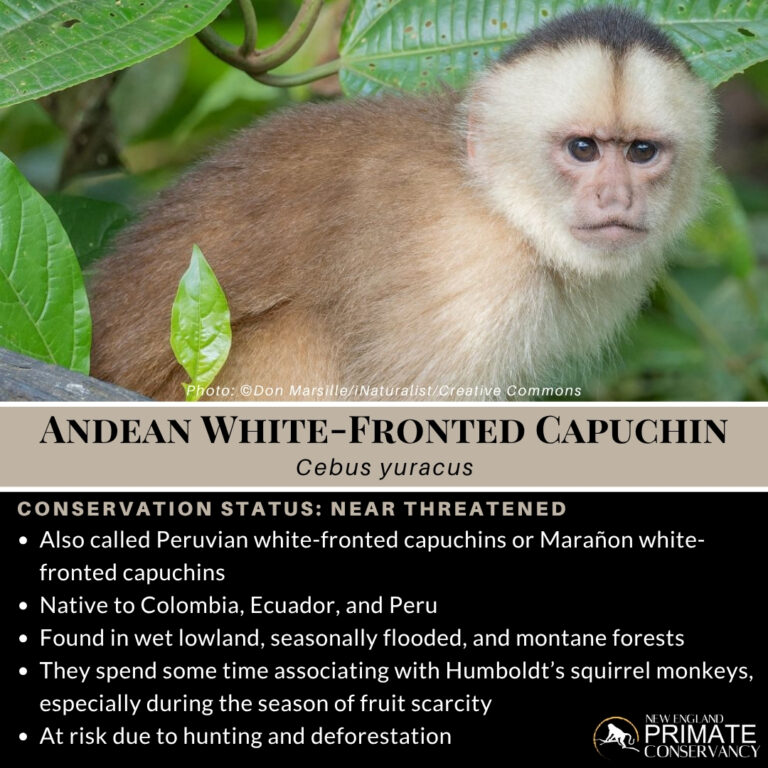
Andean white-fronted capuchin males are larger than females. Both males and females have silky soft looking fur, the color of milk caramel on the back and creamy off-white on the belly and face. The hair on top of the head is darker. Their limbs are long; their hands and feet have semi-opposable thumbs and opposable big toes, allowing them to securely grab onto branches as they move around the forest canopy. Both hands and feet have digits ending with nails that can be quite sharp. Their almond-shaped eyes are forward-facing, which is an indicator that these primates have perfect depth perception. The arch above the eyes is similar to where our eyebrows are, and the muscles along its line are flexible, giving these monkeys the ability to make a variety of facial expressions. Their ears are large and positioned on each side of the head. The fact that the ears are large compared to the size of the head indicates that their sense of hearing is quite good. Their nose is flat with nostrils flaring upwards. Their mouth can be very expressive and open halfway into a grin that may convey fear, or a full-blown smile (that does to indication happiness as it does in humans. It usually indicates fear or threat) that exposes a set of sharp canines and conveys aggression. Their tail is long and semi-prehensile, meaning that they can wrap it around a branch or each other, but they cannot hang from it. It is also fully covered in fur.
Diet
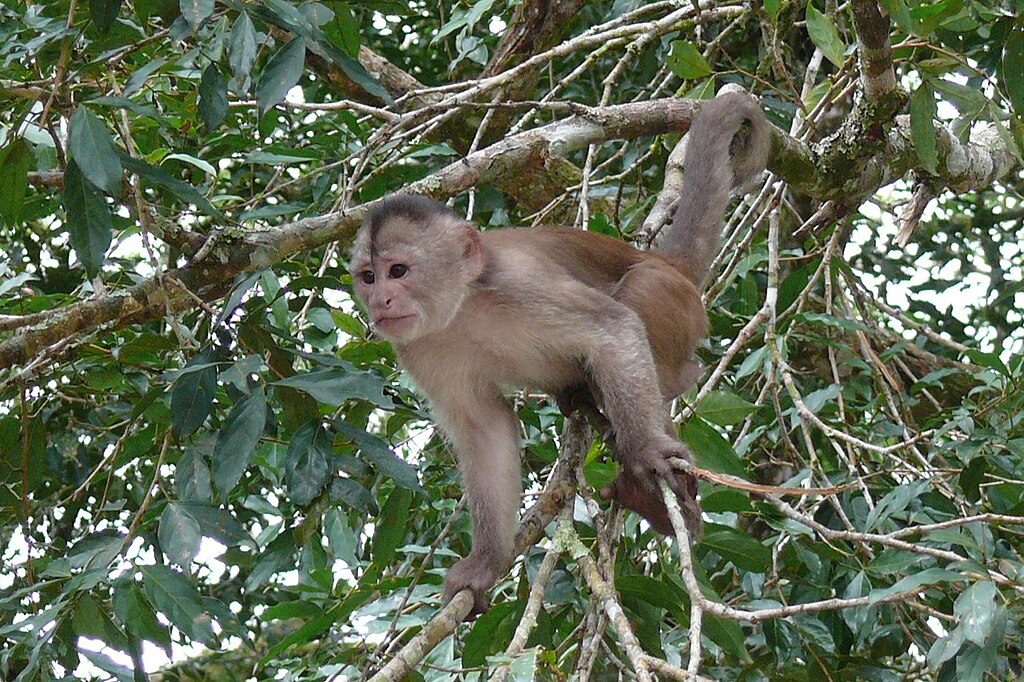
Andean white-fronted capuchins typically forage in the middle and upper canopies of primary and secondary forests, but they occasionally find food on the ground as well. While on the ground, they are extremely alert, ready to jump and climb back up into trees at the first hint of danger.
Their diet is insectivore-frugivore, relying on animal protein provided by insects, arthropods, eggs, and small vertebrates. The easily digestible carbohydrates they consume come from fleshy fruit, flowers, and seeds. They use their hands to peel or manipulate fruit and prey. They are opportunistic hunters—if an insect, an egg, or another small vertebrate happens to be near, they will grab it and consume it, but they’re not active hunters. If food falls, another capuchin monkey may grab it without any fights ensuing.
They can use tools such as a rock to crack nuts, but some groups have also been observed to use rocks as weapons—throwing them at predators or each other!
Behavior and Lifestyle
Andean white-fronted capuchins are diurnal (most active during the day) and they spend most of their time in the upper canopy—although they do occasionally forage or walk on the ground as previously mentioned.
The brain of capuchin monkeys is among the largest relative to their body size. It has many convolutions—as compared to the brains of primates that mainly consume foliage. Large brains with many convolutions are associated with tool use, problem solving, adaptability to different environments, complex foraging techniques, and complex social groups. This explains why the extremely dextrous and intelligent capuchin monkeys are indeed capable of using tools, not only rocks to crack nuts, but also leaves to drink water from. The many pathways in their brains allow them to remember when fruit is ripe, where to find it, and to switch to other sources of nutrition when high-energy food items are scarce.
Their color vision is thought to be an adaptation that allows them to find fruit or prey in highly dense green foliage environments. These primates also live in large groups with complex social interactions, and some even develop “cultures” of their own. Individuals may, for instance, grab the tail or ear of another monkey and suck on it as a way of demonstrating trust and closeness with that other individual. We can surmise that Andean white-fronted capuchin monkeys may, in some cases, develop habits that could be considered “cultural” to their groups.
Self-anointing (or rubbing one’s body with a substance such as oil or mud) is a behavior observed in many capuchin monkey species. Andean white-fronted capuchins also do it. They have been observed crushing centipedes into a paste and rubbing themselves with it to avoid mosquito bites.
Social bonding between members of the group can be achieved through grooming—especially between infants and their moms. Grooming also helps individuals get rid of unwanted parasites and keep the fur clean. Juveniles learn and bond through play by running and mock-fighting with each other.
Andean white-fronted capuchins have been observed crushing centipedes and rubbing their fur with the pureed insect to protect themselves from mosquito bites.
Andean white-fronted capuchins live in groups that can vary in size from 8 to 20 individuals. Groups typically include about the same number of males and females. At maturity, males disperse to join other groups, while females remain in their native groups. Because of this, bonds between females in a troop are the strongest. The groups are organized in hierarchies—there is a dominant male and a dominant female—each of whom is the leader in their respective gender group, but males are dominant over females. However, surprisingly, females tend to dictate where the group should go when traveling.
Typically, capuchin monkeys awaken at sunrise and go off to forage for food. The groups occupy a home range of between 290 to 590 acres (120 to 240 ha). They travel quadrupedally (walking on hands and feet) with their tail held up to keep their balance. While foraging and feeding, they sit on a branch, using their semi-prehensile tail to keep their stability while using both hands to pluck fruit, crack a nut, grab prey, and bring food up to their mouth. Then they rest for a few hours, sleeping, grooming, or playing. They resume foraging for food in the afternoon and settle in trees for the night before sunlight falls. They usually sleep in the upper canopy along branches covered by lianas or between palm branches.
Ever-vigilant, capuchin monkeys pay close attention to their environment and sound the alarm if a predator is spotted, thereby telling everyone in the group to run and hide.
Andean white-fronted capuchins share forest patches with squirrel monkeys and may interact with them, especially when food is scarce.
Although there are no specific studies detailing how Andean white-fronted capuchin monkeys communicate, we can assume they communicate similarly to other capuchin monkey species and use vocalizations, facial expressions (like raising their eyebrows or grinning), and scents.
Aggressive behavior in capuchin monkeys, in general, takes many forms and can be pretty dramatic. A capuchin monkey may, for instance, grab a branch with its tail and drag it through foliage on the ground to make noise and scare members of its own group, those in external groups, or other animals. Alpha males piloerect (i.e., the hair on their body stands on end), especially when aroused. Stressed capuchin monkeys often scratch their tails. Yawns can either display canines fully or suggest their presence, thereby telling another capuchin monkey that one is not in the mood to play. Jumping or leaping up and down in place takes the threat a notch up and is a clear warning not to mess around.
Vocalizations have different meanings. Some are alarm calls to tell the group that a snake or a predator is approaching. Others are used between mothers and infants; others still are used between adults. For instance, Andean white-fronted capuchin individuals may utter loud “yah” calls when they are separated from their group.
When different groups of Andean white-fronted capuchins encounter each other (which happens at least once a week in some areas), females and juveniles flee, while males scream loudly with high-pitched “yah” calls. These encounters are always aggressive among the males of the different groups.
Capuchin monkeys generally practice urine washing by rubbing urine on their hands and feet. This is thought to help make branches less slippery but also conveys important information about each individual’s status, health, age, and breeding through scent.
Andean white-fronted capuchins can reproduce all year long, but breeding occurs mostly when food is abundant. Alpha males mate with multiple females and sire most of the offspring. Some studies mention that there are courtship rituals, unfortunately, they are not documented.
Females give birth to one baby after a gestation period of approximately 5 months.
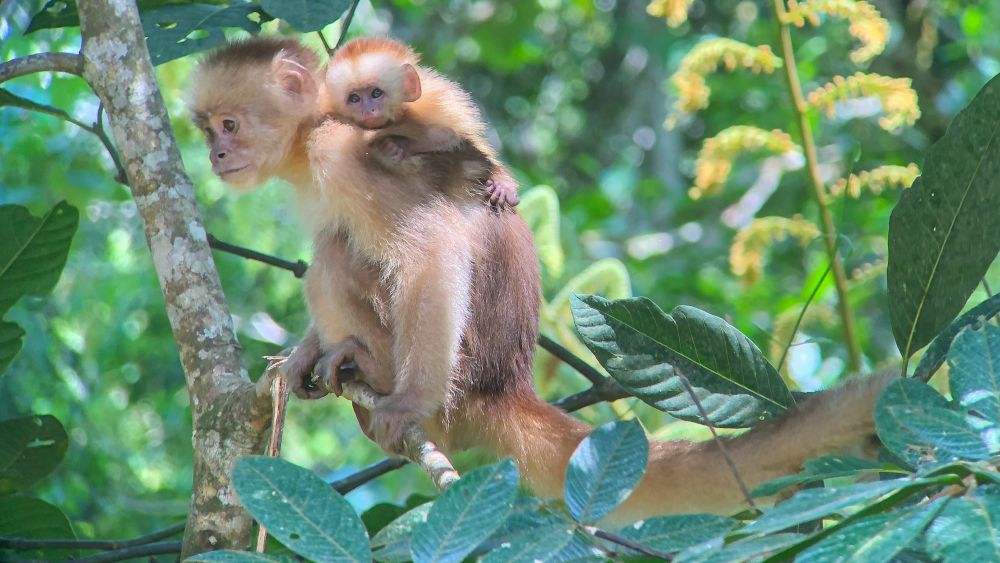
Babies are mini versions of their parents and hang on their mother’s belly for a couple of weeks before moving to her back. They grip the fur on the sides of the mother’s body with their hands and feet and seem glued to her. All females in the group are interested in the baby and help the mother—this is a type of care referred to as “allomothering,” which helps young females learn how to become a mother and provides relief time for the busy moms.
Males leave their natal group when they are about three and a half years old, but are not mature until they are 8 years old. Females reach maturity between 4 and 7 years old, and they stay with their natal group. Capuchin monkeys do not usually breed until they reach their full adult size, much later, at about 15 years of age.
Andean white-fronted capuchins eat fruit and therefore disperse seeds as they travel. The seeds contained in their feces spread throughout the forest, regenerating it and fertilizing it. Since they also consume insects and arthropods, they may contribute to the population control of these creatures. By eating leaves, they also help thin and prune trees, as all good gardeners do.


The International Union for Conservation of Nature lists the Andean white-fronted capuchin as Near Threatened (IUCN, 2021), appearing on the IUCN Red List of Threatened Species.
The main threat to the species is habitat loss, even though Andean white-fronted capuchins are able to adapt and find food in changing habitats. Indeed, data from the Global Forest Watch indicates that the forests in which they live in southern Colombia, eastern Ecuador, and northeastern Peru will likely shrink up to 15% between now and the mid-2060s. The illegal pet trade is another threat, along with hunting—especially for groups living near human settlements where populations may be considered ‘Vulnerable’.
The Andean white-fronted capuchin is listed in Appendix II of the Convention on International Trade in Endangered Species (CITES), an international agreement between governments whose goal is to ensure that international trade in specimens of wild animals and plants does not threaten their survival.
Even though there is no international conservation plan for Andean white-fronted capuchins, projects aiming to curb deforestation to protect other species will no doubt benefit these monkeys. One such example can be found in the work of the Research and Action in the Andean Bear Corridor. Scientists from the University of Sussex (England) are working with local authorities in Ecuador and Peru to protect spectacled bears and the forests they inhabit, which they happen to share with populations of Andean white-fronted capuchins.
- IUCN redlist 2021 – Cebus yuracus, Andean White-fronted Capuchin
- Ethnoprimatology of Urban Cebus Yuracus: An evaluation of Human-non-human interactions and local perceptions in Misahualli, Ecuador – Sofia Castro-Loza (2019)
- https://capuchinfoundation.org/resources/ethogram.html – Wild capuchin monkey behavior catalog.
- The genomics of ecological flexibility, large brains, and long lives in capuchin monkeys revealed with fecalFACS (2021) – Joseph D. Orrin, Michael J, Montague, Daniela Tejada-Martinez, Marc de Manuel, Javier del Campo, Saul Cheves Hernandez, Anthony Di Fiore, Claudia Fontsere, Jason A. Hodgson, Mareike C. Janiak, Lukas F K Kuderna, Esther Lizano, Maria Pia Martin, Yoshihito Niimura, George H. Perry, Carmen Soto Valverde, Wesley C. Warren, João Pedro de Magalhäes, Shoji Kawamura, Tomás Marquès-Bonet, Roman Krawetz, Amanda D. Melin
- DBpedia.org – Marañon white-fronted capuchin
- Tail Use in Capuchin Monkeys – Diomisios Youlatos
- https://www.worldlandtrust.org/news/2024/01/curious-world-of-capuchin-monkeys/
- https://zenodo.org – Cebus yuracus
- https://andeanbearresearchandaction.org/
Written by Sylvie Abrams, Jun 2025