
Nancy Ma’s Night Monkey, Aotus nancymaae
NANCY MA'S NIGHT MONKEY
Aotus nancymaae
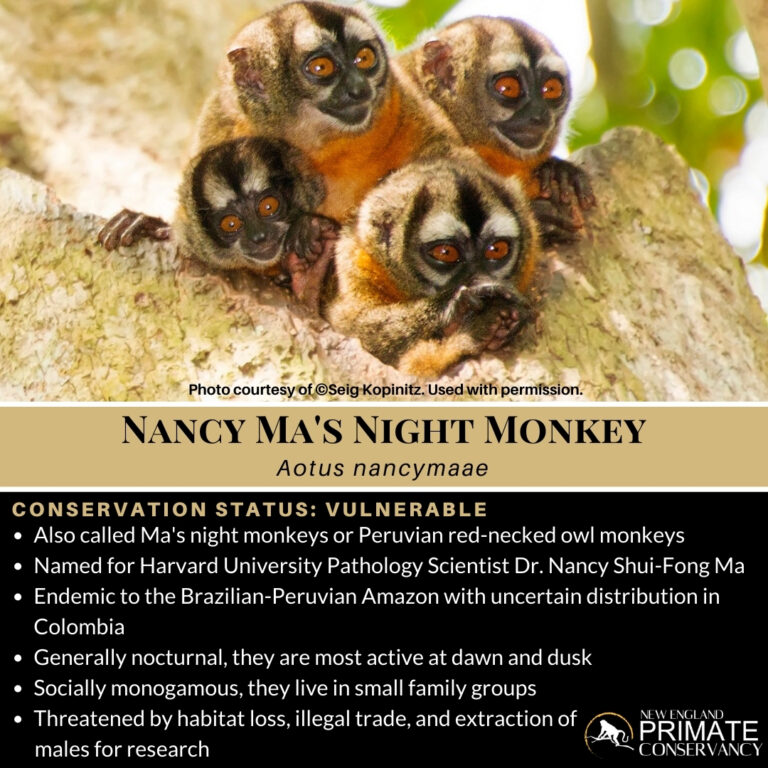
Geographic Distribution and Habitat
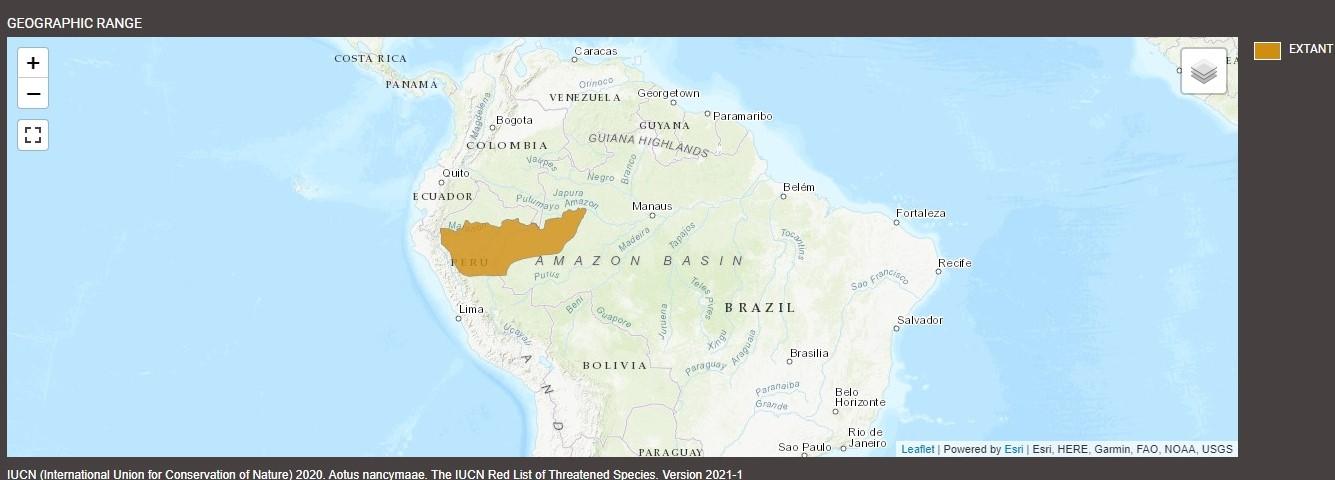
Nancy Ma’s night monkeys (Aotus nancymaae) are found in the western Amazon rainforest, where they inhabit lowland forests in eastern Peru, western Brazil, and parts of southern Colombia. Although their range spans multiple countries, they are most often associated with the dense forests surrounding the Amazon River and its tributaries.
These monkeys are well adapted to life in tropical rainforest habitats. They live in both forests that remain dry throughout the year and forests that are seasonally flooded, taking advantage of the many tree cavities, tangles of vines, and dense vegetation that provide safe places to rest during the day.
Although populations in Peru and Brazil are considered native, the species’ distribution in Colombia is more complex. Some Nancy Ma’s night monkeys were captured in Peru and Brazil and brought to Colombia for malaria research, then later released into Colombian forests. As a result, it can be difficult to determine which populations are naturally occurring and which were introduced through these releases.
Nancy Ma’s night monkey belongs to the genus Aotus, a group of primates commonly known as owl monkeys or night monkeys. The genus name Aotus comes from Greek words meaning “without ears,” referring to their small, mostly hidden ears that are covered by fur.
Scientists recognized Nancy Ma’s night monkey as a unique species in 1983 after discovering differences in its chromosomes, which are structures inside cells that carry genetic information. Before then, it was considered part of the northern night monkey (Aotus trivirgatus). The species is named in honor of Dr. Nancy Shui-Fong Ma, whose pioneering genetic research helped scientists better understand the relationships among night monkeys.
Size, Weight, and Lifespan
Nancy Ma’s night monkeys are relatively small primates. Adults measure about 12 inches (31.5 cm) from the head through body length, with a tail that adds another 12-16 inches (30-40 cm). Although the tail is nearly as long as the rest of the body, it is not prehensile, meaning it cannot grasp or hold onto branches like the tails of some other Latin American monkey species. Instead, it helps the monkeys balance as they move through the forest canopy.
Adults weigh an average of about 1.75 pounds (0.8 kg), though individuals may range from about 1.5 to 2.6 pounds (0.7-1.2 kg). Unlike many monkey species, Nancy Ma’s night monkey males and females are nearly identical in size and appearance, making it difficult to tell them apart without a closer look.
The lifespan of Nancy Ma’s night monkeys in the wild is still unknown. Their nocturnal lifestyle and dense, partially flooded habitat have made long-term research difficult. However, other closely related night monkey species have lived 20 years or more under highly managed, professional human care.
Appearance
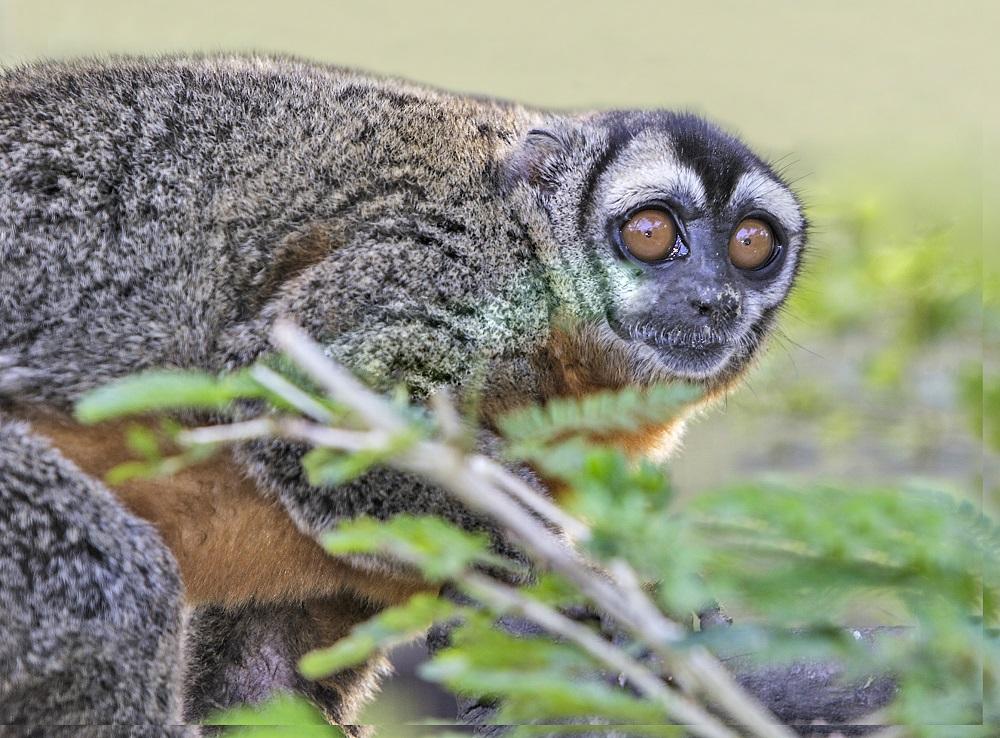
Nancy Ma’s night monkeys are often called owl monkeys because of their large, forward-facing eyes, which give them an owl-like appearance. These oversized eyes are one of their most important adaptations, helping them gather more light and see in the low light of dusk and nighttime. Like many nocturnal animals, they trade sharp color vision for the ability to see better in dim conditions.
Their faces are framed by a distinctive pattern of white fur around the eyes and mouth, outlined with dark brown or black markings. The arrangement of these markings differs among night monkey species and is one of several characteristics scientists use to tell them apart. The rest of the coat is soft grayish-brown with reddish-orange fur along the neck and shoulders, giving Nancy Ma’s night monkey their common nickname: the red-necked night monkey.
Like other night monkeys, the tail of a Nancy Ma’s monkey is long, dark, and non-prehensile, meaning it cannot grasp branches. Instead, it helps to balance while climbing through the trees. Long fingers and broad fingertip pads provide a secure grip on branches. Each hind foot has a specialized grooming claw on the second toe, which the monkeys use to scratch and groom their fur.
Diet
Nancy Ma’s night monkeys are primarily frugivores, meaning they eat mostly fruit. Ripe fruits found high in the forest canopy make up the largest part of their diet, but they also feed on flowers, nectar, young leaves, and insects. Eating a variety of foods allows them to adapt as different plants produce fruit at different times of the year.
Although fruit is their preferred food, insects provide an important source of protein. Night monkeys are surprisingly agile hunters, using their long, nimble fingers to search branches and leaves for insects. They have even been observed holding an insect steady with one hand while using the other to pull it apart before eating.
Foraging at night offers another advantage. Because most monkeys and many other fruit-eating animals are active during the day, Nancy Ma’s night monkeys may encounter less direct competition for food after sunset. This allows them to take advantage of food resources while much of the rainforest is relatively quiet.
Behavior and Lifestyle
These monkeys are unique in that they are nocturnal, which means they are most active during the night rather than during the day. Their large eyes are adapted for life in low light, allowing them to navigate through the forest and locate food after sunset. Nancy Ma’s night monkeys have monochromatic vision, meaning they have limited ability to distinguish colors and see the world primarily in shades of light and dark. Their vision reflects adaptations associated with living in low-light conditions, which help them to see textures more clearly in the dark but provide less ability to distinguish colors.
Their other senses also help them thrive after dark. A strong sense of smell helps them locate fruits and flowers, while their agile hands allow them to search branches and leaves carefully for insects. Together, these adaptations help them find food in the rainforest at night.
Like other night monkeys, Nancy Ma’s night monkeys are arboreal, meaning they spend most of their lives in trees. They rarely descend to the ground except during unusual circumstances, such as when escaping a threat or moving between habitats. They typically travel through the forest canopy while foraging but often move to lower areas of the forest when it is time to rest.
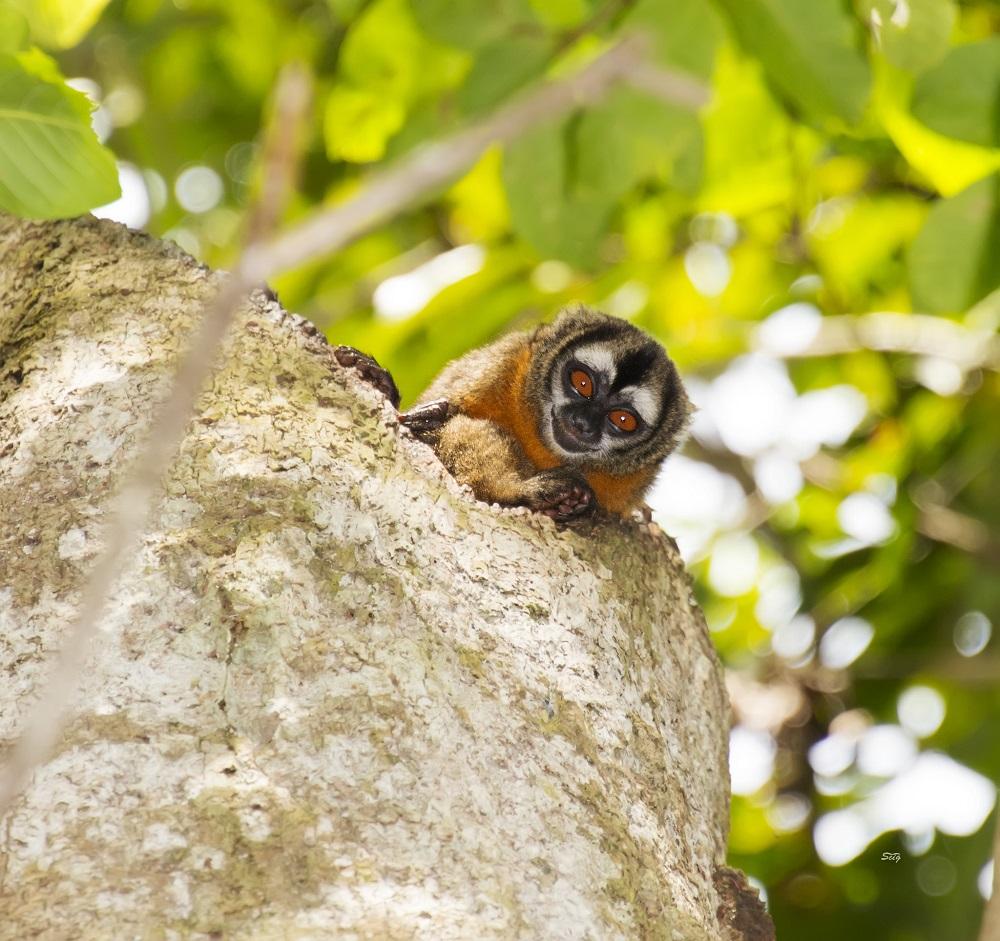
During the day, Nancy Ma’s night monkeys sleep in sheltered resting sites, such as tree hollows, cavities, and dense vegetation. These sites provide protection from predators and the elements while giving the entire family group enough space to rest together. Researchers have found that sleeping sites are typically located in the lower levels of the forest. In one study in Peru, 21% of sleeping sites were found in understory shrubs, 64% in the lower forest layer, and 14% in the middle layer. No sleeping sites were found in the upper canopy or in emergent trees (the very top of the forest). Most were located below about 82 feet (25 meters) from the ground. These sheltered, lower-level locations may help keep the monkeys hidden from predators while they sleep during the day.
Night monkeys are the only monkey species that are primarily active after dark. Their large eyes and enhanced low-light vision help them navigate the rainforest at night.
Unlike many primates, male Nancy Ma’s night monkeys provide extensive infant care, carrying, grooming, and protecting their young during much of their early development.
Nancy Ma’s night monkeys live in small family groups, typically made up of a bonded adult pair and their offspring. Unlike many monkey species, night monkeys are known for forming long-term pair bonds, meaning adults often remain with the same partner for multiple breeding seasons. Young monkeys may stay with their parents for an extended period before leaving to establish their own territories.
Family groups spend much of their time together, traveling, foraging, and resting as a unit. Living in a group provides important benefits, including protection from predators, support while raising young, and a greater ability to defend valuable resources such as sleeping sites.
Although they live in small groups, Nancy Ma’s night monkeys are territorial. Their home ranges often overlap with neighboring groups, but they are especially protective of preferred sleeping areas, such as tree cavities. Maintaining access to safe resting sites is important because these locations provide shelter during the day when the monkeys are most vulnerable.
Parents and offspring have strong social bonds, and family members remain closely associated throughout their lives together. These relationships are especially important for young monkeys as they learn how to navigate their forest environment before eventually dispersing to form their own family groups.
Although researchers have identified many of the vocalizations and scent-based behaviors used by Nancy Ma’s night monkeys, their communication system is still being studied. Many calls appear to have specific functions related to social interactions, territory, or potential threats, but scientists are still working to understand how these different signals influence behavior and work together. Continued research may reveal more about how these nocturnal monkeys communicate and navigate their complex social lives in the rainforest.
Because Nancy Ma’s night monkeys are active after dark, communication signals that do not depend on sight are especially useful. Dense rainforest vegetation can make it difficult for monkeys to see one another, while chemical cues can provide information about another individual even after it has moved away. Researchers have observed a variety of scent-based behaviors in Nancy Ma’s night monkeys, including scent marking using glands, urine-washing, and investigating other monkeys’ scents.
One of their most distinctive features is a specialized scent gland called the subcaudal gland, located at the base of the tail. When scent marking, a monkey rubs this area against a surface, leaving behind chemical information. Nancy Ma’s night monkeys also have scent glands around the muzzle and on the chest, known as the sternal area. Researchers have observed monkeys rubbing these areas against surfaces, although the exact purpose of each type of scent mark is still being studied. Chemical information in subcaudal scent marks appears to vary with age, sex, and family, suggesting that these scents may provide information about the identity or characteristics of the monkey that left them.
Scent can also be shared directly between family members. In observations under managed conditions, males sometimes rubbed their subcaudal gland against their mate’s back or head, leaving a scent on her fur. Researchers call this behavior partner-marking and suggest it may play a role in communication between mates.
Urine is another source of chemical information. Females urinate frequently, and males have been observed drinking their mates’ urine, either directly from the urine stream or from surfaces where a female has urinated. Researchers suggest that this behavior may help males detect information about a female’s reproductive state, although this has not been confirmed. Night monkeys also perform urine-washing, in which they urinate on a hand and then rub the urine onto the soles of their back feet. This behavior may help leave scent cues along travel routes or advertise territory, but its exact function is still unknown.
Although Nancy Ma’s night monkeys are not the only primates that form strong family bonds, their high level of paternal care makes them an especially interesting species for scientists studying social relationships and parenting behavior in primates.
Nancy Ma’s night monkeys are known for their strong pair bonds, with adult males and females typically forming long-term partnerships. These pairs form the foundation of a family group, which usually includes their offspring. Young monkeys may remain with their parents for up to two years before leaving to establish their own territory and find a mate.
Unlike many primates, where mothers provide most of the infant care, owl monkey fathers play an unusually active role in raising their young. After a gestation period of about 133 days, females typically give birth to a single infant. Both parents may provide care early in the infant’s life, but the father soon becomes the primary caregiver.
The father carries the infant for much of its early development, providing transportation, protection, grooming, and social support. The infant spends time with its mother primarily for nursing, while the father handles many other aspects of daily care. As the young monkey grows more independent, it gradually begins exploring its environment and learning the skills needed to eventually live on its own.
As frugivores, or fruit-eaters, night monkeys play an important role in rainforest ecosystems by helping disperse seeds. When they eat fruit, seeds may pass through their digestive system and be carried to new locations, allowing plants to spread and supporting the continued growth of the forest.
Their nocturnal lifestyle also gives them a unique place within the rainforest community because they use food resources at different times than many daytime-active primates. This reduces some direct competition and allows multiple species to share the same forest environment.
Like many animals in the rainforest, Nancy Ma’s night monkeys are also part of the food web as prey for larger predators. Although specific predator relationships are not well documented for this species, their small size and tree-dwelling lifestyle make them potential prey for animals such as large snakes, birds of prey, and carnivorous mammals.
Because they live in complex rainforest habitats, Nancy Ma’s night monkeys are one piece of a much larger ecosystem. Protecting the forests they depend on helps support not only this species, but the many plants and animals that share their environment.


The International Union for Conservation of Nature lists Nancy Ma’s night monkeys as Vulnerable (IUCN, 2018), appearing on the IUCN Red List of Threatened Species. This means the species faces a risk of extinction in the wild if threats continue. Their populations are decreasing, with habitat loss being one of the greatest challenges they face.
Like many Amazon rainforest species, Nancy Ma’s night monkeys are threatened by deforestation caused by human activities such as agriculture, livestock production, and logging. As forests are cleared, these monkeys lose the trees they depend on for food, shelter, and safe sleeping sites. Because their lifestyle is almost completely arboreal, the survival of these night monkeys is closely associated with forest habitats. Even gradual changes to the landscape can significantly affect local populations.
Nancy Ma’s night monkeys are also affected by the illegal wildlife trade. Their small size, social nature, and appealing appearance have made them targets for the exotic pet trade.
Removing individuals from the wild can have a particularly strong impact because these monkeys live in close family groups and form long-term pair bonds. Young night monkeys also depend heavily on their family for care and protection. When an infant is taken from the wild, the population loses not only that young monkey, but also the time invested in raising it. In one study of Nancy Ma’s night monkeys, breeding pairs averaged about 13 months between births. This means that even after losing an infant, a pair cannot immediately replace it, which can slow population growth and recovery.
The species also has a unique history with biomedical research. Night monkeys have been used in scientific studies for decades, particularly in malaria research because of their susceptibility to certain strains of the parasite. During the 20th century, researchers collected large numbers of night monkeys from the wild, with Nancy Ma’s night monkey among the species frequently used. Some individuals collected for research were later released in Colombia, creating populations outside the species’ natural range.
These introduced populations may create new challenges for native night monkeys in the area. Released Nancy Ma’s night monkeys may compete with resident species for food and territory, and researchers have raised concerns that they may have contributed to the displacement of native populations. There is also evidence of hybridization, meaning that individuals from different populations have bred with one another, which can change the genetic makeup of populations that were previously separated.
Although biomedical research involving wild-caught individuals is more regulated today, illegal capture and trade remain ongoing concerns. Protecting wild populations requires continued enforcement of wildlife protections, responsible research practices, and conservation of the rainforest habitats these monkeys depend on.
Nancy Ma’s night monkeys are listed in Appendix II of the Convention on International Trade in Endangered Species (CITES), an international agreement between governments whose goal is to ensure that international trade in specimens of wild animals and plants does not threaten their survival.
Protecting Nancy Ma’s night monkeys requires a combination of habitat conservation, responsible wildlife management, and continued research. Because habitat loss and illegal capture remain ongoing threats, researchers have emphasized the importance of improving conservation strategies. Protecting rainforest habitats is essential, but so is strengthening regulations and oversight surrounding wildlife research and trade. Reducing demand for wild-caught individuals and supporting responsible research practices can help prevent further pressure on wild populations.
Scientists are also continuing to study Nancy Ma’s night monkeys to better understand their population numbers, habitat needs, and behavior in the wild. This information is critical for creating effective conservation plans.
The future of Nancy Ma’s night monkeys is closely connected to the future of the Amazon rainforest. By protecting forests, supporting responsible wildlife practices, and increasing awareness of the challenges faced by rainforest species, people can help ensure that these unique nocturnal primates continue to thrive.
- https://www.iucnredlist.org/species/41540/115578713
- https://www.departments.bucknell.edu/biology/resources/msw3/documents/MSW3Citations.pdf
- Hershkovitz, P. 1983. Two new species of night monkeys, genus Aotus (Cebidae, platyrrhini): A preliminary report on Aotus taxonomy. American Journal of Primatology 4(3):209-243.
- https://www.inaturalist.org/taxa/43419-Aotus-nancymai
- https://media.rufford.org/media/project_reports/Entropika_-_Conservation_Status_of_the_Nancy_Mas_Owl_Monkey.pdf
- Groves C.P. (2005). Wilson, D. E.; Reeder, D. M. Mammal Species of the World: A Taxonomic and Geographic Reference (3rd ed.).
- https://palmoildetectives.com/2025/02/02/nancy-mas-night-monkey-aotus-nancymaae/
- Vilchez Delgado, Fernando & Mendoza, Ana Patricia & Maldonado, Angela & Peralta, Ana & Inga, Giancarlo & Escobar Mendoza, Laura & Merino, Xiomara & Talledo, Michael & Falconi, Francesca & Rosenbaum, Marieke. (2026). Health status and pathogen surveillance in free-ranging Nancy Ma’s night monkeys (Aotus nancymaee) along the Amazonian tri-border region. Journal of Wildlife Diseases. 62. 10.7589/JWD-D-25-00040.
- Wolovich, C.K. and Evans, S., 2007. Sociosexual behavior and chemical communication of Aotus nancymaae. International Journal of Primatology, 28(6), pp.1299-1313.
Written by Chloe Becker, August 2026