
Meet Junior Amboko
Primate Conservation Limelight
Junior Amboko

From watching a film about an elusive forest mammal as a teenager to helping confirm the discovery of Colobus congoensis, researcher Junior Amboko has built his career around understanding and protecting wildlife. He discusses the experiences that led him to conservation, the challenges of conducting research in one of the Congo Basin’s most remote landscapes, and why discovering a species is only the beginning of the fight to protect it.
NEPC’s Beatrice Bashibyukyan spoke with primate researcher, Junior Amboko, about a newly encountered primate species, Colobus congoensis, or the “Likweli,” and his role in its discovery.
Photo: Amboko crossing one of the Lomami National Park savannas, called Boha savanna, in the southern part of the park. Photo courtesy of Junior Amboko.
Being from the Democratic Republic of the Congo, you may already have an idea of how biologically diverse the country is. Growing up, I knew I wanted to do something related to conservation biology. That interest led me to study biology as an undergraduate.
After graduating, I got a job working in Lomami National Park. That was where I fell in love with primates. I also studied other wildlife, including okapis and elephants, but primates became my favorite group.
Actually, what first inspired me to pursue conservation was the okapi. When I was in high school, I watched a film about this beautiful animal. It resembles a zebra in some ways, but it is much larger and is found only in the Congo.
I asked the person showing the film what he did for a living, and he told me he worked in conservation. I asked what I would need to do to pursue the same career, and he explained that I could go to college, study biology, and eventually work in the field.
Later, when I started working in Lomami National Park, I began studying bonobos, which are closely related to chimpanzees. I fell in love with them. Whenever we encountered a group, they might play or run away, and I remember thinking, “These guys are just so cute!”
That was how I moved closer to [studying] primates.
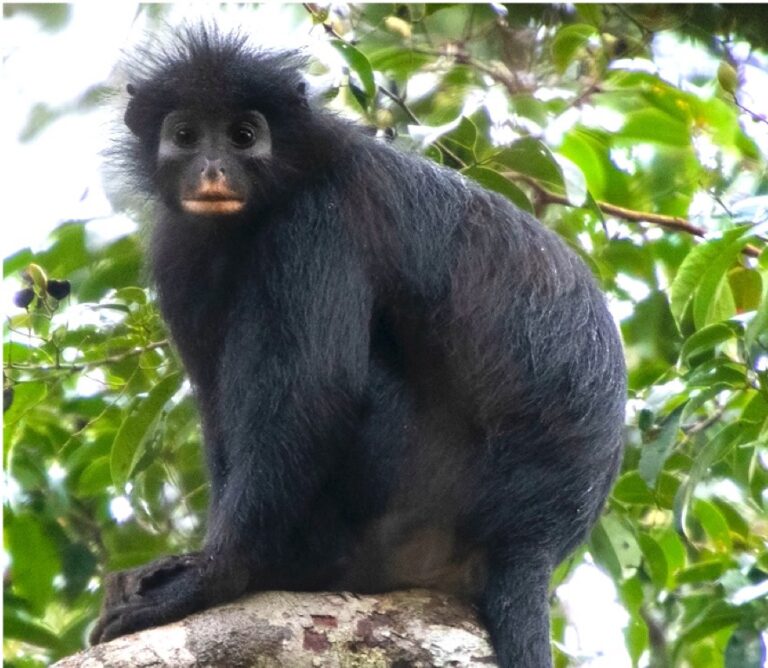
Describing a species and determining its place within a genus is one thing. The most challenging part is ensuring its protection. That's what matters most. This discovery should be a call to action. Now that we know this species exists, we still know very little about its behavior and ecological requirements. We could lose it before we fully understand it.
As human beings, we often claim to be the most intelligent organisms. But when you closely observe primates and watch their behavior, you sometimes begin to question whether we can really claim that humans are the only ones capable of thinking like that. What they do in terms of behavior can really tell us a lot about ourselves. They know how to take care of babies. You might see a mother keeping her baby close because she knows that something could go wrong. She might even slap the baby to say, “No, you’re not listening. You need to come and sit here.”
It’s exactly what our own mothers would do. So seeing this behavior from primates helps me to question myself.
I joined the project in 2014. Before I arrived, someone working with the Lukuru Wildlife Research Foundation, the organization involved in exploring the landscape that is now known as Lomami National Park, had already taken some photographs of the animals.
The photographs were blurry. There was only one image, and although we knew something looked unusual, there wasn’t enough detail to identify what made the animal different. When I joined the project, I started as a field assistant and eventually became a team leader. Later, I moved to the city to manage the project’s operations, but I continued traveling back and forth to lead research teams.
In 2018, I was preparing to visit teams working in another part of the landscape when one of the team members approached me with some photographs. When he showed them to me, I could see that the animals looked unusual. They resembled another species found in the region, but there were noticeable differences.
One feature we look at in primates is the crest on the head. I noticed that this individual did not have the crest I would have expected. We began analyzing the images, and I asked the team to return to the same location to collect more photographs. We organized another expedition, and this time they obtained images with much more detail.
We could tell that we were looking at something unusual, but we still didn’t know whether it was a new species or a subspecies.
In 2020, I applied for a National Geographic Society grant and received funding to officially launch the project as a National Geographic Explorer. We then collected additional data. In 2022, I came to the United States for graduate school, first for my master’s degree and now for my PhD. We conducted genetic, anatomical, and acoustic analyses. The evidence came together and confirmed that this was a new species, closely related to another species found farther away in the Congo Basin.
It has been a long journey. When you consider the earliest observations and photographs alongside the scientific paper published in 2026, you realize how much time has passed.

Lomami National Park is an extremely remote place, and access is very difficult.
You might have to travel by motorcycle for an entire day, then walk through the park for two days. You spend nights camping in the middle of the rainforest, often in a tent, before continuing toward the nearest village.
Once you reach the village, you have to organize your team and coordinate all the logistics. Fortunately, the Lomami River provides a route through the landscape. In some places, it is around 600 feet wide (180 meters), making it something like a highway for us. We use motorized boats to reach the animals’ range.
Reaching the area can take around five days from the nearest city during the dry season and up to 7 days during the rainy season. You may have to take a flight, travel by motorcycle, walk for two days through the park, and then take a boat to reach the target area.
All these logistical challenges make research difficult. Funding is another major obstacle. It isn’t easy to secure money for this kind of work, especially when people view it as simply searching for primates. People in Europe or the United States might ask why they should care about primates living in Lomami. Convincing people to fund this research can be difficult.
One of my favorite things about being there is that I have no social media or internet access. In some ways, it’s relaxing. I wake up early in the morning, hear the birds and primates calling, and see butterflies all around me. It’s a peaceful experience.
You can disconnect from everything and focus entirely on the forest and the work.

Discovering a new species is extremely rare, especially when it comes to primates. Primates are among the most extensively studied mammals in the world. To discover a new species is an incredible achievement. But it is only the beginning.
Describing a species and determining its place within a genus is one thing. The most challenging part is ensuring its protection. That’s what matters most. This discovery should be a call to action. Now that we know this species exists, we still know very little about its behavior and ecological requirements. We could lose it before we fully understand it.
We don’t yet know exactly how many individuals remain in the wild. Our current estimate is somewhere between 500 and 900, but the actual population could be smaller. Understanding the species’ ecology is a major focus of my PhD research. I want to investigate Likweli ecology by examining its habitat characteristics and forest composition, interspecific associations with sympatric species and the vertical use of forest layers (floor, mid and high canopy).
As we learn more about its behavior and ecological requirements, we can develop more effective conservation strategies. Protecting the species’ habitat would also benefit other wildlife living in the same area, so we should take advantage of that opportunity.
As in many parts of Central Africa, hunting is a major threat to wildlife, particularly primates. This species is no exception.
Hunting occurs around the park and, in some cases, inside it. Although hunting is prohibited within the park, people still find ways to enter and hunt animals. The species’ extremely limited range also makes it particularly vulnerable. Even a relatively small environmental change could affect the entire population.
As far as we know, there is only one viable population of this species in the Congo, and it occupies a very restricted area. If that population disappears, we may have no way to recover the species.
Another concern is that colobus monkeys generally do not do well in captivity. They are highly adapted to their natural environment in the forest canopy, and keeping them in zoos is not a reliable alternative to protecting them in the wild. Habitat loss is therefore another major threat. Together, hunting and habitat loss are the two biggest immediate pressures facing the species.
One of my favorite things about being there is that I have no social media or internet access. In some ways, it's relaxing. I wake up early in the morning, hear the birds and primates calling, and see butterflies all around me. It's a peaceful experience.
I’m always in favor of producing short documentaries—three to five minutes long—that show people working on the ground and talking about primates. These videos can include photographs and footage that illustrate the animals’ behavior and the challenges researchers face. This kind of content can attract people’s attention. They might see what researchers are doing and become interested in the animals themselves.
I have videos from our bonobo research that show mothers carrying their babies while moving around and searching for food. When people see these behaviors, they may begin to feel connected to the animals. They might think, “I can’t go there myself, but I can at least contribute five or ten dollars to support the research.”
We need to find ways to connect people with researchers and help them understand what is happening on the ground.
I also strongly support educating younger generations through more visual and interactive content. Rather than relying only on printed photographs, we should give young people opportunities to watch videos showing how primates behave, find food, interact with one another, and sometimes fight.

Photo courtesy of Junior Amboko.